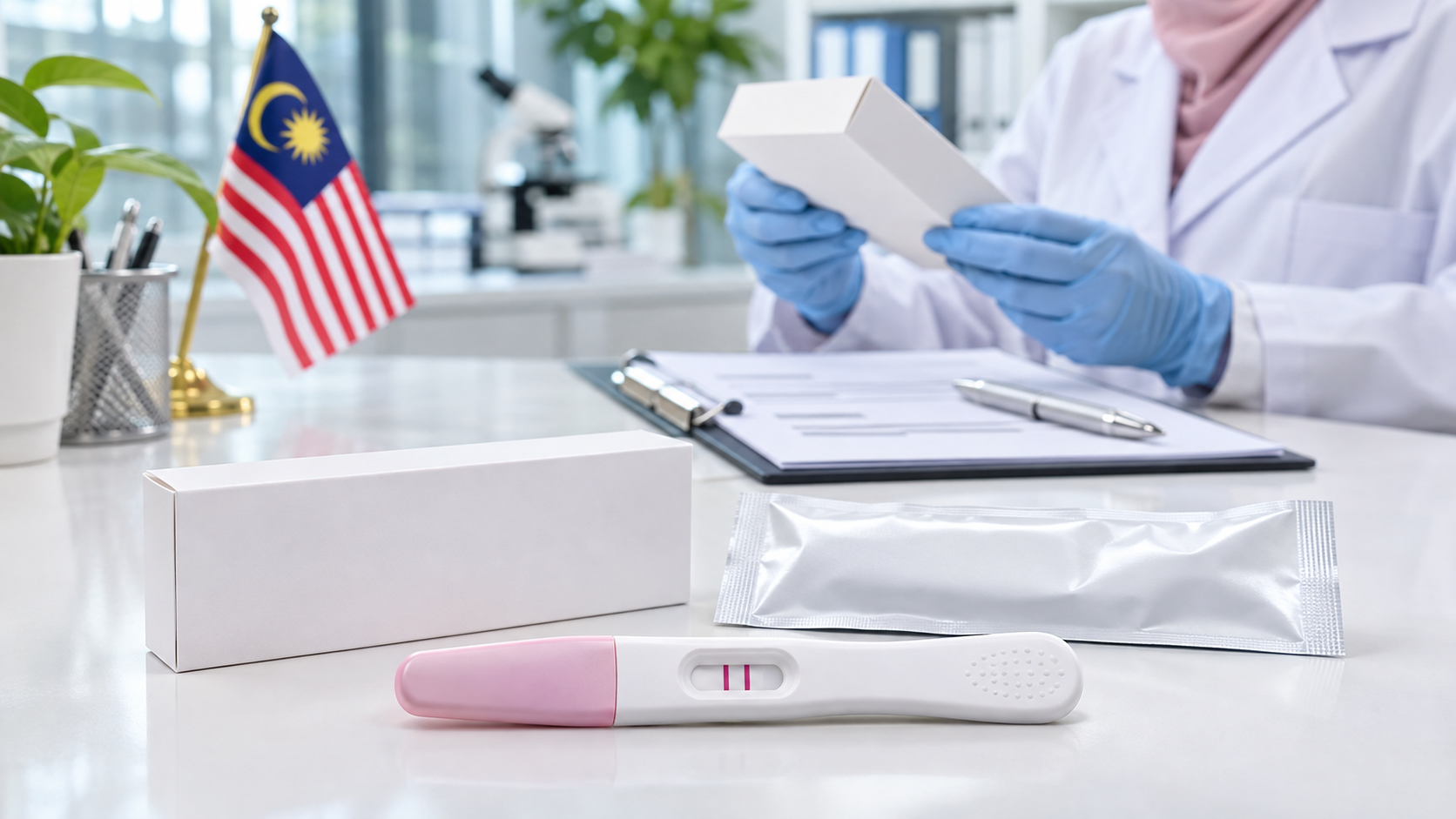
A pregnancy test kit sold in Malaysia is a Class B IVD under the MDA IVD classification rules (MDA/GD/0001). Registration is mandatory under Act 737 and must be submitted through a licensed Local Authorised Representative (LAR) via the MeDC@St portal, with CAB conformity assessment completed before MDA will accept the application.
Pregnancy test kits occupy a specific and well-defined position in Malaysia's medical device regulatory framework. They are in vitro diagnostic (IVD) devices that test for human chorionic gonadotropin (hCG) in urine for self-use by lay users, a combination of factors that determines both their classification and the documentation requirements that follow. Getting the classification right before preparing any documentation is the single most important decision in the registration process.
This article sets out how pregnancy test kits are classified under Malaysia's IVD rules, which registration pathway applies, what documentation is required, and the specific labelling obligations that apply to self-testing devices intended for the Malaysian market.
- Pregnancy test kits fall into Class B IVDs in Malaysia according to MDA/GD/0001 and are categorized as self-testing devices in Rule 3.
- Registration of Class B IVDs requires CAB conformity assessment after which the registration application will be accepted by MDA through MeDC@St.
- Technical dossier should comply with the format of IVD CSDT (MDA/GD/0004) and should include a performance evaluation report; clinical evaluation report for general medical devices does not suffice.
- Self-testing IVDs marketed in Malaysia should have an Instructions for Use (IFU) in Bahasa Malaysia language. An English version only label is a typical deficiency during CAB and MDA review.
- All IVDs registration applications should be done by a licensed LAR with an MDA Establishment Licence and GDPMD certificate. Manufacturers from abroad cannot apply for approval directly with MDA.
- As of 2 January 2026, ePermit will be mandatory for all importation of registered pregnancy test kits into Malaysia.
How Pregnancy Test Kits Are Classified in Malaysia
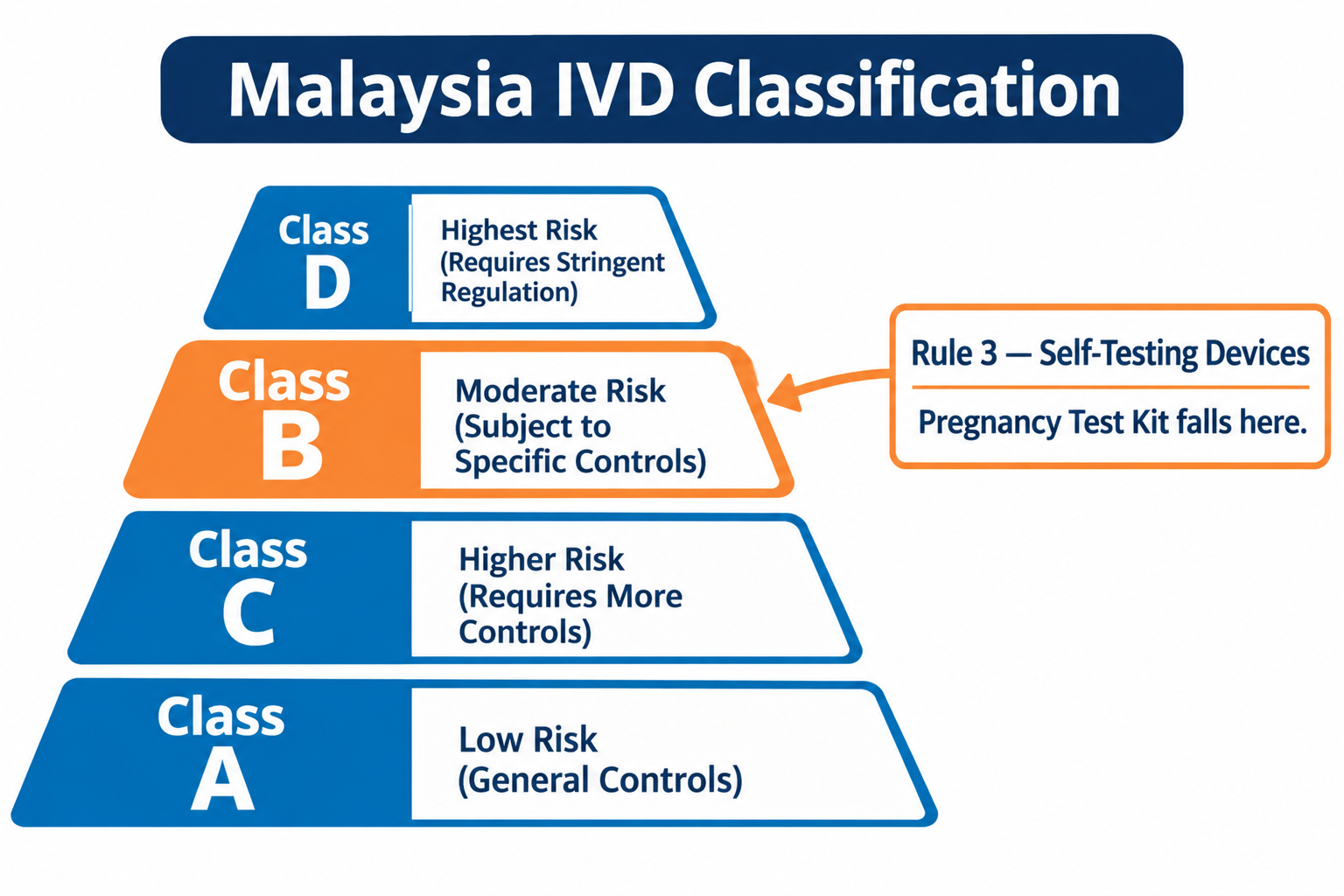
Malaysia's IVD classification system is set out in MDA/GD/0001, which contains seven classification rules. The correct classification for a pregnancy test kit follows from the device's intended use and the user population it is designed for, not from general assumptions about the product category.
Rule 3: Self-Testing IVDs
Rule 3 of MDA/GD/0001 applies to IVDs intended for self-testing, meaning devices designed to be used by lay users in a home or non-laboratory setting. A standard urine-based pregnancy test kit meets this definition: it is designed for use by a person without medical training, produces a result without laboratory equipment, and is intended to inform a personal health decision.
Under Rule 3, a self-testing IVD is classified as Class B unless it falls under a higher rule that would classify it as Class C or D. For a pregnancy test kit that tests for hCG only, no higher rule applies. The device is Class B.
When a Pregnancy Test Kit Could Be Classified Higher
For a combination product that not only tests for hCG, but also for an additional analyte, there might be a case of different classification, based on the rule for the additional analyte. In a situation when multiple rules are applicable to a single device, the higher of the applicable rules will define the class. Verify the classification of combination products by each rule before creating the technical dossier.
Applicable Regulatory Framework
The table below provides summary of important regulatory documents related to registration of pregnancy test kit in Malaysia. Understanding of which document is responsible for what will help to create a complete technical dossier.
| Regulatory Instrument | Scope | Relevance to Pregnancy Test Kit |
|---|---|---|
| Medical Device Act 2012 (Act 737) | Primary law for all medical devices in Malaysia | This defines the need for registration prior to sale, supply or importation. Pregnancy test kits fall under medical devices as defined by the Act. |
| MDA/GD/0001: IVD Classification | Classification of IVDs based on seven rules | Rule 3 (self testing devices) applies. Classifies standard pregnancy test kits as Class B. |
| MDA/GD/0004: IVD CSDT | Common Submission Dossier Template for IVDs | The template for preparing technical dossier, which is mandatory for submission to the CAB and MDA. |
| MDA/GD/0002: IVD Essential Principles | Safety and performance principles specific for IVDs | The DoC should reference this document and not the generic one which applies to medical devices other than IVDs. |
| Medical Device Regulations 2012 | Subordinate regulations for fees, labeling, post market requirements | Registration fees, labeling requirements, including labeling in Bahasa Malaysia IFU, reporting of adverse event timelines. |
| MDA CAB Guidelines | Conformity assessment processes for Class B, C, D IVDs | Governs the CAB review process. The full assessment route and verification route are both available for Class B IVDs. |
Registration Requirements for Class B IVDs
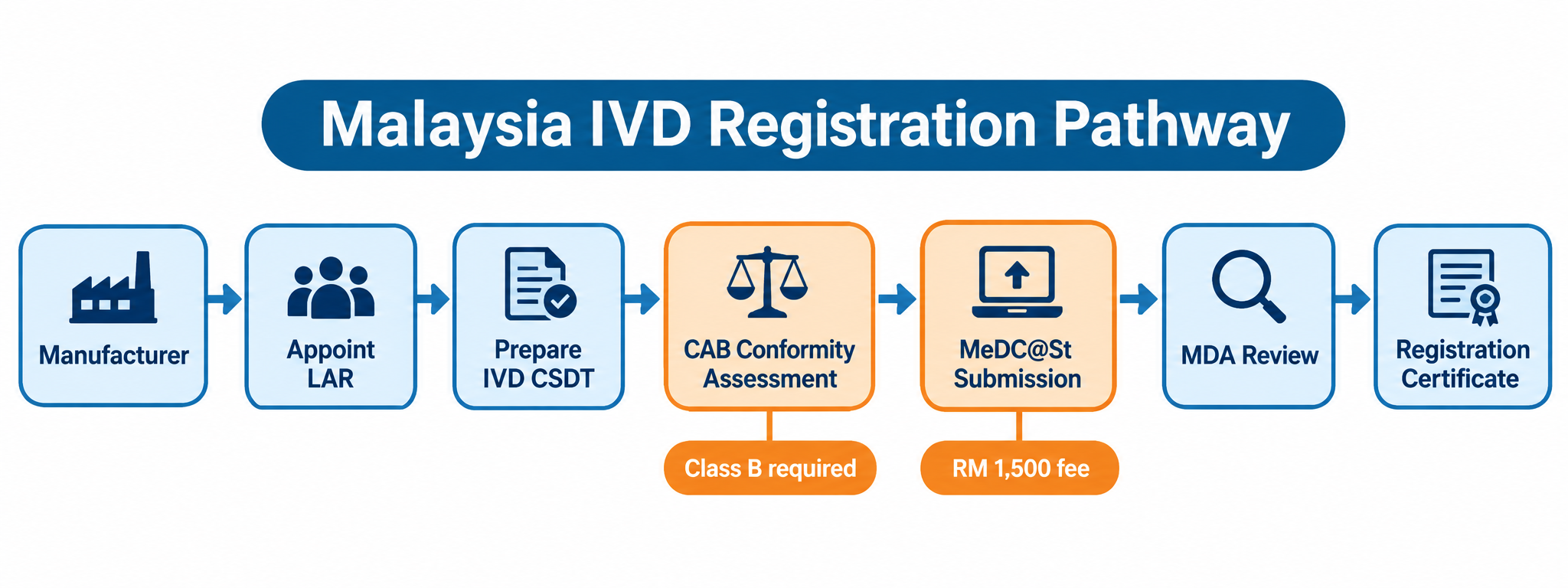
Because a pregnancy test kit is a Class B IVD, it must undergo CAB conformity assessment before MDA will accept the registration application. This makes the registration process a two-stage submission: first to the CAB, then to MDA via MeDC@St.
-
Confirm Classification and Appoint a Licensed LAR
Before any documentation work begins, confirm that the device is correctly classified as Class B under Rule 3. Document the classification rationale. Appoint a Malaysian entity holding a valid MDA Establishment Licence and GDPMD certificate as the Local Authorised Representative. The LAR will submit all applications on the manufacturer's behalf and is legally responsible for the device's compliance in Malaysia.
The LAR appointment must be formalised in a written agreement before any submission is made. All registration certificates will be issued in the LAR's name.
-
Prepare the IVD CSDT Technical Dossier
The technical dossier should conform to the IVD CSDT structure, as described in MDA/GD/0004. The minimum requirement for pregnancy test kit includes: a performance evaluation report (not clinical evaluation report), a Declaration of Conformity that refers to MDA/GD/0002, an ISO 13485 certificate limited to IVD manufacturing, a risk management file as per ISO 14971, and the labelling with Bahasa Malaysia IFU.
The performance evaluation report for the pregnancy test kit should show the analytical sensitivity and specificity (minimum concentration of hCG detected), cross reactivity with related hormones (LH, FSH, TSH), precision throughout the analytical range, and a lay user testing to prove that a lay person is able to understand the test result using the IFU without any further help.
-
Submit to CAB for Conformity Assessment
Submit the IVD CSDT to a Conformity Assessment Body (CAB) that is approved by MDA. The CAB assesses the dossier based on the IVD Essential Principles (MDA/GD/0002). A Conformity Assessment Certificate (CAC) is issued upon successful assessment.
Pregnancy test kits that hold CE marking, FDA 510(k) clearance, or HSA approval may qualify for the verification route, which is typically faster than full assessment. Confirm eligibility with the CAB before building the submission timeline around this route. Full CAB assessment for a well-prepared Class B IVD dossier typically takes three to six months.
-
Submit to MDA via MeDC@St
Once the CAB issues the Conformity Assessment Certificate, the LAR submits the registration application through the MeDC@St portal. The application must include the complete IVD CSDT, all supporting documents, and the valid CAC. The registration fee for Class B is RM 1,500, payable through the portal at the time of submission.
MDA will conduct an administrative completeness check before accepting the application into substantive review. The 180-day review target starts from the date of acceptance, not the date of submission. Document consistency across all submitted files is critical at this stage: device name, intended use, and manufacturer details must be identical in the application form, DoC, labelling, and CSDT.
-
Respond to MDA Technical Queries
During substantive review, MDA may raise technical queries through MeDC@St. The LAR is notified via the portal and email. Responses must be submitted within the timeframe specified in the query, typically 30 to 60 days. For pregnancy test kits, queries most commonly concern the performance evaluation data, the lay user study methodology, or the Bahasa Malaysia IFU content.
-
Receive the Registration Certificate
If approved, MDA issues a registration certificate, available for download through MeDC@St. The certificate is valid for five years from the date of issue. The device is simultaneously listed in the Malaysia Medical Device Register (MMDR). Renewal must be initiated before the certificate lapses. A lapsed registration cannot be renewed and the device must be re-registered.
Documentation Requirements for Pregnancy Test Kit Registration
The documents required are those for registration of general IVDs and additional documents for registration of self-testing devices. The following are the basic documents with the requirements for registration of a pregnancy test kit.
| Document | Status | Specific Requirements for Pregnancy Test Kit |
|---|---|---|
| IVD CSDT (MDA/GD/0004) | Required | Complete technical dossier following the IVD-specific format. Submitted first to CAB for Class B, then to MDA via MeDC@St. |
| Performance Evaluation Report | Required | Must include: analytical sensitivity (minimum detectable hCG), analytical specificity (cross-reactivity with LH, FSH, TSH), precision, and a lay user study with untrained individuals demonstrating correct result interpretation without assistance. |
| Declaration of Conformity | Required | Must reference MDA/GD/0002 (IVD Essential Principles), not the general EPSP. Must be signed by the manufacturer, not the LAR. Must state the standards adopted to demonstrate conformity. |
| ISO 13485 Certificate | Required | Scope must explicitly cover IVD manufacture or lateral flow assay (LFA) test device manufacture. A certificate scoped to instrument manufacture alone does not cover test strips or reagent kits. |
| Risk Management File (ISO 14971) | Required | Hazards must include: false negative results (missed pregnancy), false positive results, interference from hCG-containing medications, and use by untrained lay users. |
| Labelling and IFU (English) | Required | Must comply with IVD labelling requirements under the Medical Device Regulations 2012. Must include expiry date, storage conditions, GMDN code, and name and address of the LAR. |
| Labelling and IFU (Bahasa Malaysia) | Required | Mandatory for all self-testing IVDs. Must be a complete translation at a reading level appropriate for lay users. A partial adaptation or summary is not accepted. Missing BM IFU is the most common deficiency raised for pregnancy test kit submissions. |
| CAB Conformity Assessment Certificate | Required | Must be current and valid at the time of MDA submission. Confirm the validity period before planning the MDA submission date. |
| Reference Regulatory Approval (verification route) | Where applicable | CE marking, FDA 510(k), HSA, TGA, PMDA, or Thai FDA approval. Supports the verification route for CAB assessment. HSA permanently recognised from 1 March 2026. |
| GMDN Code | Required | The GMDN code must be included in the MeDC@St application form and on device labelling. The correct GMDN code for a urine-based pregnancy test strip is confirmed through the GMDN Agency database. |
Labelling Requirements Specific to Pregnancy Test Kits
The labelling requirements that apply to pregnancy test kits are more stringent than those for other medical devices because the device is a self-testing IVD intended for use by lay persons. The requirements apply to both the device label (packaging) and the Instructions for Use (IFU).
The following are the key items that the label and IFU must contain for a pregnancy test kit available in Malaysia:
- Device name and intended use in plain language accessible to lay users
- Name and address of the manufacturer
- Name and address of the Malaysian LAR
- Lot number or batch number
- Manufacturing date and expiry date
- Storage conditions (temperature range, humidity if applicable)
- GMDN code
- Instructions for use in both English and Bahasa Malaysia
- Interpretation guide for both positive and negative results, including the evaporation line scenario
- Statement that the device is for in vitro diagnostic use only
- Statement to consult a healthcare professional to confirm a positive result
Estimated Registration Timeline
The timeline for registering a pregnancy test kit in Malaysia is determined primarily by dossier preparation time and CAB assessment duration. MDA's 180-day review target applies from the point of application acceptance, but the total elapsed time from starting preparation to receiving the certificate is considerably longer.
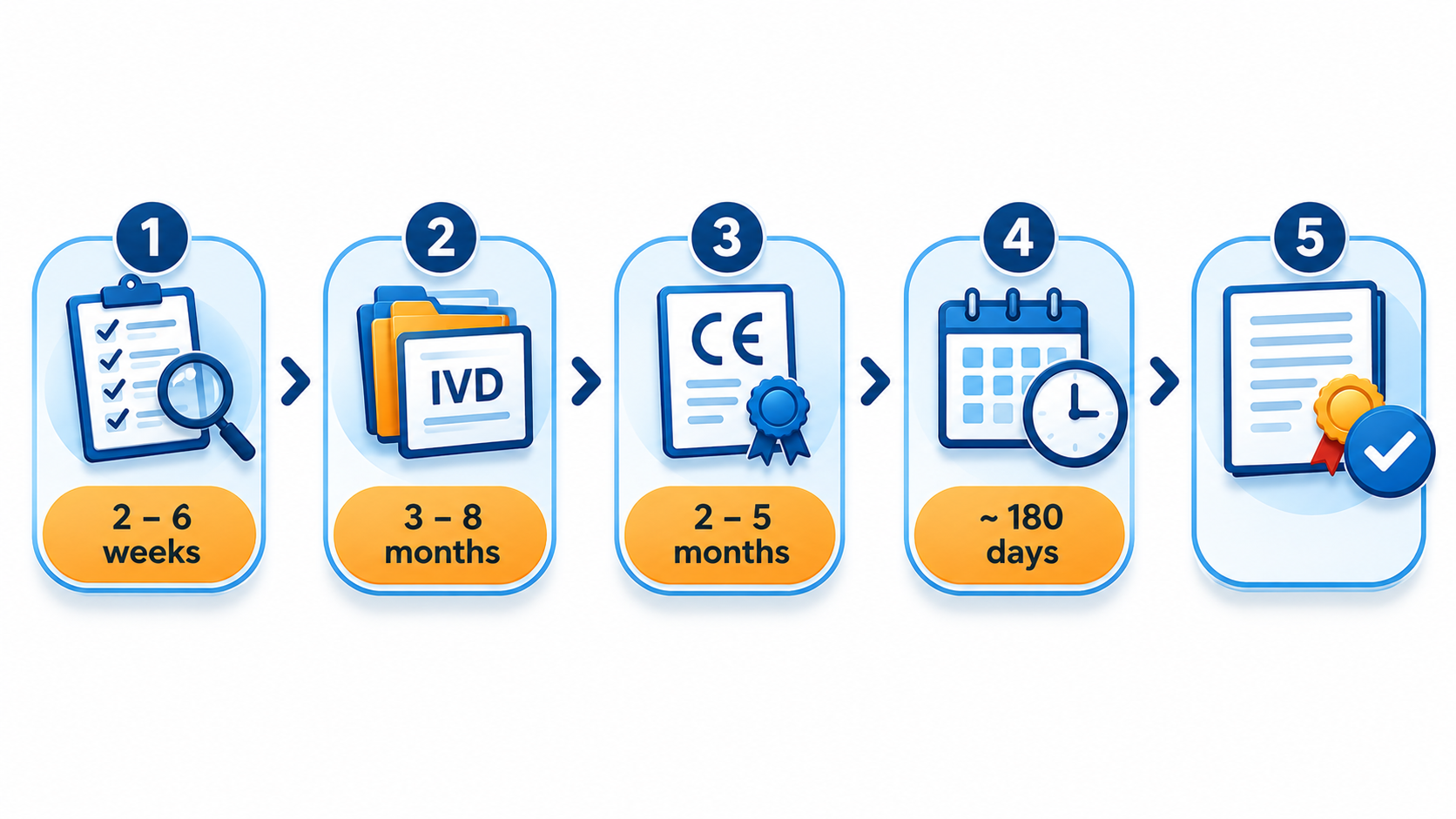
Identify and appoint a suitable LAR with IVD registration experience. Confirm the Class B classification in writing and document the rationale.
Compile the IVD CSDT, performance evaluation report, lay user study, risk management file, and Bahasa Malaysia IFU. The lay user study and performance evaluation data are typically the longest components to prepare if not already available from other market registrations.
Shorter for the verification route where CE, FDA, or HSA approval is available. Full assessment of a well-prepared Class B dossier typically takes three to five months. Deficiency rounds extend this timeline.
Administrative completeness check precedes substantive review. The 180-day clock starts from MDA acceptance. Technical queries may extend the total review period beyond the target.
Valid for five years. Device listed in MMDR. ePermit required for each import shipment from 2 January 2026.
Common Mistakes in Pregnancy Test Kit Registration
-
Submitting a clinical evaluation report instead of a performance evaluation report
A clinical evaluation report structured around clinical outcomes literature, acceptable for a general medical device, does not satisfy IVD registration requirements. For a pregnancy test kit, the performance evaluation must include analytical performance data specific to the device: minimum detectable hCG concentration, cross-reactivity data, precision studies, and a lay user study. Using the wrong report type is raised as a deficiency at both CAB and MDA stages.
-
Missing or inadequate Bahasa Malaysia IFU
The Bahasa Malaysia IFU is not optional for self-testing IVDs. Submitting English-only labelling, or a partial BM translation that summarises rather than fully translates the IFU, is a standard deficiency for pregnancy test kit submissions. The BM IFU must be written at a reading level appropriate for lay users and must cover all content in the English IFU.
-
ISO 13485 certificate scope does not cover the product type
A certificate scoped to "IVD instruments" or "laboratory equipment" does not automatically cover lateral flow immunoassay test strips or reagent kits. MDA and CABs verify that the scope explicitly covers the product being registered. Where the scope is ambiguous, obtain a scope clarification letter from the certification body before submission.
-
No lay user study in the performance evaluation
Rule 3 self-testing IVDs require evidence that lay users can correctly use the device and interpret results without assistance. A performance evaluation that covers only analytical performance without a lay user study is incomplete for a pregnancy test kit. The study must use a representative sample of the intended user population, not trained laboratory staff.
-
Inconsistencies in device name or intended use across submitted documents
The device name and intended use statement must be identical in the MeDC@St application form, Declaration of Conformity, IFU, and IVD CSDT. Any discrepancy triggers an administrative deficiency at the completeness check stage, delaying the start of the 180-day review clock. A cross-check of all submitted documents against a single reference list before submission eliminates most of these deficiencies.
Pregnancy Test Kit Registration Support
TT Medical Management provides end-to-end IVD registration support for manufacturers bringing pregnancy test kits and other self-testing IVDs to the Malaysian market. From classification confirmation and dossier preparation to CAB submission and MDA query management, our team handles the full process on your behalf.
Contact us to discuss your device's classification and the most efficient registration route for your situation.
Discuss Your RegistrationFrequently Asked Questions
Is a pregnancy test kit a medical device in Malaysia?
Yes. A pregnancy test kit is an in vitro diagnostic (IVD) medical device under the Medical Device Act 2012 (Act 737). It falls within the definition of a medical device because it is intended to test a specimen derived from the human body (urine) to provide information about a physiological state (pregnancy). All IVD medical devices must be registered with MDA before they can be sold, supplied, or imported into Malaysia.
The requirement applies regardless of whether the device is sold in a pharmacy, convenience store, or through an online platform. Unregistered pregnancy test kits may not be legally sold in Malaysia.
What class is a pregnancy test kit under Malaysia's IVD classification rules?
A standard urine-based pregnancy test kit is Class B under MDA/GD/0001. Classification is determined by Rule 3, which applies to IVDs intended for self-testing, meaning devices designed for use by lay users in a non-laboratory setting. Class B is the correct classification for a device that tests for hCG in urine and is marketed directly to consumers for home use.
A pregnancy test kit that is also designed to function as a companion diagnostic, or that tests for additional analytes governed by a higher classification rule, may attract a higher classification. Confirm the classification for combination products against all applicable rules before preparing the dossier.
Does a pregnancy test kit need CAB conformity assessment in Malaysia?
Yes. Class B IVDs, including pregnancy test kits, require CAB conformity assessment before MDA will accept the registration application. Only Class A IVDs are exempt from CAB assessment and can submit directly to MDA. The CAB reviews the IVD CSDT against the Essential Principles (MDA/GD/0002) and issues a Conformity Assessment Certificate on successful completion.
Pregnancy test kits with existing CE marking, FDA 510(k) clearance, or HSA approval may qualify for the verification route, which typically results in a shorter CAB assessment timeline than full assessment. Confirm eligibility with the intended CAB before building the submission timeline.
Is a Bahasa Malaysia IFU required for a pregnancy test kit in Malaysia?
Yes. The Bahasa Malaysia IFU is mandatory for all self-testing IVDs sold in Malaysia. A pregnancy test kit classified under Rule 3 as a self-testing device must include a complete IFU in Bahasa Malaysia. The BM IFU must be a full translation written at a reading level appropriate for lay users. A partial adaptation or summary is not accepted.
Missing or inadequate Bahasa Malaysia labelling is consistently one of the most common deficiencies raised for pregnancy test kit submissions at both the CAB and MDA stages. Preparing the BM IFU early in the dossier preparation process prevents this from delaying the submission.
Can a foreign manufacturer register a pregnancy test kit in Malaysia directly?
No. All IVD registration applications in Malaysia must be submitted through a Malaysian Local Authorised Representative (LAR) who holds a valid MDA Establishment Licence and GDPMD certificate. Foreign manufacturers cannot hold a MeDC@St account directly and cannot submit applications to MDA without a licensed LAR.
The LAR is legally responsible for the device's compliance in Malaysia after registration, including post-market surveillance, adverse event reporting, ePermit applications for each shipment, and registration renewal. Selecting a LAR with specific IVD registration experience and confirming their MeDC@St account is active is the first practical step in any Malaysian pregnancy test kit registration project.
What is the registration fee for a pregnancy test kit in Malaysia?
The MDA registration fee for a Class B IVD is RM 1,500, payable through the MeDC@St portal at the time of submission. This fee covers the MDA review only. CAB conformity assessment fees are separate and are charged directly by the CAB; they vary depending on the CAB, the assessment route (full assessment or verification), and the complexity of the dossier.
Additional costs to plan for include the LAR's service fees, translation costs for the Bahasa Malaysia IFU, performance evaluation studies if not already available, and the mandatory ePermit fee for each import shipment from 2 January 2026.