Blood pressure monitors are classed as a Class B device in Malaysia. They must be registered under the Medical Device Act 2012 (Act 737). These can be registered via your Local Authorised Representative (LAR) through the MeDC@St portal. A Conformity Assessment Certificate (CAC) from an MDA recognised CAB plus a full technical dossier as per MDA/GD/0003.
- As they are classed as a Class B device due to the Non-Invasive Active Diagnostic usage, they must be registered under Act 737. Supplying or importing a device without registration is illegal and can result in fines up to RM 500,000.
- Cannot be registered as a foreign Manufacturer. Need to have a LAR.
- To register a Class B device you need a Conformity Assessment Certificate (CAC) from an MDA recognised CAB body or approval from a recognised reference authority (HSA Singapore, CE (EU), Thai FDA).
- Technical dossier must have testing carried out to ISO 81060-1 / ISO 81060-2.
- Registration Fee for a Class B device is RM 250 (Application Fee) and RM 1,000 (Registration Fee). Your certificate is valid for 5 years.
Blood pressure monitors are one of the most common diagnostic devices in Malaysia. They are used throughout Hospitals, Clinics, Pharmacies and increasingly in your homes. Many foreign manufacturers are unaware that blood pressure monitors (Manual Sphygmomanometer, Semi-Automatic, Fully Automatic Electronic) need registering with the Medical Device Authority (MDA). This article will help explain how they are classed, what needs to be done to register them and what documentation will be needed.
Regulatory Framework for Blood Pressure Monitor Registration in Malaysia
Blood pressure monitors are registered in Malaysia under the Medical Device Act 2012 (Act 737) and Medical Device Regulations 2012. All medical devices including diagnostic devices like Blood Pressure Monitors must be registered with the MDA. The MDA enforces this law, maintains the Malaysia Medical Device Register (MMDR), and publishes the guidance documents and standards that manufacturers must follow to register their devices.
The key legislation, guidance documents and standards relevant to Blood Pressure Monitor registration are:
| Instrument | Description | Relevant Aspect for Blood Pressure Monitors |
|---|---|---|
| Act 737 (Medical Device Act 2012) | Primary legislation governing the regulation of all medical devices in Malaysia | Mandatory registration of blood pressure monitors prior to supply or import into Malaysia. |
| Medical Device Regulations 2012 | Subsidiary rules covering classification, registration, fees, and enforcement under Act 737 | Contains the classification rules used to determine that blood pressure monitors fall under Class B. |
| MDA/GD/0002 (Essential Principles) | Safety and performance requirements all medical devices must meet before registration | Declaration of Conformity in the technical dossier must reference compliance with MDA/GD/0002. |
| MDA/GD/0003 (CSDT for General Medical Devices) | Format and contents of the Common Submission Dossier Template for Class B devices | Prescribes the structure of the technical dossier that the LAR submits to MDA for blood pressure monitor registration. |
| ISO 81060-1 / ISO 81060-2 | International standards for non-invasive sphygmomanometers Part 1 (requirements) and Part 2 (clinical validation) | Performance testing and clinical validation results to these standards are required in the technical dossier. |
| ISO 13485:2016 | International standard for Quality Management Systems of medical device manufacturers | ISO 13485 certificate from the manufacturer is required as part of the technical dossier. |
How Are Blood Pressure Monitors Classified in Malaysia?
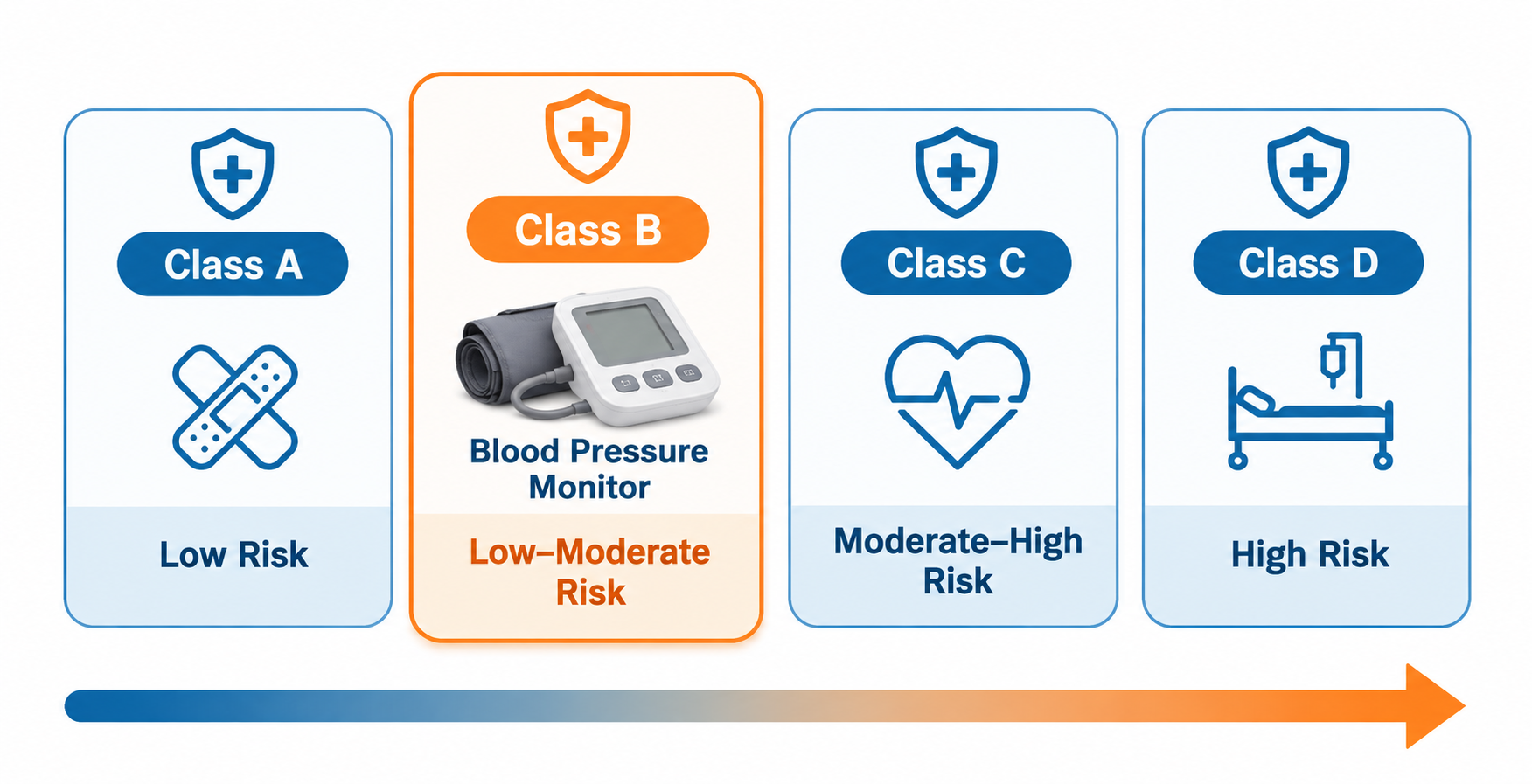
Medical Devices are split into 4 classes (from lowest risk Class A to highest risk Class D) depending on the intended use, functioning and invasiveness of the device and potential risks if it were to fail. In Malaysia, Blood Pressure Monitors are classified as Class B.
Why Class B?
Blood Pressure Monitors are classed as Class B as they are an active, non-invasive diagnostic. They are used to monitor the arterial blood pressure without penetration of the body. They are considered an active device because they transfer energy (in this instance pneumatic pressure) and the results provided will affect clinical decisions. According to the classifications in the Medical Device Regulations 2012, non-invasive diagnostic active devices will be located in Class B. This is considered a low/medium risk device and therefore must undergo a conformity assessment process.
Blood Pressure Monitors generally fall into two categories.
Manual Aneroid/Mercury Sphygmomanometers (Class B)
These are traditional blood pressure monitors. This includes Mercury Column Sphygmomanometers and Aneroid Gauges. These are manually operated by a trained clinician using a Stethoscope. They are classified as a Class B. Whilst the devices themselves can be quite simple mechanically they are an active device used for diagnostics. This means that if they give inaccurate readings then it could result in incorrect diagnosis. Mercury Sphygmomanometers are becoming less popular globally but can still be registered under Act 737.
Semi Automatic/Automatic Electronic Blood Pressure Monitors (Class B)
This is the most common type of Blood Pressure Monitors to be registered. They are fully automatic active devices that inflate the cuff and monitor the oscillometric wave. These will give you results for systolic, diastolic and pulse. Home use and professional versions are all classed as Class B. If the device has extra functions such as AFib detection or transmitting data to a healthcare provider then you should request a classification letter from the MDA to confirm they are still classed as a Class B device.
Blood Pressure Monitor Registration Requirements in Malaysia
All Blood Pressure Monitors being supplied or imported into Malaysia must be registered with the MDA. The Local Authorised Representative (LAR) will be responsible for registering the device. They must have a valid Establishment Licence from the MDA, a certificate of Good Distribution Practice for Medical Devices (GDPMD), and an active MeDC@St account.
For Class B devices the LAR will need to provide a full technical dossier based on MDA/GD/0003 (Common Submission Dossier Template (CSDT)). This should show how the device meets the Essential Principles (MDA/GD/0002), and have a Certificate of Conformity (CAC) from an MDA recognised Conformity Assessment Body (CAB) or a foreign reference approval from a recognised authority (Singapore Health Sciences Authority (HSA), CE Marking, FDA USA or Thai FDA (from 1 May 2026) (MDA–Thai FDA Reliance Programme).
Fees
The government fees for registering your device will be RM 250 (Application Fee) and RM 1,000 (Registration Fee), totaling RM 1,250. These will be paid to the MDA via MeDC@St. There will also be third party fees involved, depending on which CAB you use and the LAR fee.
Step-by-Step: How to Register a Blood Pressure Monitor in Malaysia
-
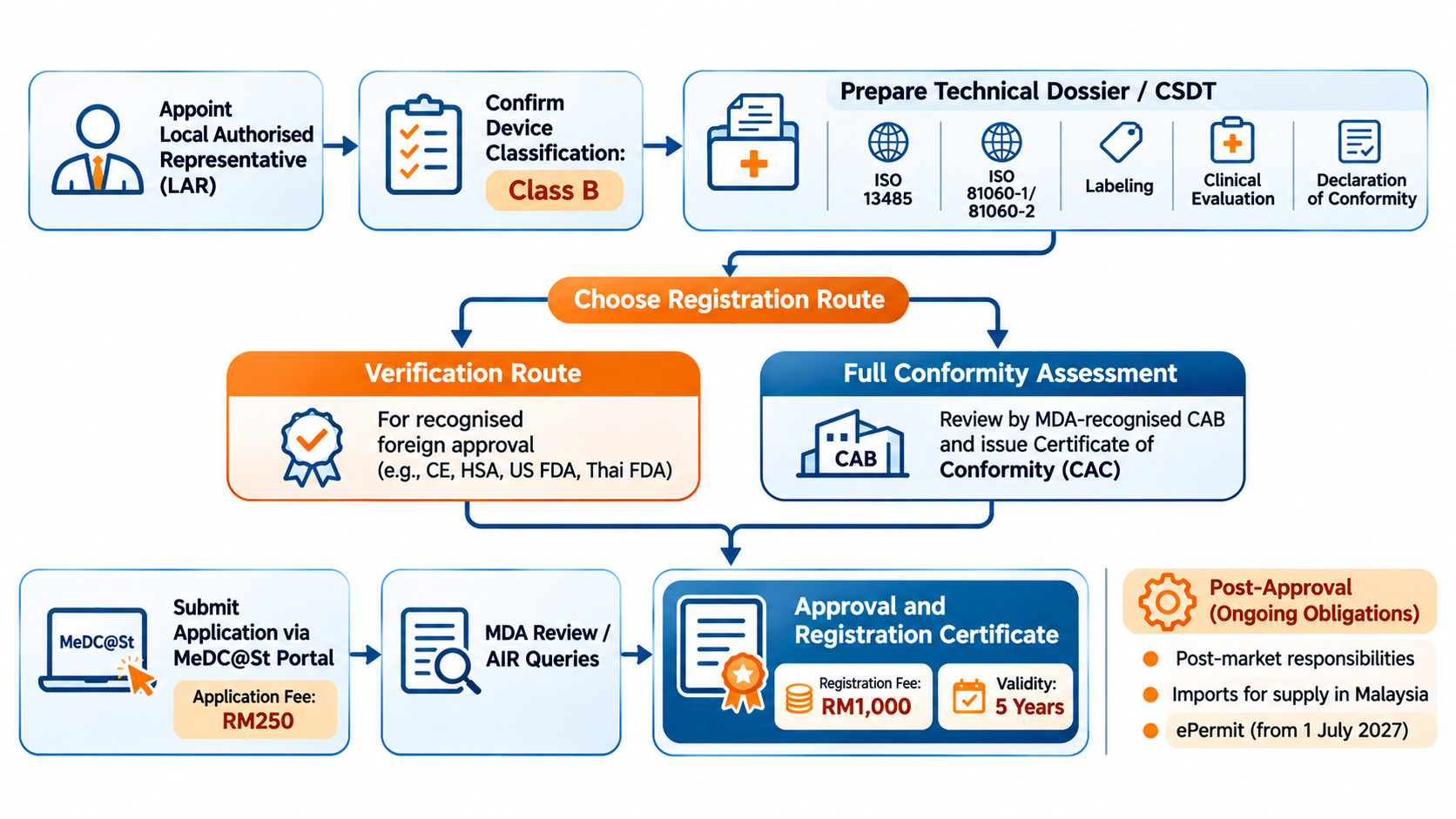
Local Authorised Representative
As a foreign manufacturer you cannot directly register your device. You will need to appoint a Local Authorised Representative (LAR) who has a valid MDA Establishment Licence, a certificate of GDPMD and an active MeDC@St account. The LAR will be legally responsible for the device within Malaysia and will be your contact with the MDA.
-
Device Classification
You will need to confirm with your manufacturer and LAR that the device is classed as Class B under the Medical Device Regulations 2012. Upper Arm Oscillometric devices and Manual Sphygmomanometers will be classed as Class B. If your device has extra functions that will provide diagnostic information then you should request a classification letter from the MDA via MeDC@St.
-
Technical Dossier (CSDT)
LAR & Manufacturer must complete the Technical Dossier (based on MDA/GD/0003) including:
- Device Description & Specifications – including GMDN code, Intended Use & Variations
- Justification of Classification – Why is this a Class B device?
- Declaration of Conformity – Refer to Essential Principles (MDA/GD/0002)
- ISO 13485:2016 Certificate
- Risk Management Document (ISO 14971)
- Test Results & Clinical Validation – ISO 81060-1 & ISO 81060-2
- Clinical Evaluation Report (CER)
- Labelling & IFU – Ensure labelling meets MDA requirements
- PMF
- Certificate of Conformity (CAC)
-
Certificate of Conformity (CAC)
Class B devices must be reviewed by an approved CAB. Once reviewed you will have a Certificate of Conformity (CAC). If the Manufacturer holds a valid approval from an approved Reference Authority (CE Marking, HSA Singapore, FDA USA and Thai FDA from May 2026) they will be able to use the Verification Route. Under this route the CAB verifies that the foreign approval is current and that the device scope matches the Malaysian registration, rather than conducting a full independent assessment. This can significantly reduce both cost and time.
-
Application
Once you have completed your Application, Technical Dossier and CAC you will need to submit this to MDA using the MeDC@St Portal. You will be charged a fee of RM 250. Your application will then be reviewed by the MDA and may have questions (AIRs).
-
MDA Review
If using the Verification Route it usually takes 3-4 months for Class B devices. If using the full Conformity Assessment route it can take 4-6 months. You will be issued with an approval letter and Registration Certificate.
-
Registration Certificate
This is valid for 5 years. There will be a fee of RM 1,000 charged to the LAR. The Manufacturer and LAR will be responsible for dealing with Post Market, Adverse Events and Renewals. From 1 July 2027 you will require an ePermit for all shipments of registered BP monitors into Malaysia. (Was originally 2 January 2026)
Documents Required to Register Blood Pressure Monitors
The following documents are required to register your Class B Blood Pressure Monitor. All documents must be completed in English.
| Document | Purpose | Class B |
|---|---|---|
| Device Description & Specifications | States the name of the device, its intended use, GMDN code, device variants, measuring range, and technical specifications | Required |
| Rationale for Classification | Written explanation justifying the Class B classification based on the classification rules in the Medical Device Regulations 2012 | Required |
| Declaration of Conformity | Manufacturer's declaration that the device conforms to the Essential Principles in MDA/GD/0002 | Required |
| ISO 13485 Certificate | Certificate confirming the manufacturer operates a Quality Management System conformant with ISO 13485:2016 | Required |
| Risk Management File (ISO 14971) | Documentation of the identification, assessment, and mitigation of risks associated with the blood pressure monitor | Required |
| Performance Testing Results (ISO 81060-1) | Accuracy and performance test results demonstrating that the device meets the requirements of ISO 81060-1 for non-invasive sphygmomanometers | Required |
| Clinical Validation Data (ISO 81060-2) | Clinical validation study results demonstrating accuracy of the device against an auscultatory reference in a human subject study, in accordance with ISO 81060-2 | Required |
| Clinical Evaluation Report (CER) | Report demonstrating the clinical safety and performance of the device based on available clinical data, literature, and post-market experience | Required |
| Labelling & Instructions for Use (IFU) | Device label and IFU in formats compliant with MDA labelling requirements; must include intended use, contraindications, warnings, and operating instructions | Required |
| Post-Market Surveillance Plan | Plan for ongoing monitoring of device safety and performance after registration, including adverse event reporting procedures | Required |
| Conformity Assessment Certificate (CAC) | Certificate issued by an MDA-recognised CAB following successful conformity assessment, or a recognised foreign reference approval (CE, HSA, FDA, Thai FDA) | Required |
| Free Sale Certificate / Foreign Approval | Regulatory approval from CE (EU), HSA (Singapore), FDA (USA), TGA (Australia), or Thai FDA (from May 2026) may support the Verification Route for Class B | Optional (Verification Route) |
Labelling Requirements for Blood Pressure Monitors in Malaysia
All BP Monitor devices sold into Malaysia must have device labelling and Instructions for Use (IFU). The labelling must comply with MDA labelling requirements (Act 737) and the Essential Principles (MDA/GD/0002). All labelling must be in English/Bahasa Malaysia and clearly legible. Below is a typical list of information that will be required on your device labelling/IFU:
- Device name and model number (Registered with MDA)
- Manufacturer details
- Local Authorised Representative (LAR) (Malaysia)
- MDA Registration Number (Will be added on registration)
- Date of manufacture, expiry date / shelf life (where applicable)
- Intended use and Intended User (Clinical professional or Lay user)
- Range of measurements e.g. 0-300mmHg. Accuracy.
- Range of cuff sizes and how to apply.
- Contra-indications, Warnings and Precautions.
- How to clean, store and maintain.
- Battery type and disposal instructions (if electronic).
Common Errors
-
Incorrectly assuming device is Class A
It is common to incorrectly assume non-invasive devices fall under Class A. However, Blood Pressure Monitors are active non-invasive diagnostic devices which provide readings used to make clinical decisions. Therefore, they fall under Class B (Medical Device Regulations 2012). If you incorrectly submit a Class A application for a blood pressure monitor, the MDA will reject your submission.
-
Missing or incomplete ISO 81060-2 clinical validation data
ISO 81060-2 clinical validation is a mandatory component of the technical dossier for blood pressure monitors. Many manufacturers submit without this data or submit studies conducted under an earlier version of the standard (ISO 81060-2:2013 or the AAMI SP10 protocol). The MDA expects studies conducted in line with the current edition of ISO 81060-2. Missing or non-compliant validation data is one of the most common reasons for Additional Information Requests (AIRs) and registration delays.
-
Incorrect or missing GMDN code
The GMDN code entered in the MeDC@St application must match the type of device being registered. Using a generic or incorrect GMDN code such as a code for a manual sphygmomanometer when registering an automatic electronic monitor creates inconsistencies in the dossier that the MDA will query. Confirm the correct GMDN code with your LAR before submitting the application.
-
Attempting to register without a qualified LAR
Foreign manufacturers occasionally attempt to submit registration applications directly or appoint an entity that does not hold the required MDA Establishment Licence. All Class B applications must be submitted by a licensed LAR with a valid GDPMD certificate. Applications submitted through an unlicensed entity are invalid and will not be processed by the MDA.
-
Label discrepancies between submitted dossier and physical product
Where the device label submitted as part of the registration dossier differs from the label printed on the physical product in model name, measuring range, or LAR details the MDA may treat the physical product as unregistered. Manufacturers should ensure that only the exact label version submitted in the dossier is applied to products entering the Malaysian market, and that any post-registration label changes are assessed for the need to file a Variation.
Appoint TT Medical as Your LAR for Blood Pressure Monitor Registration
TT Medical Management provides end-to-end LAR and regulatory consultancy services for blood pressure monitor manufacturers entering the Malaysian market. Our team handles dossier preparation, CAB coordination, MeDC@St submission, and ongoing post-market compliance so you can focus on your product.
Frequently Asked Questions: Blood Pressure Monitor Registration in Malaysia
Is a blood pressure monitor a medical device under Malaysian law?
Yes. Under the Medical Device Act 2012 (Act 737), a blood pressure monitor is a medical device because it is an instrument intended for the diagnosis of a human physiological condition specifically, the measurement of arterial blood pressure. As a medical device, it must be registered with the MDA before it can be legally supplied or imported into Malaysia.
What class is a blood pressure monitor in Malaysia?
Blood pressure monitors including manual aneroid sphygmomanometers, semi-automatic, and fully automatic electronic monitors are classified as Class B under Malaysia's Medical Device Regulations 2012. They are non-invasive active devices used for diagnostic purposes, which places them in the low-to-moderate risk Class B category. Where a device includes additional diagnostic features such as AFib detection or remote monitoring capabilities, manufacturers should confirm the classification with the MDA.
Can a foreign manufacturer register a blood pressure monitor directly with the MDA?
No. Foreign manufacturers cannot submit a registration application to the MDA directly. They must appoint a Local Authorised Representative (LAR) in Malaysia who holds a valid MDA Establishment Licence and a GDPMD certificate. The LAR submits the application through the MeDC@St portal on behalf of the manufacturer and assumes legal responsibility for the device in Malaysia.
Is ISO 81060-2 clinical validation mandatory for registration?
Yes. ISO 81060-2 clinical validation data is a required component of the technical dossier for blood pressure monitors in Malaysia. The study must demonstrate the accuracy of the device against an auscultatory reference standard, conducted on at least 85 human subjects in line with the current edition of ISO 81060-2. Manufacturers who do not have a conformant ISO 81060-2 study will need to conduct one before registration can proceed, as this is one of the most frequently queried elements in blood pressure monitor dossiers reviewed by the MDA.
What is the registration fee for a Class B blood pressure monitor in Malaysia?
The government registration fees for a Class B medical device in Malaysia are RM 250 (application fee) plus RM 1,000 (registration fee), totalling RM 1,250. These fees are paid through the MeDC@St portal. Third-party costs including CAB conformity assessment fees and LAR annual service fees are additional and vary depending on the provider and the complexity of the dossier.
How long does blood pressure monitor registration in Malaysia take?
For Class B blood pressure monitors, the typical timeline from dossier preparation to obtaining a Registration Certificate is 6 to 9 months under the full conformity assessment route, or 4 to 6 months under the Verification Route (where the manufacturer holds a recognised foreign approval from CE, HSA Singapore, US FDA, or Thai FDA). Timeline is also affected by the completeness of the dossier at submission and the number of Additional Information Requests (AIRs) raised by the MDA during evaluation.
Is ePermit required for importing blood pressure monitors into Malaysia?
Yes. From 1 July 2027, ePermit will be mandatory for every import shipment of registered medical devices into Malaysia, including blood pressure monitors. The MDA officially postponed the mandatory enforcement date from the original 2 January 2026. The ePermit is applied for through the MeDC@St portal by the LAR before each import shipment.