
A Local Authorised Representative (LAR) is a Malaysia-based company or individual licensed by the Medical Device Authority (MDA) to act as the official in-country representative for a foreign medical device manufacturer. Under the Medical Device Act 2012 (Act 737), foreign manufacturers cannot register medical devices in Malaysia directly — they must appoint an LAR who holds a valid MDA Establishment Licence and GDPMD certificate. The LAR is legally responsible for all regulatory submissions, MDA communications, and post-market obligations on behalf of the manufacturer.
If you are a foreign medical device manufacturer and you want to sell your products in Malaysia, there is one step you cannot skip: appointing a Local Authorised Representative. It is not optional. It is not a formality. It is the single structural requirement that determines whether your device can legally enter the Malaysian market at all.
Under the Medical Device Act 2012 (Act 737), foreign manufacturers cannot hold an MDA Establishment Licence directly — and without an Establishment Licence, no device registration can be submitted. The LAR holds that licence on your behalf, submits your registration through the MDA's MeDC@St system, and remains legally responsible for your regulatory obligations in Malaysia for as long as your device is on the market.
This guide explains exactly what a LAR is, what they are legally required to do, what qualifications they must hold, and what to look for when choosing one.
Key Takeaways
- All foreign medical device manufacturers must appoint a LAR to register and sell devices in Malaysia — there are no exceptions.
- The LAR must hold a valid MDA Establishment Licence and a GDPMD (Good Distribution Practice for Medical Devices) certificate.
- Since 1 July 2024, one licence per establishment role policy applies — a single entity cannot hold multiple establishment role licences simultaneously.
- The LAR is legally responsible for MDA submissions, post-market surveillance, vigilance reporting, and renewal — not just initial registration.
- Foreign manufacturers cannot hold an MDA Establishment Licence directly — only the LAR can.
- The LAR relationship affects your ongoing market access, not just your initial entry — choosing the right LAR is a long-term business decision.
- If you change your LAR, there is a formal transfer process with the MDA — device registrations cannot simply be moved without notification.
What Is a Local Authorised Representative (LAR)?
A Local Authorised Representative is a company or individual based in Malaysia that has been officially licensed by the MDA to act on behalf of a foreign medical device manufacturer for all regulatory matters in Malaysia. The LAR is the manufacturer's legal agent in the country.
The legal basis for the LAR requirement is Section 6 of the Medical Device Act 2012. Under this section, any person who imports, sells, or provides a medical device for use in Malaysia must be licensed. Since foreign manufacturers cannot obtain the necessary MDA licences directly, the LAR acts as the licensed entity through which all regulatory activities flow.
Does Every Foreign Manufacturer Need a LAR?
Yes — without exception. Any foreign manufacturer whose medical device is to be imported, sold, or distributed in Malaysia must appoint a LAR before any registration can be submitted. This applies regardless of:
The LAR requirement applies to all device classes — Class A, B, C, and D. Even Class A devices, which are exempt from CAB conformity assessment, must still be submitted to the MDA through a licensed LAR.
Whether you are a multinational corporation or a small manufacturer entering Malaysia for the first time, the requirement is the same. There are no exemptions based on the size of the manufacturer or the scale of the market entry.
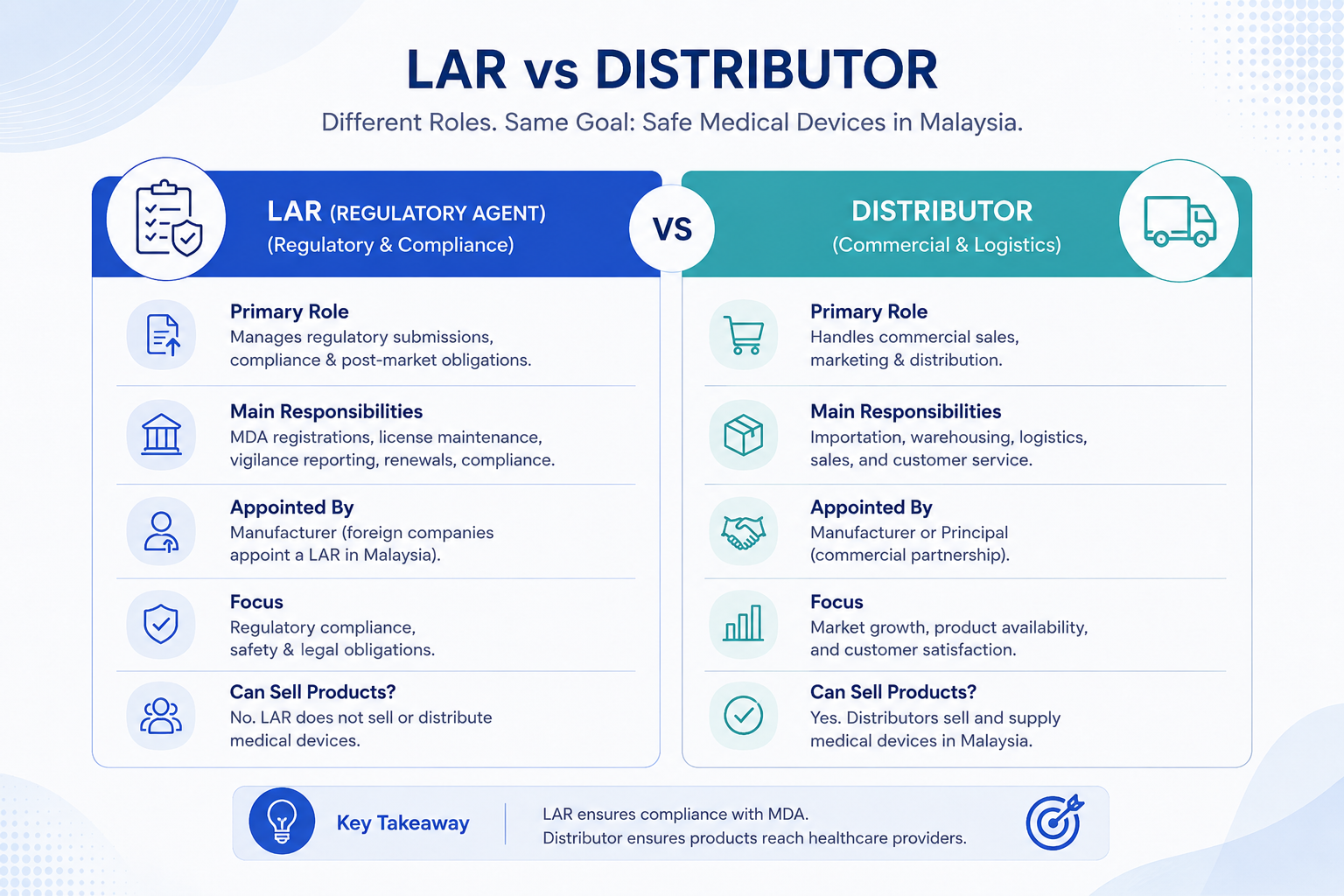
Having a Malaysian distributor is not the same as having a LAR. A distributor handles commercial sales — the LAR is the licensed regulatory agent responsible for MDA compliance. In some cases, a distributor may also hold a LAR licence, but this is not automatic — it depends on their specific licences.
In Vitro Diagnostic devices are classified as medical devices under Act 737 and regulated by the MDA. The LAR requirement applies equally to IVD manufacturers. Read more about IVD classification in Malaysia for more context.
 Qualifications
What a LAR Must Hold and Demonstrate
Not every company in Malaysia can act as a LAR. The MDA has specific requirements that a LAR must satisfy — and these are verified during the Establishment Licence application and renewal process.
| MDA Establishment Licence | A valid Establishment Licence issued by the MDA, specifically for the role of Local Authorised Representative. Since 1 July 2024, one licence per establishment role policy applies — a single entity cannot simultaneously hold licences for multiple establishment roles (e.g. LAR + importer). |
| GDPMD certificate | A current Good Distribution Practice for Medical Devices (GDPMD) certificate, demonstrating that the entity's storage, handling, and distribution practices meet MDA quality standards. This must be kept current throughout the engagement. |
| Regulatory expertise | The LAR must employ individuals with documented expertise in medical device regulations and quality management. The MDA expects the LAR to have genuine regulatory capability — not just a licence on paper. |
| Malaysian presence | The LAR must be based in Malaysia. The individual signing as Authorised Representative (AR) must be a Malaysian citizen or permanent resident. A foreign company cannot act as the LAR even if they have a regional office in Malaysia. |
| MeDC@St system access | The LAR must hold an active MeDC@St account through which all MDA submissions are made. Only the LAR can submit registration applications — the foreign manufacturer cannot submit directly. |
What the LAR Is Legally Responsible For
The LAR's role extends well beyond submitting the initial registration application. They are legally responsible for the device's regulatory standing in Malaysia for the full duration of market presence. This is not a one-time transaction — it is an ongoing legal relationship.
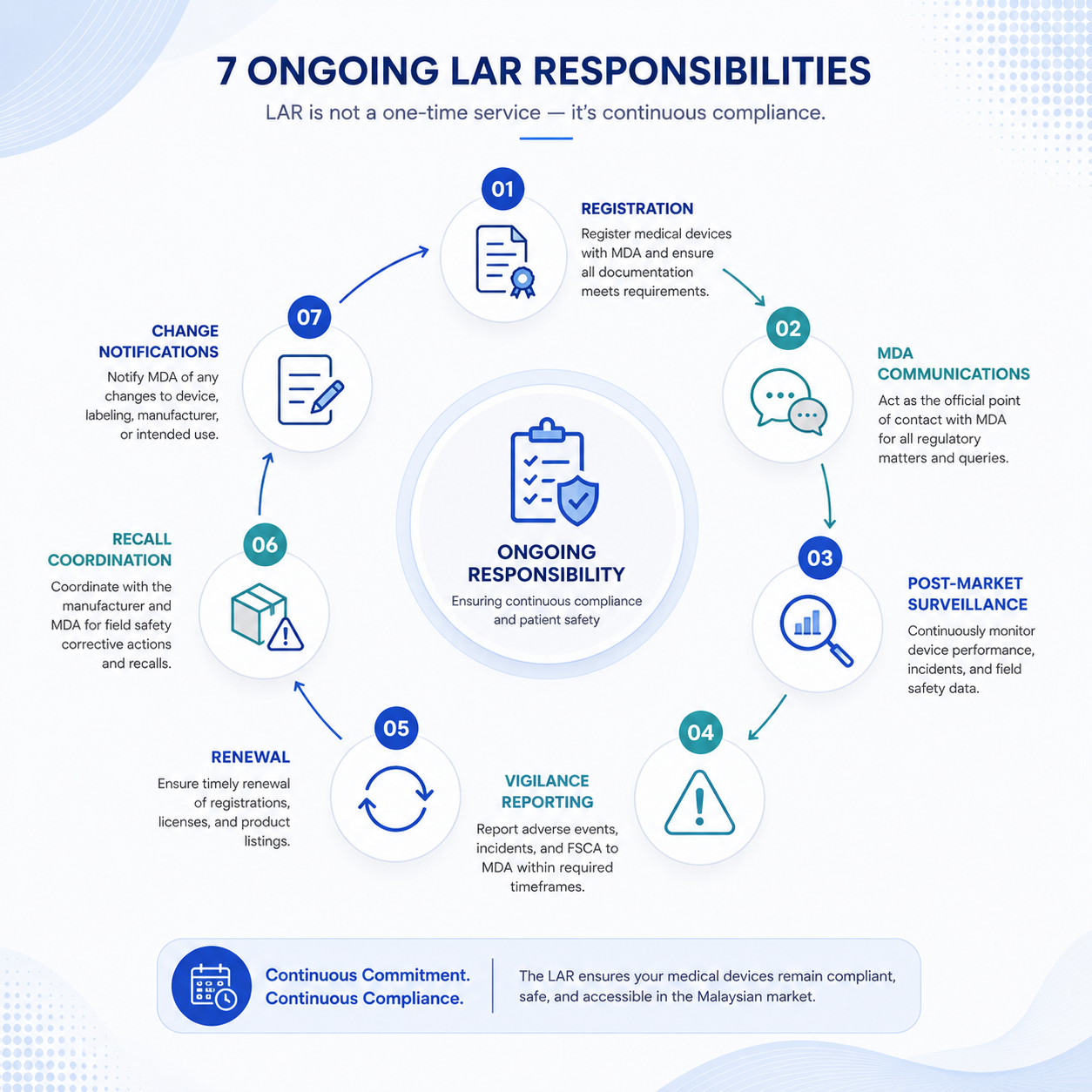
The LAR prepares and submits the full registration application via MeDC@St, including the CSDT, Declaration of Conformity, CAB certificate, labelling, and all supporting documents. For Class B, C, and D devices, the LAR also coordinates the CAB conformity assessment before submission.
All official communications between the manufacturer and the MDA flow through the LAR. If the MDA raises queries during the registration review or post-approval, the LAR is the point of contact responsible for responding within the required timeframe.
After registration, the LAR is responsible for maintaining the manufacturer's post-market surveillance obligations in Malaysia — collecting and reviewing safety data, monitoring device performance, and ensuring complaints are handled according to MDA requirements.
If a serious adverse event or device malfunction occurs in Malaysia, the LAR is responsible for submitting the required vigilance report to the MDA within the mandatory timeframe. Failure to report is a serious regulatory breach that can result in enforcement action.
Medical device registrations in Malaysia are valid for five years. The LAR is responsible for submitting the re-registration application before the registration expires. Failure to renew on time means the device can no longer be legally marketed in Malaysia until registration is restored.
In the event of a product recall or field safety corrective action (FSCA), the LAR coordinates with the manufacturer and the MDA to execute the recall in Malaysia — notifying affected customers, arranging product retrieval, and submitting the required reports to the MDA.
Any significant change to a registered device — design modifications, new indications, labelling updates, or manufacturing site changes — must be notified to the MDA through the LAR. Some changes require a formal change notification application; others may require a new registration.
How to Choose the Right LAR for Your Device
The LAR relationship is not just a regulatory checkbox — it directly affects your ongoing market access, the speed of your registration, and how effectively your post-market obligations are managed. These are the most important factors to evaluate before appointing a LAR.
Confirm that the LAR holds a current, valid MDA Establishment Licence for the LAR role — not an expired or suspended licence. Check their GDPMD certificate status as well. Both must be current at the time of engagement and maintained throughout.
A valid licence means a company is eligible to act as a LAR — it does not guarantee regulatory expertise. Ask about their track record: how many registrations have they successfully completed, what device types and classes have they handled, and how do they manage MDA query responses and post-market obligations.
Some LARs provide only the minimum legal representation — licence holding and signature authority. Others provide full regulatory support including CSDT preparation, CAB coordination, MDA query management, post-market surveillance, and renewal management. Understand exactly what is and is not included before signing.
If you need to change your LAR, there is a formal MDA process for transferring device registrations. This takes time and requires coordination between the outgoing LAR, the new LAR, and the MDA. Ensure your LAR agreement clearly defines the responsibilities and process in the event of termination — unclear agreements make transfers significantly harder.
Your LAR relationship doesn't end when the certificate is issued. Post-market surveillance, renewal, vigilance reporting, and regulatory updates all flow through your LAR for the life of your registration. Choose a LAR that has the infrastructure and regulatory depth to support you over the full five-year registration cycle.
What Happens Without a LAR
Without a LAR holding a valid MDA Establishment Licence, no registration application can be submitted via MeDC@St. The MDA system requires a licensed establishment account — which only the LAR can hold on behalf of a foreign manufacturer.
Without registration — which requires a LAR — the device cannot be legally imported into Malaysia, sold to hospitals or distributors, or tendered for government procurement. Operating without registration under Act 737 is a criminal offence.
If your LAR's Establishment Licence is suspended, revoked, or lapses, your device registrations are affected. This is one of the most important risks to manage in the LAR relationship — which is why verifying and monitoring your LAR's licence status throughout the engagement is essential.
The MDA has authority to seize unregistered devices and take enforcement action against establishments operating without proper licensing. For manufacturers relying on their Malaysian revenue, the commercial and reputational risk of a licence or registration lapse is significant.
Why Manufacturers Choose TT Medical as Their LAR
TT Medical Management provides Local Authorised Representative services for foreign medical device manufacturers entering the Malaysian market. As a licensed LAR with a GDPMD certificate and a dedicated regulatory team, we manage the full scope of your Malaysian regulatory obligations — from initial registration through to renewal and ongoing post-market compliance.
Final Thoughts
The LAR is not a middleman — they are your legal representative in Malaysia, responsible for your device's regulatory standing from registration through to renewal. Choosing the right LAR is one of the most important decisions in your Malaysian market entry strategy.
A LAR with genuine regulatory expertise — not just a licence — will protect your registration timeline, manage your MDA relationship effectively, and ensure your post-market obligations are handled correctly. A LAR who is a licence holder in name only creates risk at every stage of the process.
If you are planning to enter the Malaysian market and want to understand more about what the LAR relationship involves in practice, speak to our consultancy team. We'll walk you through the process and help you understand what to look for.
FAQ