
To appoint a LAR in Malaysia, you must: identify a company that holds a valid MDA Establishment Licence for the LAR role and a current GDPMD certificate; conduct due diligence on their regulatory expertise and track record; negotiate and sign a LAR agreement covering scope, responsibilities, and termination; issue a Letter of Authorization (LoA) to the LAR; and have the LAR set up your MeDC@St account. The LAR can then submit your device registration application on your behalf. The appointment itself is a commercial agreement between you and the LAR — but both parties must meet their respective MDA obligations for the arrangement to be valid.
Once you understand what a Local Authorised Representative is and why you need one, the next question is: how do I actually appoint one? What does the process look like, what documents are involved, and what should the agreement cover?
Appointing a LAR is not a single form to fill in — it involves choosing the right partner, agreeing on the scope of the relationship, and putting the correct legal and regulatory documentation in place before any registration work can begin. Getting this foundation right determines how smoothly everything that follows will go.
This guide walks through the complete LAR appointment process step by step — from shortlisting candidates to having your first registration application ready for submission.
Key Takeaways
- The LAR appointment is a commercial agreement between the manufacturer and the LAR — but both parties must hold valid MDA licences for the arrangement to be legally effective.
- The LAR must hold a current MDA Establishment Licence for the LAR role and a current GDPMD certificate — verify both before signing.
- Since 1 July 2024, one licence per establishment role applies — a single entity cannot hold multiple establishment role licences simultaneously.
- A Letter of Authorization (LoA) from the manufacturer to the LAR is required as part of the formal appointment and MDA submission documentation.
- You can appoint a different LAR for each device — registrations are held per device, not per manufacturer.
- Your LAR agreement must clearly cover scope of services, responsibilities, termination, and the transfer process — vague agreements create risk if the relationship ends.
- The LAR appointment should happen before documentation preparation begins — not after the CSDT is already drafted.
How to Appoint a LAR in Malaysia: Step by Step
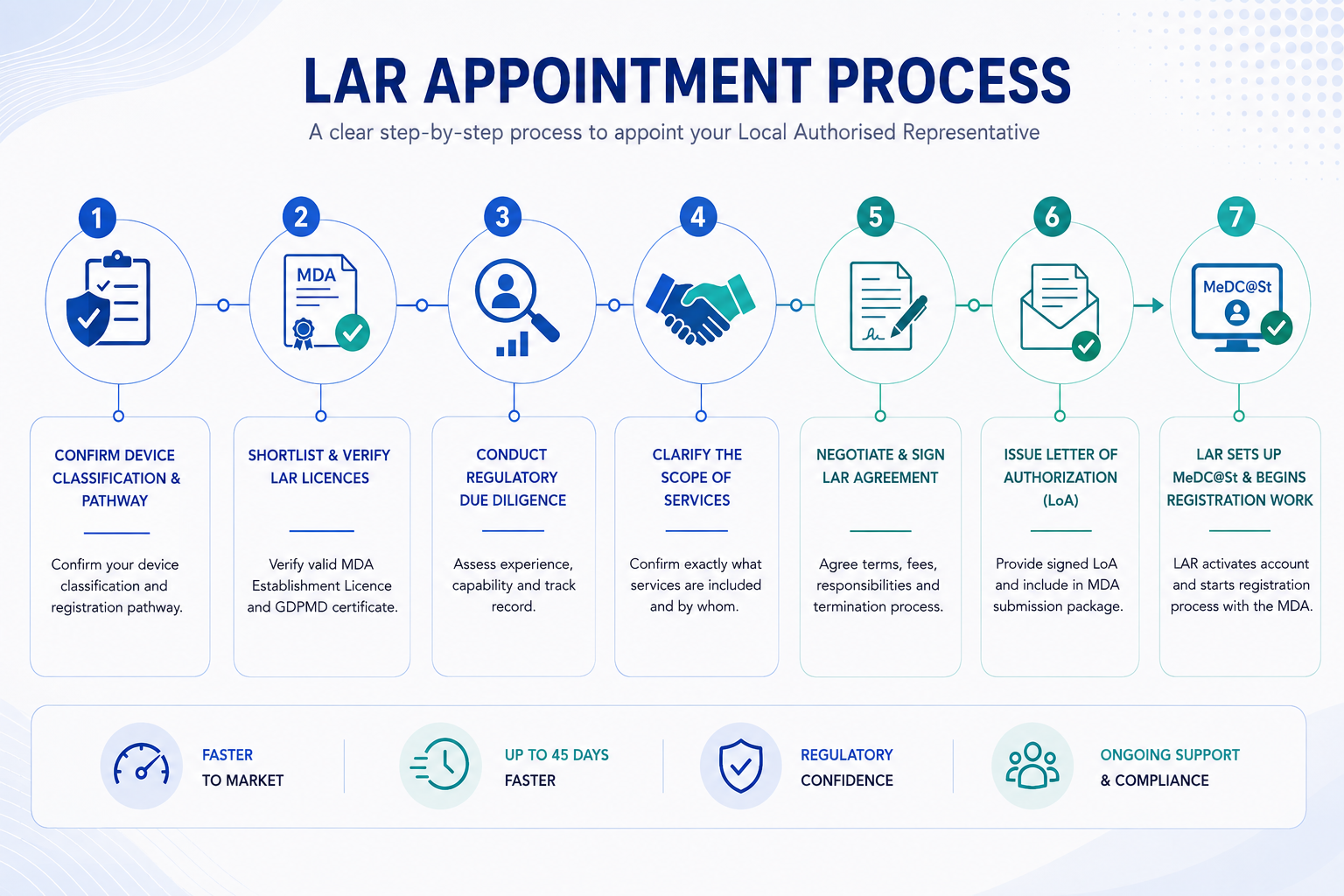
Before approaching any LAR, confirm your device classification and whether you will be taking the full assessment or verification route. This determines the scope of work required from your LAR and affects how you evaluate their capabilities. A LAR experienced in Class C and D submissions is very different from one that primarily handles Class A.
Identify LAR candidates and verify — before any conversation about scope or fees — that each holds both of the following:
- A current, valid MDA Establishment Licence for the Local Authorised Representative role
- A current GDPMD (Good Distribution Practice for Medical Devices) certificate
Both can be verified through the MDA. Ask the LAR for copies of both documents and check the validity dates. Since 1 July 2024, the one licence per establishment role policy means a single entity cannot hold multiple establishment role licences — verify their specific licence scope.
A valid licence confirms eligibility — it does not confirm capability. Before committing, assess the LAR's actual regulatory expertise:
- How many successful MDA registrations have they completed?
- What device types and classes have they handled?
- Do they have experience with your specific assessment route (full or verification)?
- Can they provide references from current clients?
- How do they manage post-market obligations — PMS, vigilance reporting, renewal?
- What is their process for managing MDA query responses?
LAR services vary significantly. Some offer only the minimum legal representation — licence holding and submission authority. Others provide full end-to-end regulatory support. Before signing, confirm exactly what is included:
- CSDT preparation and review — or submission only?
- CAB selection and coordination — or do you manage this?
- MDA query management — who responds, and within what timeframe?
- Post-market surveillance and vigilance reporting — ongoing or on request?
- Registration renewal — included or separately quoted?
- Change notifications and variation applications — included or extra?
The LAR agreement is the foundation of the relationship. It should clearly cover the full scope of services, responsibilities of each party, fees and payment terms, the process for terminating the agreement, and — critically — the process for transferring device registrations to a new LAR if the relationship ends. Vague agreements create serious risk if the relationship breaks down. See the section below on what a LAR agreement must cover.
The manufacturer must provide a signed Letter of Authorization to the LAR. This formal document authorises the LAR to act on the manufacturer's behalf in all MDA matters for the specified devices. The LoA is a required document in the MDA submission package and must be included alongside the Annex B AR Declaration. It should specify the device(s) covered, the scope of authority, and be signed by an authorised signatory of the manufacturer.
Once the agreement and LoA are in place, the LAR activates or updates their MeDC@St account to include your devices. The LAR can then begin coordinating the registration process — confirming classification, initiating documentation preparation, and engaging the CAB for Class B, C, and D devices. From this point, all MDA communications flow through the LAR.
What Your LAR Agreement Must Cover
The LAR agreement is a commercial contract between the manufacturer and the LAR. The MDA does not prescribe a standard format, but certain elements are essential for the agreement to adequately protect both parties — and to ensure the regulatory relationship functions correctly.
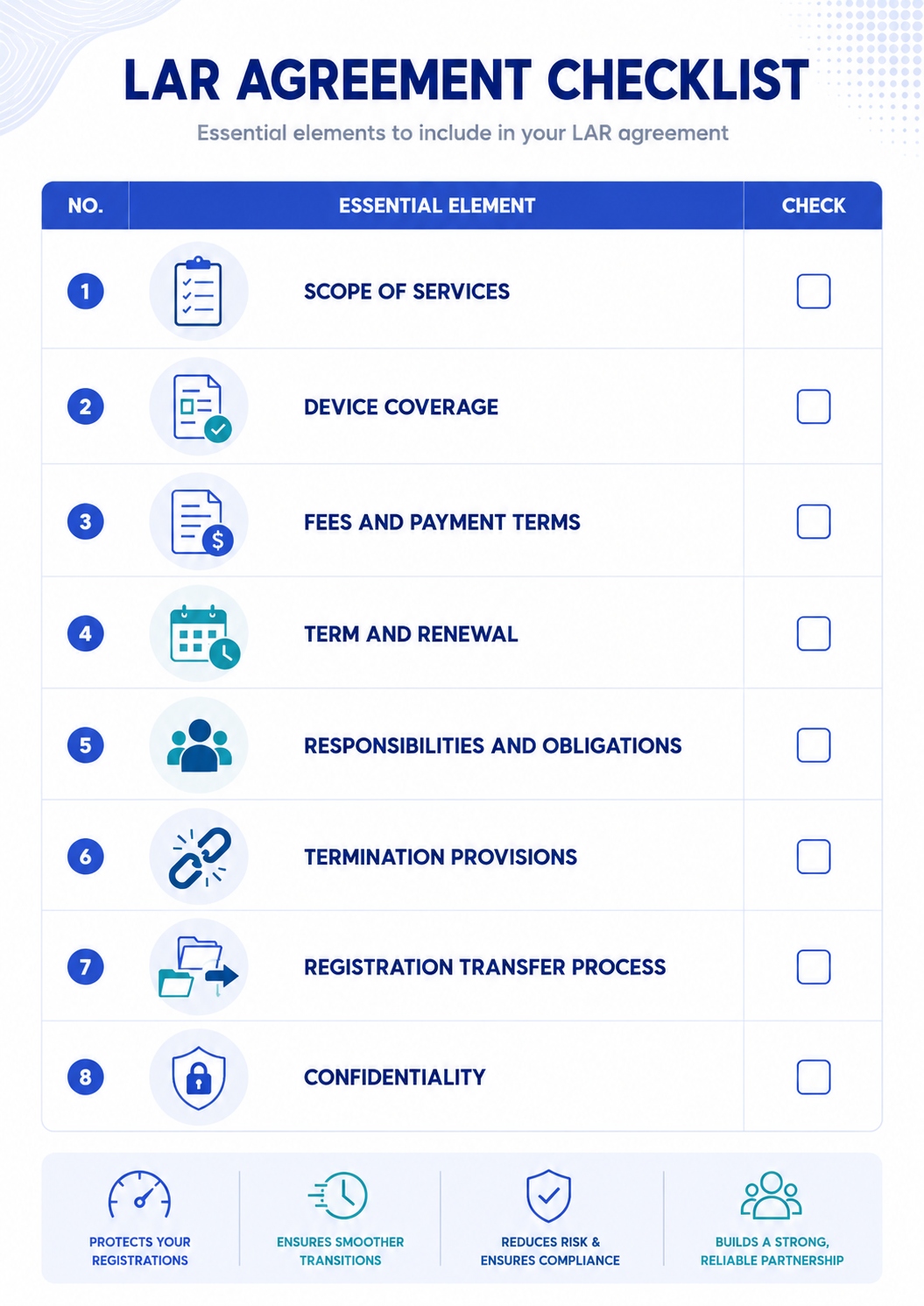
| Scope of services | A precise description of every regulatory service included — registration submission, CAB coordination, query management, PMS, vigilance reporting, renewal, change notifications. Do not leave this as a general description. |
| Device coverage | A clear list of the specific devices, models, and configurations covered by the agreement. Registration is held per device — the LAR agreement must reflect exactly which products are covered. |
| Fees and payment terms | Annual LAR fees, registration application fees, and any additional fees for variations, renewals, or out-of-scope services. Clarify which fees are passed through at cost and which are included. |
| Term and renewal | The initial term of the agreement, renewal conditions, and notice periods. Since device registrations are valid for five years, the LAR agreement should align with the registration cycle. |
| Responsibilities and obligations | Which party is responsible for what — manufacturer obligations (providing documentation, approving labelling, reporting adverse events) and LAR obligations (MDA submissions, query responses, post-market management). |
| Termination provisions | The conditions under which either party can terminate, the required notice period, and the obligations of each party during the notice period — particularly the LAR's obligation to cooperate with the transfer process. |
| Registration transfer process | The most critical clause for risk management. What happens to device registrations when the relationship ends? The agreement must establish that the LAR will cooperate fully with any transfer of registrations to a new LAR, including providing all necessary MDA documentation and not withholding consent. |
| Confidentiality | Protection of the manufacturer's technical documentation, regulatory strategies, and commercial information that the LAR will have access to during the engagement. |
What the Letter of Authorization (LoA) Must Include
The LoA is a formal document from the manufacturer authorising the LAR to act on their behalf in Malaysia. It is a required document in the MDA submission package. A LoA that is vague, incomplete, or not signed by the correct signatory will be queried by the MDA.
Full legal name, registered address, and country of the manufacturer issuing the authorization.
Full legal name and registered Malaysian address of the appointed Local Authorised Representative.
The specific device(s), product names, models, and configurations for which the LAR is authorized to act. A general "all products" authorization is typically not accepted — the LoA should be device-specific.
A clear statement of what the LAR is authorized to do — submitting registration applications, communicating with the MDA, managing post-market obligations, and acting as the legal regulatory agent in Malaysia.
The date from which the authorization is effective. The LoA should remain valid for at least the duration of the registration cycle — typically five years — unless explicitly time-limited.
Signed by a person with authority to bind the manufacturer — typically the CEO, Managing Director, or an equivalent senior executive. The same signatory requirements that apply to the Declaration of Conformity apply here.
Common Mistakes When Appointing a LAR
A distributor handles commercial sales. A LAR is a licensed regulatory agent. These are different roles requiring different MDA licences. Verify that your distributor specifically holds an Establishment Licence for the LAR role — not just a distributor licence — before treating them as your regulatory representative.
If your LAR's GDPMD certificate expires during the engagement, your device registrations are at risk. Check validity at appointment — and build a requirement into your LAR agreement for the LAR to notify you of any licence or certificate renewal dates in advance.
Without a clearly defined registration transfer process in the agreement, changing your LAR later becomes very difficult. Some LAR agreements make transfer conditions deliberately unclear — making it harder for the manufacturer to leave. Read the transfer provisions carefully before signing.
The LAR should be appointed before documentation preparation begins — not after. An experienced LAR will shape the documentation strategy, advise on the assessment route, and ensure the CSDT is structured to meet the specific requirements of the MDA and the chosen CAB. Starting documentation without a LAR in place wastes time and often leads to rework.
A LoA that authorizes the LAR to act for "all medical device products" without specifying the devices, models, or configurations may be queried by the MDA. Ensure your LoA is device-specific and covers exactly the products being registered.
Appointing TT Medical as Your LAR
TT Medical Management is a licensed Local Authorised Representative in Malaysia, holding a valid MDA Establishment Licence and current GDPMD certificate. We provide end-to-end registration support — from LAR appointment through to post-market compliance and renewal — so manufacturers deal with a single point of contact for all their Malaysian regulatory obligations.
Final Thoughts
Appointing a LAR is the first and most important step in your Malaysian registration process. It is a decision that will affect your registration timeline, your ongoing market access, and how effectively your post-market obligations are managed for the full life of your registration.
Take the time to verify licences, conduct proper due diligence, and negotiate a LAR agreement that protects your interests — especially the transfer provisions. And appoint your LAR before documentation work begins, not after. A good LAR doesn't just submit your application — they shape your entire regulatory strategy in Malaysia from the outset.
If you would like to discuss the LAR appointment process in more detail or appoint TT Medical as your LAR, contact our team. We'll walk you through what the process looks like for your specific device and help you get started.
FAQ