
Yes — you can change your Local Authorised Representative in Malaysia. Device registrations can be transferred from one LAR to another via a formal process with the Medical Device Authority (MDA). The critical variable is the cooperation of your outgoing LAR — because device registrations are held under the LAR's Establishment Licence, the transfer requires their written agreement and active participation. Without it, the process becomes significantly more difficult. This is why the transfer provisions in your LAR agreement matter so much before you sign.
Changing your Local Authorised Representative in Malaysia is not something most manufacturers plan for when they first enter the market. But it happens — and more often than people expect. A distributor relationship breaks down. A LAR becomes unresponsive. Post-market obligations are not being met. The manufacturer's commercial strategy shifts and a different partner makes more sense.
Whatever the reason, the LAR change process is a formal regulatory procedure — not a simple administrative update. Understanding how it works, what it requires from both parties, and what risks to manage is essential before you initiate a change.
This guide covers the full LAR transfer process in Malaysia — step by step, including the scenarios where it gets complicated and how to protect yourself before they arise.
Key Takeaways
- Yes, you can change your LAR — device registrations can be transferred from one LAR to another via the MDA's formal process.
- The outgoing LAR's cooperation is essential — the transfer requires their written agreement and active participation in the MDA process.
- Device registrations continue under the existing registration number during and after transfer — you do not need to re-register the device.
- During the transfer process, the outgoing LAR remains legally responsible for post-market obligations until the transfer is formally completed.
- If the outgoing LAR is uncooperative, the process becomes significantly harder — this is why transfer provisions in the original LAR agreement are so important.
- If your LAR's Establishment Licence lapses or is revoked, you must act quickly to appoint a new LAR and initiate a transfer before market access is affected.
- Manufacturers can reduce transfer risk by appointing an independent LAR rather than using their distributor as LAR — distributor changes would otherwise require a parallel LAR change.
Common Reasons for Changing a LAR in Malaysia
Many manufacturers initially appoint their Malaysian distributor as LAR for convenience. When the commercial relationship ends — due to non-performance, strategic changes, or market restructuring — the LAR relationship must also be formally ended and transferred. Separating these two roles at the outset avoids this complication entirely.
A LAR who fails to manage post-approval responsibilities — PMS, vigilance reporting, renewal deadlines, change notifications — puts the manufacturer's market access at risk. When the relationship is causing compliance problems rather than preventing them, a change is necessary.
If the LAR's MDA Establishment Licence or GDPMD certificate lapses or is revoked, the device registrations held under that licence are immediately at risk. Manufacturers in this situation must act quickly to appoint a replacement LAR and initiate the transfer process before market access is affected.
As a manufacturer's Malaysian business grows, they may consolidate under a new regulatory partner who can offer broader capabilities — full-service regulatory support, stronger MDA relationships, or more experienced handling of their specific device categories.
If the LAR's business closes or merges with another entity, the manufacturer must appoint a new LAR and complete the formal transfer — regardless of whether the original LAR agreement included adequate provisions for this scenario. This is one of the most time-pressured transfer situations.
How to Change Your LAR: Step by Step
The LAR transfer process involves both regulatory and commercial steps. The MDA requires formal documentation from both the outgoing and incoming LAR — making cooperation from the outgoing party a practical necessity.
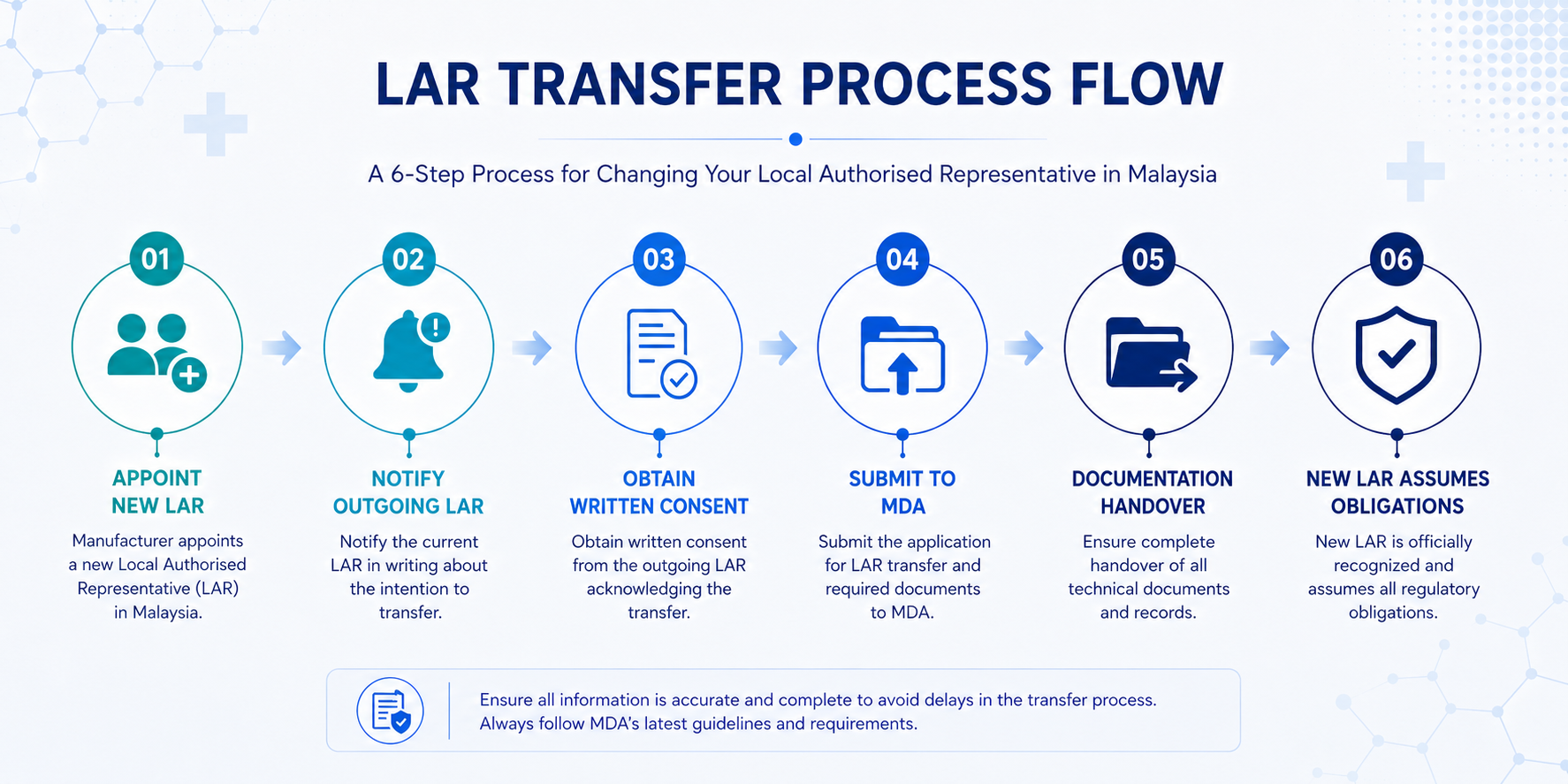
Before initiating any formal transfer, identify and appoint your new LAR. Verify their MDA Establishment Licence for the LAR role and their current GDPMD certificate. Sign the new LAR agreement — including clear transfer-in provisions — and issue a new Letter of Authorization (LoA) to the incoming LAR. See our guide on how to appoint a LAR for full due diligence criteria.
Issue a formal written termination notice to the outgoing LAR per the terms of your LAR agreement. This notice should trigger the termination provisions — including the outgoing LAR's obligation to cooperate with the transfer process, provide all necessary documentation, and not withhold consent. The notice period and obligations should be clearly defined in your original agreement.
The MDA transfer process requires the outgoing LAR's written agreement. This is the most critical step — and the one most likely to create complications. A cooperative outgoing LAR will provide written consent promptly. An uncooperative one may delay, obstruct, or withhold consent — which is why transfer provisions in the original LAR agreement are so important. Without written consent, you will need to pursue other avenues (see below).
The incoming LAR submits a formal change of establishment application via MeDC@St. The application package includes the outgoing LAR's written consent, the new LoA from the manufacturer to the incoming LAR, the incoming LAR's Establishment Licence and GDPMD certificate, and confirmation of the device registration details to be transferred. The MDA reviews the application and, once approved, updates the registration records to reflect the new LAR.
Once the MDA transfer is approved, the outgoing LAR must hand over all regulatory documentation held on behalf of the manufacturer — registration certificates, CSDT files, CAB certificates, post-market surveillance records, complaint logs, and any ongoing MDA correspondence. Incomplete documentation handover is a common post-transfer complication that can affect the incoming LAR's ability to manage post-market obligations effectively.
After the transfer is complete, the incoming LAR assumes full responsibility for all post-market obligations — PMS, vigilance reporting, renewal management, and change notifications. Confirm with the incoming LAR that they have reviewed all existing obligations, that renewal dates are calendared, and that any open MDA queries or ongoing FSCA actions have been properly transitioned.
What Happens If Your Outgoing LAR Is Uncooperative
The LAR transfer process is designed to be a cooperative procedure. But not all outgoing LARs cooperate — and this is one of the most significant commercial risks in the Malaysian regulatory landscape for foreign manufacturers.
A LAR agreement with explicit transfer obligations — including a specific obligation to provide written MDA consent within a defined timeframe — gives you contractual grounds to demand cooperation and, if necessary, pursue legal remedies under Malaysian contract law. This is the strongest protection available and the reason why transfer provisions must be negotiated at the outset, not assumed.
Without clear contractual provisions, an uncooperative outgoing LAR creates a genuinely difficult situation. You may need to engage Malaysian legal counsel to pursue the matter contractually. In the interim, the outgoing LAR remains the licensed establishment on your device registrations — which means their post-market obligations remain in place, but so does their leverage.
If the LAR's Establishment Licence is no longer valid, the situation is more urgent — your device registrations may already be affected. In this scenario, engage the MDA directly about the status of your registrations and the process for emergency transfer to a new LAR. Acting quickly is critical to minimising the market access gap.
The most effective protection is preventive: appoint an independent LAR rather than your distributor, negotiate explicit transfer provisions before signing, and choose a LAR with a track record of professional conduct during transitions. An independent LAR has no commercial incentive to obstruct a transfer in the way a distributor-LAR might.
What Doesn't Change When You Transfer Your LAR
The existing registration number is retained after the transfer — you do not need to re-register the device from scratch. The MDA updates the establishment records to reflect the new LAR, but the registration itself continues under the same number.
The registration expiry date is not reset by a LAR transfer. The five-year validity period continues from the original registration date. The incoming LAR assumes responsibility for renewal at the existing expiry date — which may be imminent, depending on when the transfer occurs.
The device's approved intended use, classification, labelling, and technical specifications remain unchanged by the LAR transfer. Any changes to these details must go through the standard MDA change notification process — they are not part of the LAR transfer.
All existing post-market obligations — PMS, vigilance reporting, renewal, change notifications — transfer to the incoming LAR along with the registration. The obligations themselves do not change; only the entity responsible for fulfilling them changes.
Transferring to TT Medical as Your New LAR
TT Medical supports manufacturers through the full LAR transfer process — from initiating the formal change of establishment application via MeDC@St to managing the documentation handover from the outgoing LAR and assuming responsibility for all ongoing post-market obligations.
If you are currently experiencing difficulties with your existing LAR — unresponsiveness, post-market obligation failures, or an impending licence lapse — contact our team to discuss the transfer options available to you.
Final Thoughts
Yes — you can change your LAR in Malaysia. The process is formal but manageable, and your device registrations survive the transition without the need for re-registration. The single biggest risk in any LAR change is an uncooperative outgoing LAR — and the most effective protection against that risk is a LAR agreement with explicit, enforceable transfer provisions negotiated before you sign.
If you are planning a LAR change, experiencing problems with your current LAR, or want to understand your options before committing to a new arrangement, speak to our consultancy team. We will walk you through the transfer process and help you understand what to expect at each stage.
FAQ