
If you're planning to bring a healthcare product into Malaysia, chances are you've asked this at some point: Do I go through MDA or NPRA?
It sounds like a small question, but getting it wrong can easily set you back a few months. A lot of manufacturers assume the answer is obvious until they realise their product sits in a grey area — and by then, they've already started preparing the wrong submission.
This guide breaks down the key differences between MDA and NPRA, what each authority regulates, and how to determine the right pathway for your product.
Key Takeaways
- MDA and NPRA regulate different types of healthcare products, each with its own requirements and process.
- The core difference is whether a product works through a physical mechanism (MDA) or a chemical/biological effect (NPRA).
- Misclassification is a common issue that leads to delays, rework, and longer approval timelines.
- Many health-related products assumed to be under NPRA are actually classified as medical devices under MDA.
- Getting clarity early saves time, reduces costs, and avoids unnecessary back-and-forth with regulators.
 Overview
MDA vs NPRA: The Core Difference
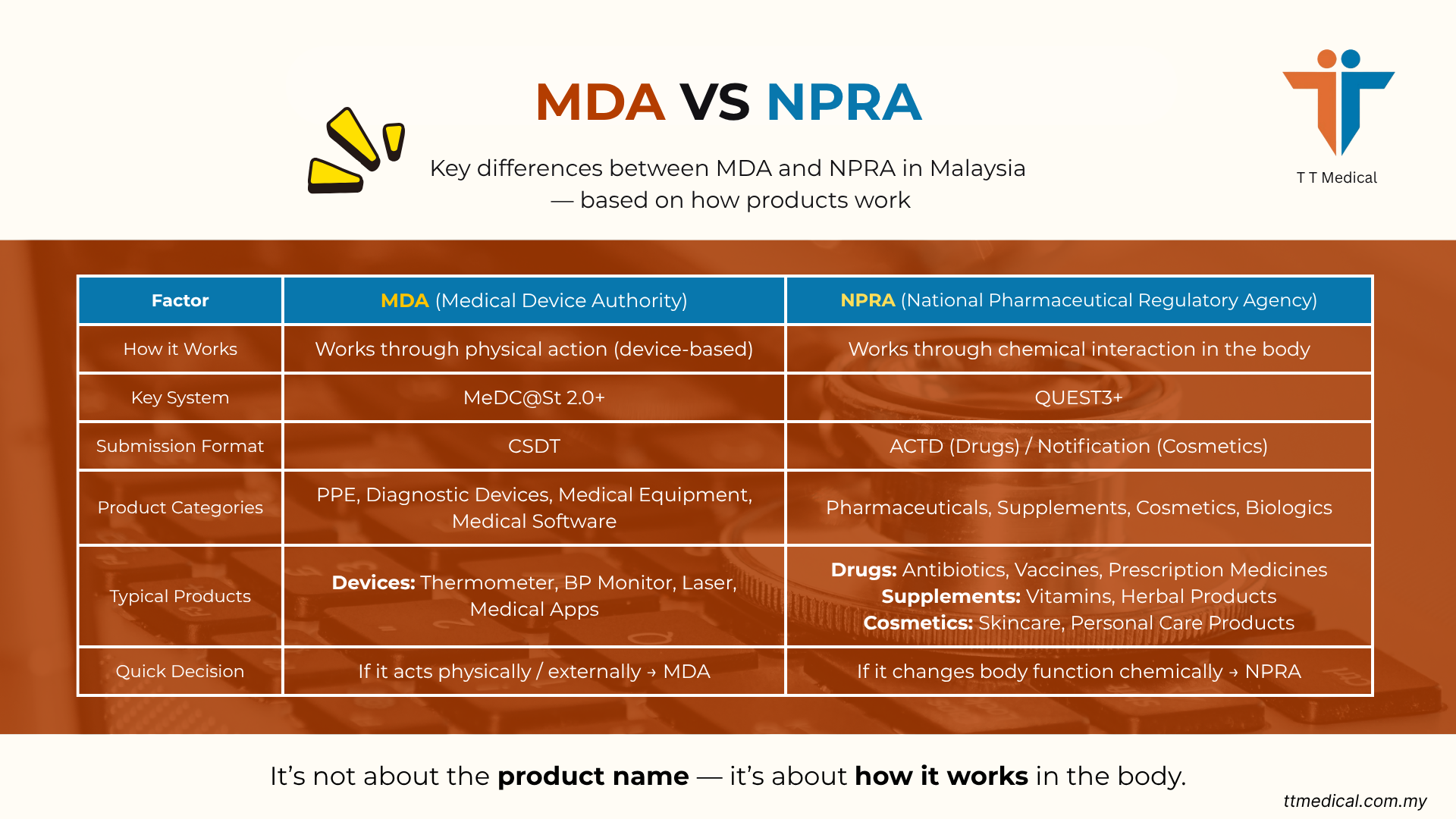
In Malaysia, healthcare products are mainly regulated by two bodies under the Ministry of Health. The simplest way to tell them apart is by looking at how the product works.
MDAWhat Does MDA Regulate?
The Medical Device Authority is responsible for all products that achieve their medical purpose through a physical, mechanical, or structural function — not through a chemical or biological effect on the body.
Applications are submitted through the MeDC@St 2.0 system as part of the medical device registration process in Malaysia. Devices are classified based on risk, from Class A (low risk) to Class D (high risk). If you're unsure how your product is classified, it helps to understand the medical device classification framework before starting.
Surgical masks, gloves, and syringes are regulated by the MDA as non-active medical devices. Their medical purpose is achieved through physical barrier function, not chemical interaction.
Products like thermometers and blood pressure monitors measure physical parameters. Their function is mechanical or electronic — making them active or non-active medical devices under MDA.
As of June 2026, aesthetic technology such as lasers and HIFU devices are under enhanced regulatory control by the MDA. Manufacturers and distributors of these devices must ensure full compliance with updated requirements.
Medical apps used for diagnosis, monitoring, or clinical decision support are classified as active medical devices under MDA — even if they run on a standard smartphone. See our guide on active vs non-active devices for more detail.
What Does NPRA Regulate?
The National Pharmaceutical Regulatory Agency handles products that act inside the body through chemical or biological means. If your product changes how the body functions at a chemical level, NPRA is where you'll be dealing with.
Submissions go through the QUEST3+ system. You'll need to prepare a full ACTD dossier covering safety, quality, and product efficacy. Compared to MDA, NPRA typically looks more closely at the formulation and the effect the product has on the body.
Key Differences: MDA vs NPRA
| Factor | MDA (Medical Device Authority) | NPRA (Natl. Pharm. Regulatory Agency) |
|---|---|---|
| Primary focus | Physical / mechanical performance | Chemical / biological effect |
| Submission system | MeDC@St 2.0 | QUEST3+ |
| Submission format | CSDT (Common Submission Dossier) | ACTD (ASEAN Common Technical Dossier) |
| Main concern | Safety and performance | Safety, efficacy, and quality |
| Common example | Blood pressure monitor | Blood pressure medication |
| Local rep required | LAR required for foreign manufacturers | Local agent / licence holder required |
Where Most Manufacturers Get It Wrong
A lot of delays don't come from the process itself — they happen when a product doesn't clearly fit into one category. These are the most common grey area products that cause confusion.
In these cases, it is usually better to get a proper product classification assessment before submission to avoid delays later. If needed, your product may be reviewed by the MDDCI to confirm the correct category — it adds an extra step, but it helps avoid bigger issues if the product is classified incorrectly.
Why It MattersWhy Getting This Right Matters More Than You Think
Choosing the wrong regulatory route doesn't just slow you down — it can affect your entire market entry plan. If you're coordinating multiple markets, one delay can throw everything off.
Submitting to the wrong authority means restarting the process from scratch — including documentation preparation, system access setup, and potentially new testing requirements.
Distributors and hospital procurement cycles run on fixed timelines. A classification error that pushes approval back by several months can cost you an entire selling window.
Re-submissions mean paying additional regulatory fees, potentially commissioning new testing, and committing more time from your regulatory team — all of which could have been avoided.
Get It Right the First Time
If you're not 100% sure where your product sits, you're not alone — this is exactly where most manufacturers need support. TT Medical helps manufacturers clarify whether their product falls under MDA or NPRA, prepare the right documentation from the start, and manage the submission end-to-end.
Final Thoughts
The difference between MDA and NPRA comes down to one question: does your product work through a physical mechanism, or through a chemical and biological effect? Getting that answer right before you start saves months of avoidable rework.
If your product sits in a grey area — or if you're simply not sure which route to take — speak to our consultancy team before you begin. Getting the classification right the first time is always faster and less costly than fixing it later.
FAQ