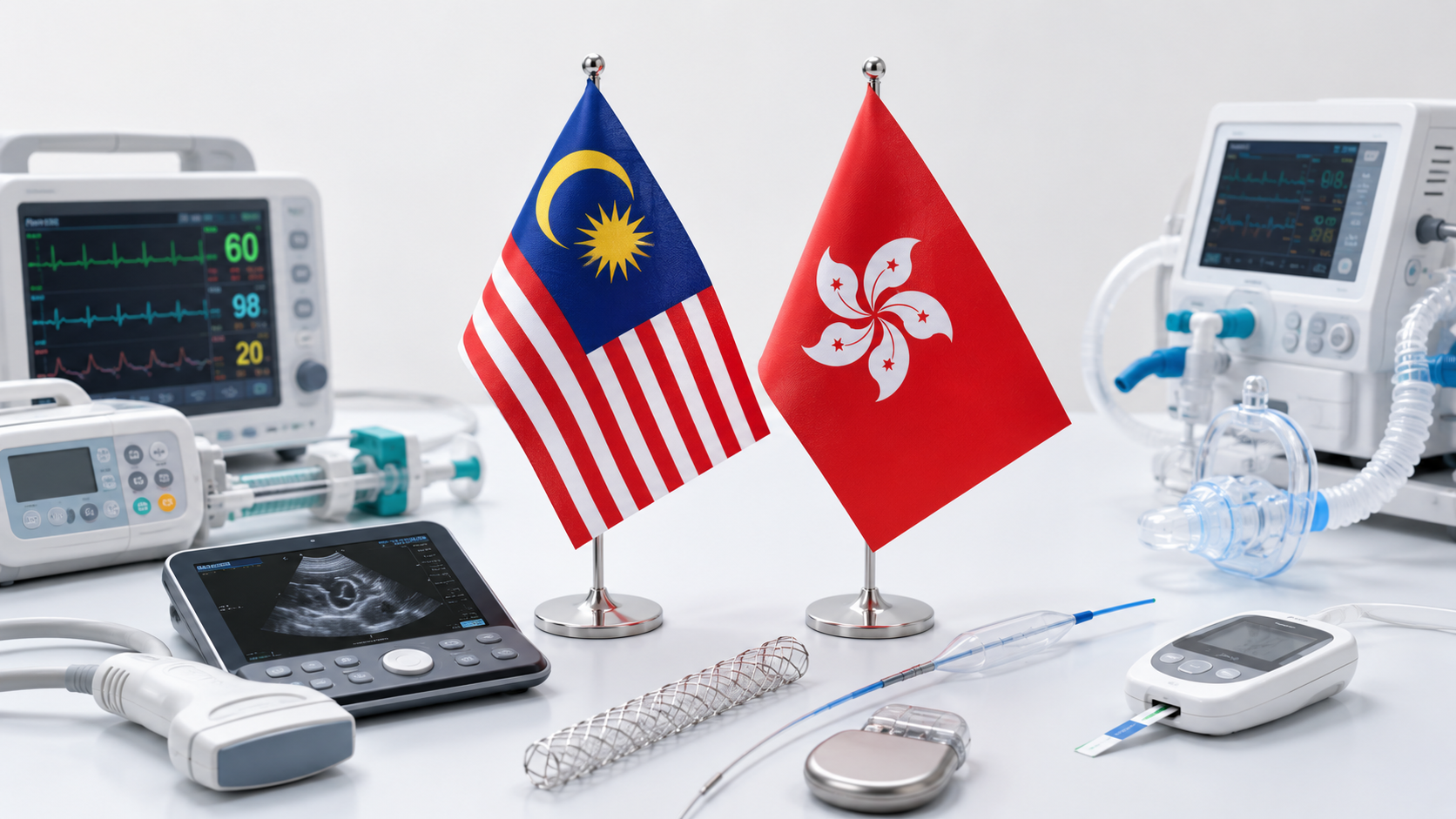
Hong Kong uses a voluntary listing system (MDACS) with Class I–IV for general devices and Class A–D for IVDs, overseen by the Medical Device Division (MDD). Malaysia uses a mandatory registration system under the MDA and Act 737, with Class A–D classification for all devices. Both require a local representative — Hong Kong calls it a Local Responsible Person (LRP), Malaysia calls it a Local Authorised Representative (LAR). Malaysia's process is mandatory and more documentation-intensive; Hong Kong's MDACS is currently voluntary but strategically important for market access.
For medical device manufacturers planning to expand across Asia, Hong Kong and Malaysia are two of the most strategically important markets to understand. Both have structured regulatory frameworks, both require local representation, and both use risk-based classification systems — but the similarities end there.
The differences in process, documentation requirements, legal basis, and enforcement are significant enough to affect your market entry timeline, resource planning, and regulatory strategy. This guide gives you a clear, side-by-side comparison of the medical device registration process in Hong Kong and Malaysia, so you can plan both entries with the full picture in front of you.
For a deep dive into the Malaysia side, see our complete guide to medical device registration in Malaysia. For the Hong Kong side, Hong Kong medical device registration overview covers the regulatory landscape in detail.
Key Takeaways
- Hong Kong's MDACS is currently voluntary — Malaysia's MDA registration is mandatory before any device can be sold.
- Both markets use a risk-based Class A to D (or I to IV) system aligned with international standards.
- Both require a local representative — Hong Kong's LRP and Malaysia's LAR play similar roles but have different legal obligations.
- Malaysia requires a full CSDT and CAB conformity assessment for Class B, C, and D devices.
- Hong Kong's MDACS requires a Summary Technical Documentation (STED) for higher-risk devices.
- Manufacturers entering both markets can leverage prior approvals (FDA, CE) in both systems to expedite assessment.
- Running both registrations in parallel is viable — but documentation strategy should be planned at the outset.
Hong Kong vs Malaysia: Regulatory Overview
Mandatory vs Voluntary: The Fundamental Difference
This is the most important distinction between the two markets and the one that most affects how manufacturers prioritise their submissions.
The MDACS is currently a voluntary administrative control system. Devices can technically be sold in Hong Kong without MDACS listing — however, Hong Kong device registration guidance, listing is strategically critical for market credibility, hospital procurement, and preparation for anticipated mandatory regulation. Devices procured by the Department of Health require MDACS listing. The direction of travel is toward mandatory enforcement.
Under the Medical Device Act 2012 (Act 737), no medical device can be imported, sold, or marketed in Malaysia without MDA registration. There are no exceptions — selling an unregistered device is a criminal offence that can result in fines, product seizures, and licence suspension. Registration is the legal prerequisite for market entry, not an optional enhancement.
Detailed Comparison: Registration Process
| Factor | 🇭🇰 Hong Kong (MDACS) | 🇲🇾 Malaysia (MDA) |
|---|---|---|
| Registration status | Voluntary (MDACS listing) | Mandatory (MDA registration) |
| Regulatory body | Medical Device Division (MDD), Dept of Health | Medical Device Authority (MDA), Ministry of Health |
| Submission system | MDACS portal (online) | MeDC@St 2.0 (online) |
| Classification (general) | Class I, II, III, IV | Class A, B, C, D |
| Classification (IVD) | Class A, B, C, D | Class A, B, C, D (same framework) |
| Local representative | Local Responsible Person (LRP) | Local Authorised Representative (LAR) |
| Dossier format | STED (Summary Technical Dossier) | CSDT (Common Submission Dossier Template) |
| Conformity assessment | Not always required; CAB review for higher classes | Required for Class B, C, D by registered CAB |
| Prior approval recognition | CE, FDA, TGA recognition supports listing | Verification Route available for CE, FDA, HSA, TGA, Health Canada |
| Post-market obligations | Vigilance reporting, safety notices | Vigilance reporting, renewal, MDA notification for changes |
| Legal penalty for non-compliance | Varies — enforcement increasing | Fines, seizures, licence suspension, legal action |
LRP vs LAR: What Foreign Manufacturers Need to Know
Both Hong Kong and Malaysia require foreign manufacturers to appoint a local representative. While the roles are similar in principle, the legal weight and specific responsibilities differ.
The LRP is the official liaison between the foreign manufacturer and the MDD. The Hong Kong LRP requirements confirm the LRP handles all formal communications with the MDD, manages the MDACS listing application, and is responsible for post-market vigilance and compliance activities. Without a Hong Kong-based LRP, foreign manufacturers cannot submit or maintain a listing. The LRP can be an individual or a corporate entity registered in Hong Kong.
The LAR is legally mandated under Act 737 for all foreign manufacturers. The LAR holds the MeDC@St account, submits the registration application, and maintains ongoing post-market compliance obligations including vigilance reporting and renewal. Importantly, the LAR must also hold a valid establishment licence from the MDA.
How Device Classification Compares
Both markets use a risk-based classification system with four tiers. The terminology differs slightly — Hong Kong uses Roman numerals (I–IV) for general devices and letters (A–D) for IVDs; Malaysia uses letters (A–D) for all devices including IVDs. The underlying risk logic is aligned with GHTF principles in both cases.
| Risk Level | 🇭🇰 HK General | 🇭🇰 HK IVD | 🇲🇾 Malaysia (all) |
|---|---|---|---|
| Low risk | Class I | Class A | Class A |
| Low to moderate | Class II | Class B | Class B |
| Moderate to high | Class III | Class C | Class C |
| High risk | Class IV | Class D | Class D |
For more on how Malaysia's medical device classification system works, including IVDs and the rules for each class, see our dedicated classification guide.
DocumentationTechnical Documentation: STED vs CSDT
Both systems require structured technical documentation — but the format and depth requirements differ.
The STED is the standard dossier format for MDACS submissions. It covers device description, intended use, risk management, clinical evidence, and labelling. For lower-risk Class I and Class II devices, a lighter version is typically accepted. Higher-risk Class III and IV devices require more comprehensive evidence. The STED format aligns with international IMDRF/GHTF guidelines, which means manufacturers with existing CE or FDA dossiers often have a strong head start.
The CSDT is required for Class B, C, and D devices in Malaysia, governed by MDA guidance document MDA/GD/0008. It follows a structured 8-section format covering executive summary, EPSP checklist with cross-references, device description, design verification and validation, clinical evidence, labelling and IFU, risk management, and manufacturer information. Every section must be addressed — non-applicable sections require a written justification. See our full MDA document checklist for a complete breakdown.
Running Both Registrations in Parallel
For manufacturers targeting both markets simultaneously, parallel registration is viable — and often the most efficient approach. The key is planning documentation with both systems in mind from the outset.
Risk management files (ISO 14971), clinical evaluation reports, biocompatibility assessments (ISO 10993), quality management system documentation (ISO 13485), and labelling are required by both systems. Building these documents in a format that satisfies both the STED and CSDT requirements from the start avoids the need for parallel documentation tracks.
You will need a separate LRP for Hong Kong and a separate LAR for Malaysia — these are distinct legal roles in distinct jurisdictions. Both should ideally be engaged early so they can advise on local nuances during documentation preparation.
Hong Kong's MDACS listing timeline is generally faster for lower-risk devices. Malaysia's process for Class B and above includes mandatory CAB conformity assessment before MDA review, which adds time. Factor this into your launch planning — particularly if you are targeting hospital procurement in either market.
Both markets offer expedited pathways for devices with existing international approvals. In Malaysia, the Verification Route allows CABs to rely on prior FDA, CE, HSA, TGA, or Health Canada assessments. In Hong Kong, MDACS similarly recognises CE and FDA compliance as supporting evidence. This is the most effective way to reduce the overall timeline when entering both markets.
Expert Resources for Both Markets
Navigating two regulatory systems simultaneously requires reliable, market-specific expertise. For Hong Kong, Hong Kong device registration process covers documentation preparation, device classification, the step-by-step MDACS process, and market access strategy.
For Malaysia, TT Medical Management has published a full series of guides covering the complete registration process, device classification, documentation requirements, and common mistakes to avoid.
How We Can HelpMalaysia Registration Support from TT Medical
TT Medical Management is Malaysia's experienced Local Authorised Representative, providing end-to-end registration support for foreign manufacturers entering the Malaysian market. Whether you are entering Malaysia alongside Hong Kong or as a standalone market, our team handles the full process from classification confirmation through to MDA approval.
Final Thoughts
Hong Kong and Malaysia are complementary markets for medical device manufacturers — both strategically important, both accessible with the right preparation, and both more manageable when entered with a coordinated documentation strategy.
The key difference to keep in mind: Malaysia's registration is mandatory and legally enforced, while Hong Kong's MDACS is currently voluntary but heading toward stricter regulation. Planning both entries with that difference at the centre of your strategy is the most reliable way to protect your timeline and avoid avoidable rework.
For Hong Kong registration support, reach out to a qualified MDACS consultant. For Malaysia, contact TT Medical's consultancy team to discuss your registration requirements.
FAQ