
ISO 13485 is the international quality management system (QMS) standard specific to medical device manufacturers. While not strictly mandated by name under Malaysia's Medical Device Act 2012, the Medical Device Authority (MDA) recognises it as the primary evidence of an acceptable QMS — and in practice, manufacturers must hold a certified QMS to obtain an Establishment Licence and register Class B, C, and D devices. Without it, market entry into Malaysia is effectively not possible for most device categories.
If you ask whether ISO 13485 is "mandatory" for medical device registration in Malaysia, you'll get a technically accurate but practically misleading answer: no, it isn't named as a strict legal requirement in Act 737 itself. But ask any manufacturer who has tried to register a device in Malaysia without it, and you'll get a very different answer.
The Medical Device Authority (MDA) requires every manufacturer marketing devices in Malaysia to maintain a certified quality management system, and ISO 13485 is the standard it recognises as the primary acceptable evidence. In practice, this makes it a functional requirement for almost every manufacturer entering the Malaysian market — particularly for Class B, C, and D devices that require conformity assessment.
This guide explains what ISO 13485 actually covers, why the MDA treats it as central to registration, what happens if you don't have it, and how it fits into the broader registration process.
Key Takeaways
- ISO 13485 is the international standard for quality management systems specific to medical device manufacturers.
- The MDA recognises ISO 13485 as the primary acceptable QMS evidence, alongside MDSAP, US FDA QSR, and Japan's MHLW Ordinance 169 under the verification pathway.
- An Establishment Licence — required for manufacturers, importers, and distributors — depends on demonstrating a certified QMS.
- Class B, C, and D devices require conformity assessment by a CAB, which evaluates QMS certification as part of the review.
- ISO 9001 certification is not an acceptable substitute — ISO 13485 has medical-device-specific requirements that ISO 9001 does not cover.
- ISO 13485 also supports market access in the EU, Canada, Singapore, Australia, and most other major regulatory jurisdictions.
What Is ISO 13485?
ISO 13485 is the international standard titled "Medical devices — Quality management systems — Requirements for regulatory purposes." It sets out the requirements for a quality management system covering the entire lifecycle of a medical device — design, development, production, installation, and servicing.
The standard is based on the same process-based approach as ISO 9001, but with significant medical-device-specific additions: stronger emphasis on risk management, design controls, process validation, traceability, and regulatory compliance. This is why ISO 9001 — a general quality management standard — is not accepted as a substitute for ISO 13485 in almost any jurisdiction, including Malaysia.
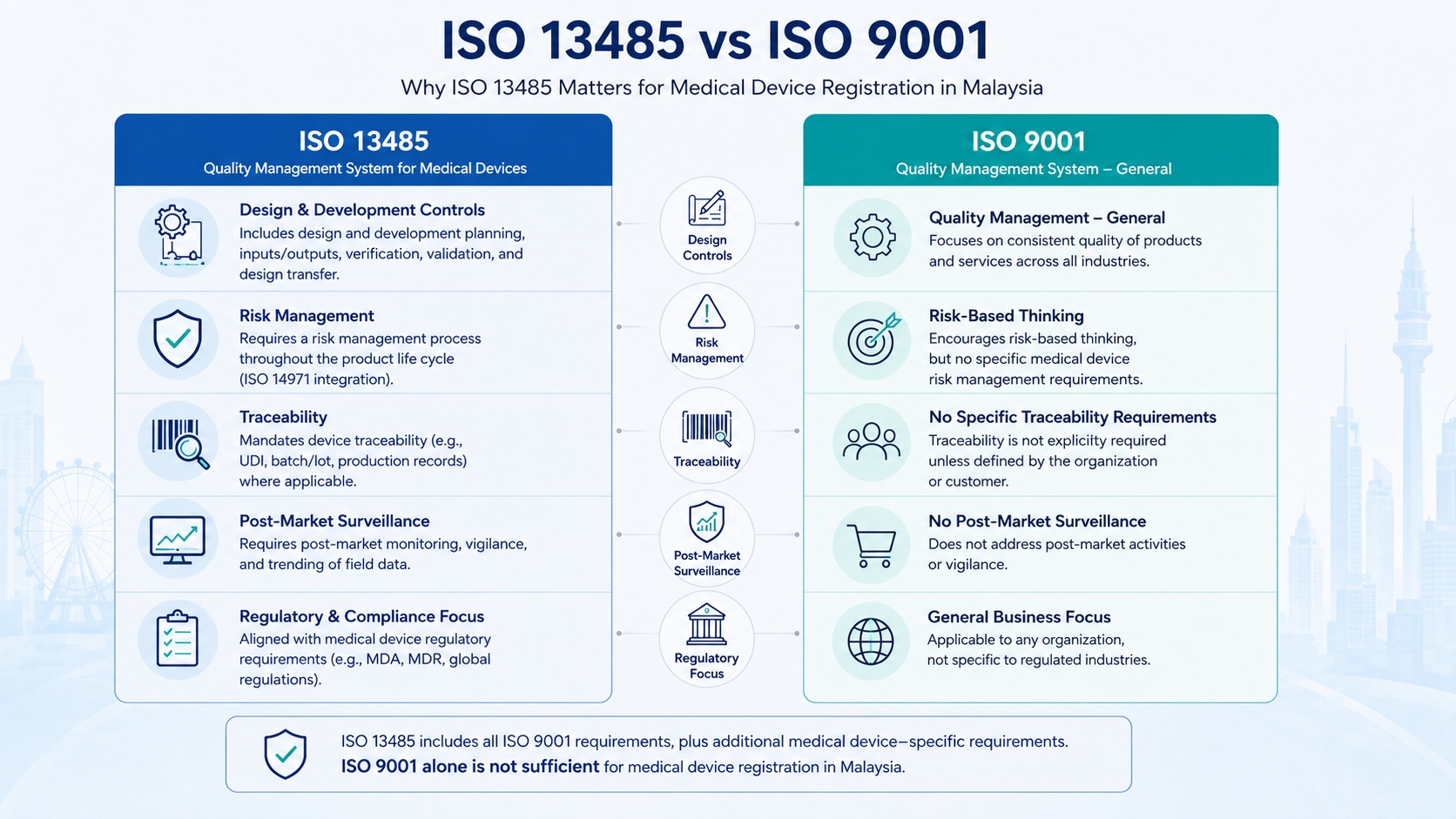 Why It Matters
Why ISO 13485 Matters for Malaysia Specifically
The MDA referred to ISO 13485 directly when implementing the Medical Device Act 2012, and it plays a functional role at several points in the Malaysian registration system — even though it is not always labelled as a strict legal mandate.
Every manufacturer, importer, and distributor operating in Malaysia must hold an Establishment Licence from the MDA. Obtaining this licence requires demonstrating a certified quality management system — and ISO 13485 is the standard the MDA recognises as primary evidence. Without it, securing the Establishment Licence becomes significantly harder.
For Class B, C, and D devices, a registered Conformity Assessment Body (CAB) reviews the manufacturer's QMS certification as part of the conformity assessment process before MDA submission. A valid ISO 13485 certificate is one of the documents the CAB checks for authenticity and validity.
ISO 13485 ensures manufacturers consistently design, produce, and deliver devices that are safe for their intended use. It mandates rigorous risk management throughout the product lifecycle — directly supporting the Essential Principles of Safety and Performance (EPSP) that every device must meet under Act 737.
Malaysia's QMS expectations are closely aligned with neighbouring markets. Singapore now requires SAC-accredited ISO 13485 certification (effective January 2025), and most ASEAN markets follow similar GHTF-aligned quality system principles. A single ISO 13485 certification supports multiple market entries across the region.
ISO 13485 and the Verification Pathway
While ISO 13485 is the primary standard the MDA recognises, it is not the only QMS certification accepted. Under the verification pathway, the MDA also accepts equivalent quality system certifications from other major regulatory frameworks.
| QMS Standard | Origin / Authority | MDA Acceptance |
|---|---|---|
| ISO 13485 | International (ISO) | Primary recognised standard |
| MDSAP | Medical Device Single Audit Program (multi-country) | Accepted under verification pathway |
| US FDA QSR / QMSR | United States Food and Drug Administration | Accepted under verification pathway |
| Japan MHLW Ordinance 169 | Japan Ministry of Health, Labour and Welfare | Accepted under verification pathway |
| ISO 9001 (general QMS) | International (ISO) — non-medical | Not accepted as a substitute |
This means manufacturers who already hold MDSAP certification, US FDA QSR compliance, or Japan MHLW Ordinance 169 certification do not necessarily need to obtain a separate ISO 13485 certificate from scratch — but ISO 13485 remains the most widely held and broadly recognised option, and the one most CABs are most familiar reviewing.
ScopeWhat Does an ISO 13485 QMS Actually Cover?
ISO 13485 governs the full product lifecycle, not just manufacturing. For a manufacturer preparing for MDA registration, the certified QMS should demonstrate control across each of the following areas.
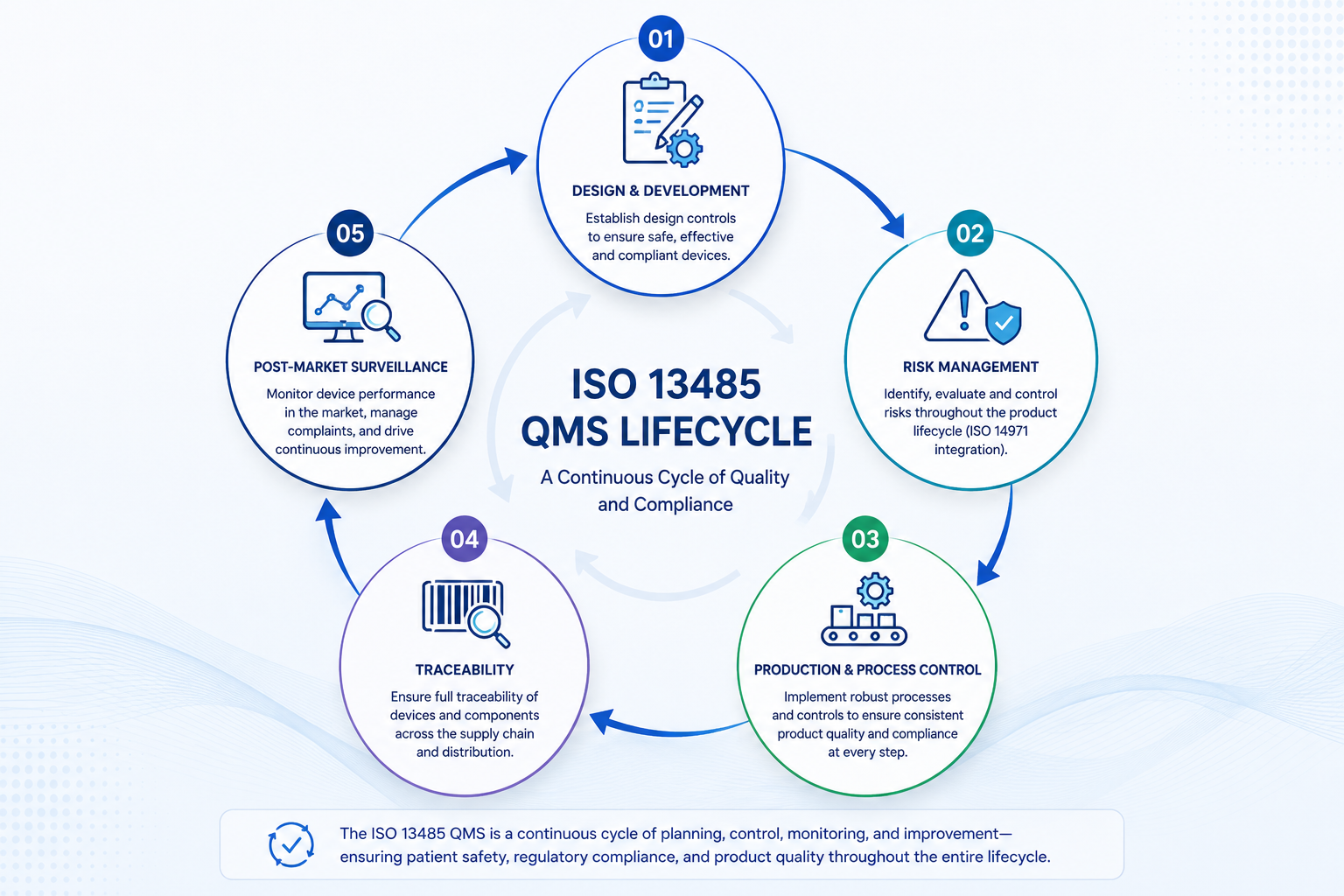
Documented design inputs, outputs, verification, and validation processes that demonstrate the device was developed under controlled, repeatable conditions.
Integration of risk management activities — typically aligned with ISO 14971 — throughout the device lifecycle, from design through to post-market monitoring.
Validated manufacturing processes, environmental controls, and documented procedures ensuring consistent product quality across every production run.
The ability to trace every raw material, component, and finished device through the supply chain — essential for effective recalls and vigilance reporting.
Documented processes for monitoring device performance after market entry, managing complaints, and reporting adverse events — directly supporting MDA post-market obligations.
What Happens Without ISO 13485 Certification?
Manufacturers sometimes ask whether they can defer ISO 13485 certification and register their device first. In practice, this rarely works out as planned.
Without certified QMS evidence, the Establishment Licence application — required before any registration can proceed — is likely to be queried or delayed by the MDA.
For Class B, C, and D devices, the CAB needs to verify QMS certification as part of its review. Without it, the conformity assessment — a mandatory step before MDA submission — cannot be completed.
Hospital procurement and distributor due diligence in Malaysia routinely ask for QMS certification. Lacking ISO 13485 can affect commercial relationships even where the MDA process technically proceeds.
Without ISO 13485, expansion into Singapore, the EU, Canada, or Australia is significantly harder, since most of these markets treat it as a near-mandatory requirement for market access.
How ISO 13485 Certification Works
ISO 13485 certification is obtained from an accredited certification body — not from the MDA directly. The MDA recognises certificates issued by notified bodies, regulatory authorities, or MDA-registered Conformity Assessment Bodies.
An initial assessment comparing your current quality processes against ISO 13485 requirements, identifying what needs to be built, documented, or improved before certification audit.
Building out the documented quality management system — procedures, work instructions, records, and controls — covering design, production, risk management, and post-market processes.
An accredited certification body conducts the audit, assessing whether the implemented QMS genuinely meets ISO 13485 requirements. Certification bodies operating in Malaysia include SIRIM QAS, SGS, TÜV SÜD, and Intertek, among others.
ISO 13485 certification is not a one-time event. Certification bodies conduct periodic surveillance audits to confirm the QMS remains compliant and effectively implemented over time.
The cost and timeline vary significantly depending on company size, device complexity, and current quality system maturity — ranging from a focused gap analysis through to full implementation support spanning several months. Working with a consultant experienced specifically in medical device quality systems — not a generic ISO consultant — is widely recommended, since a QMS that fails to support MDA registration defeats the purpose of certification.
How We Can HelpRegistration Support from TT Medical
While TT Medical does not issue ISO 13485 certification directly, we work closely with manufacturers to ensure their QMS documentation is correctly reflected and referenced throughout their MDA submission — and we coordinate with CABs to confirm certification is accepted without delay.
Final Thoughts
ISO 13485 may not be written into Act 737 as an explicit legal mandate by name, but in practice it is the foundation that makes Malaysian medical device registration possible. It underpins your Establishment Licence, supports your CAB conformity assessment, and demonstrates the kind of consistent quality and risk management the MDA expects from every manufacturer.
If you are planning to register a medical device in Malaysia and don't yet hold ISO 13485 certification, this should be one of the first items on your regulatory roadmap — not an afterthought addressed once your submission stalls. Speak to our consultancy team to understand how your current QMS status fits into your overall registration timeline.
FAQ