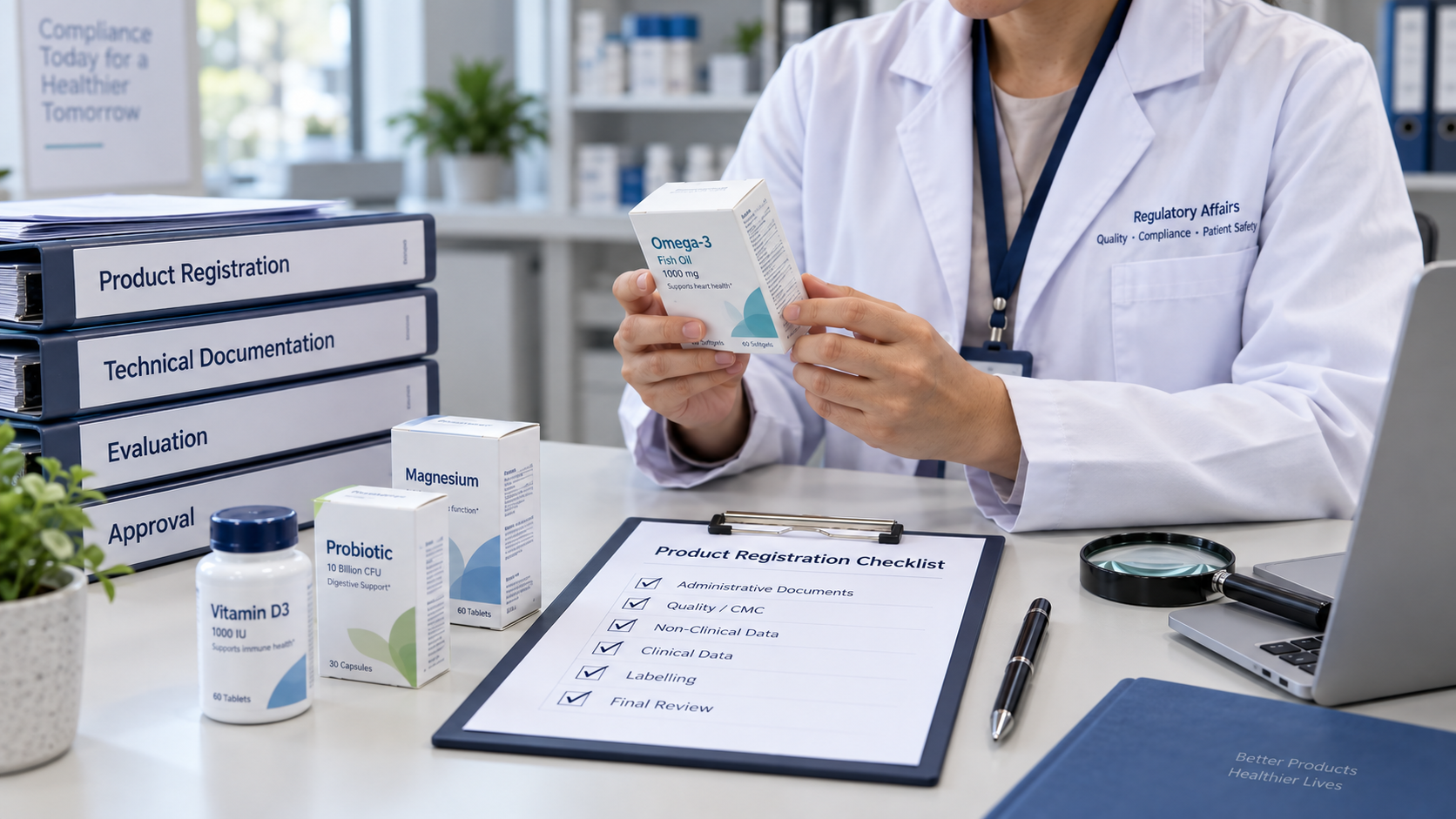
The NPRA (National Pharmaceutical Regulatory Agency) is Malaysia's regulator for pharmaceutical products, health supplements, traditional medicines and cosmetics. It operates separately from the MDA (Medical Device Authority) which covers devices. NPRA registration requires an incorporated Product Registration Holder (PRH), an ASEAN Common Technical Dossier (ACTD) submitted via QUEST3+, and a standard review period of approximately 210 working days for pharmaceuticals. Cosmetics follow a notification route rather than full registration, with a fee of RM 50 per product. In 2026, NPRA launched a recognition procedure pilot for FDA and EMA-approved drugs targeting 60 working days.
If you sell or plan to sell products in Malaysia that sit near the boundary between devices and other health product categories, you will at some point encounter the question: does this go to the MDA or the NPRA? The two agencies operate under the Ministry of Health umbrella but regulate entirely different product categories under entirely different legal frameworks.
Understanding how NPRA registration works matters for medical device manufacturers for several reasons. Some manufacturers have product lines that span both categories. Others encounter products in their distribution chain that are regulated by NPRA rather than the MDA. For anyone trying to understand the Malaysian regulatory landscape as a whole, the difference between the MDA and NPRA is foundational knowledge.
This guide explains what the NPRA regulates, what its registration process looks like across product categories, who can hold a registration, and what changed in 2026.
Key Takeaways
- The NPRA regulates pharmaceuticals, health supplements, traditional medicines and cosmetics. It does not regulate devices — those fall under the MDA and Act 737.
- Only a locally incorporated Malaysian entity can hold an NPRA product registration. Foreign companies must appoint a Product Registration Holder (PRH).
- Pharmaceutical products require full registration under the Drug Control Authority (DCA). The standard review timeline is approximately 210 working days.
- Cosmetics in Malaysia follow a notification system rather than full registration. Notification is done via QUEST3+ at RM 50 per product per variant.
- All NPRA submissions — pharmaceuticals, health supplements, traditional medicines and cosmetics — go through the QUEST3+ portal.
- In May 2026, NPRA launched a recognition procedure pilot for drugs already approved by the FDA or EMA, targeting a 60-working-day review timeline.
- If your product makes medical claims, it may be classified as a pharmaceutical rather than a supplement or cosmetic — classification determines the regulatory route and timeline.
What NPRA Regulates vs What MDA Regulates
The most common point of confusion for manufacturers entering the Malaysian market for the first time is which regulator covers their product. The division is by product category, not by the manufacturer's industry.
NPRA Product Categories and Registration Requirements
| Product Category | Registration Type | Key Requirement | Typical Timeline |
|---|---|---|---|
| New pharmaceutical (NCE) | Full registration, DCA | Complete ACTD dossier including clinical data, GMP certification (PIC/S standard), CPP from country of origin | ~245 working days |
| Generic pharmaceutical | Abridged registration, DCA | Bioequivalence data, quality dossier, GMP certification | ~210 working days |
| FDA / EMA approved drug (pilot) | Recognition procedure (pilot 2026) | Complete ACTD submission within 3 months of reference approval; up to 3 query rounds | ~60 working days |
| Health supplement | Registration, DCA | Safety and quality dossier; no therapeutic claims permitted on label | ~210 working days |
| Traditional medicine (herbal/natural) | Registration, DCA | Stability studies, safety profile, GMP certification for manufacturer | ~210 working days |
| Cosmetic product | Notification (not registration) | Cosmetic Notification Holder (CNH) required; Product Information File (PIF); submitted via QUEST3+ | Near-immediate on approval; RM 50 per product per variant |
NPRA Product Registration Fees
All NPRA application fees are set under the Control of Drugs and Cosmetics Regulations 1984 (CDCR 1984). Fees comprise a processing fee paid on submission and an analysis fee payable after screening. Fees are non-refundable once the application is submitted and payment is confirmed.
| Product Category | Processing Fee | Analysis Fee | Total |
|---|---|---|---|
| New Drug Product / Biologic, single active ingredient | RM 1,000 | RM 3,000 | RM 4,000 |
| New Drug Product / Biologic, two or more active ingredients | RM 1,000 | RM 4,000 | RM 5,000 |
| Generic (Scheduled Poison), single active ingredient | RM 1,000 | RM 1,200 | RM 2,200 |
| Generic (Scheduled Poison), two or more active ingredients | RM 1,000 | RM 2,000 | RM 3,000 |
| Health supplement | RM 1,000 | RM 500 – RM 1,200 (tiered by claim type) | RM 1,500 – RM 2,200 |
| Traditional medicine | RM 500 | RM 300 – RM 1,000 | RM 800 – RM 1,500 |
| Cosmetic notification | RM 50 per product per variant | Nil | RM 50 per product per variant |
The Product Registration Holder (PRH) Requirement
Like the MDA's requirement for a Local Authorised Representative, the NPRA requires all foreign manufacturers to appoint a locally incorporated Malaysian entity as the Product Registration Holder. The PRH is the legally responsible party for the product's registration and all post-market obligations in Malaysia.
The PRH must be a company incorporated in Malaysia under the Companies Commission of Malaysia (SSM). This is structurally similar to the MDA's LAR requirement — for a full explanation of how that parallel system works for medical devices, see our guide on whether foreign manufacturers can sell medical devices in Malaysia. The PRH must hold the relevant import, manufacture, or wholesale licence issued by the NPRA, and have a scope of business consistent with the product category being registered. Individuals cannot be a PRH. The foreign manufacturer cannot act as its own PRH.
The PRH submits the registration application via QUEST3+, holds the registration certificate, manages all NPRA communications, and is legally responsible for post-market surveillance, recall management, and adverse event reporting in Malaysia for the full duration of the product's market presence.
The PRH (NPRA) and the LAR (MDA) are parallel but separate roles under different regulatory frameworks. A company can hold both roles for different products, but the licences, obligations, and submission systems are entirely separate. A company holding an MDA Establishment Licence does not automatically qualify as an NPRA PRH.
The NPRA Pharmaceutical Registration Process
All pharmaceutical products must be registered with the Drug Control Authority (DCA) before they can be legally imported, distributed, or sold in Malaysia. The submission is made via NPRA's QUEST3+ portal by the PRH.
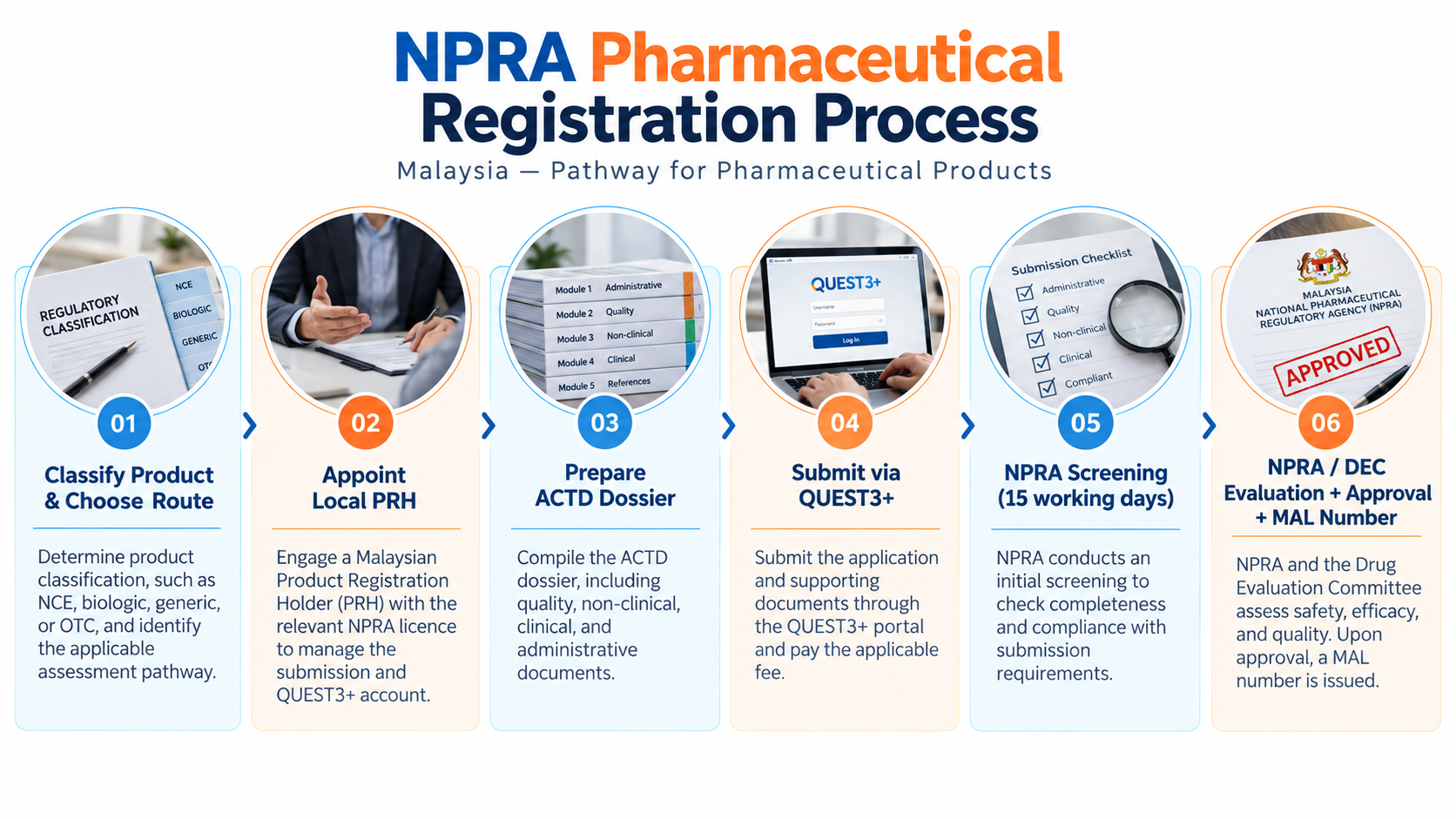
How to read this: The process runs left to right from product classification through to final approval. NPRA conducts an initial screening within 15 working days of submission — incomplete dossiers are returned at this stage without entering the evaluation queue. The DEC evaluation that follows targets approximately 210 working days for standard pharmaceutical applications. The 2026 recognition procedure pilot for FDA/EMA-approved drugs compresses the DEC evaluation stage to a target of 60 working days. The MAL number issued at approval must appear on the product label before commercial distribution begins in Malaysia.
Products are classified as new drug products (NCE), biologics, generics, or OTC medicines. The classification determines which assessment pathway applies: full review for NCEs, abridged review for generics, verification review for products already approved in reference markets, or the 2026 recognition procedure pilot for FDA/EMA-approved drugs. Misclassification is one of the most common causes of dossier rejection.
The PRH must hold the relevant NPRA licence before a submission can be made. Depending on the product and business model, this may be a Manufacturer's Licence, Import Licence, or Wholesale Licence. The PRH is registered in the QUEST3+ system and becomes the submission account holder.
The ASEAN Common Technical Dossier (ACTD) is the standard dossier format for pharmaceutical submissions across ASEAN. It comprises four parts: Quality (drug substance and product, manufacturing, GMP), Non-Clinical (safety and efficacy studies), Clinical (human trial data), and Administrative (application forms, CPP, labelling). Malaysia's Climate Zone IVb (hot and humid) means stability data must reflect local storage conditions — European or US climate data is frequently rejected.
The PRH submits the complete ACTD dossier via QUEST3+. NPRA conducts an initial screening within 15 working days to confirm the application is complete and formatted correctly. Incomplete applications are returned at this stage without entering the evaluation queue — thoroughness at submission is essential to avoid losing the queue position.
Accepted applications proceed to formal evaluation by NPRA's technical reviewers and the Drug Evaluation Committee (DEC). The DEC assesses safety, efficacy, and quality. NPRA may issue queries during evaluation — the PRH must respond within the specified timeframe. Delayed query responses pause the evaluation clock and extend the timeline.
Upon approval, the DCA issues a registration certificate and a Malaysian Approval Letter (MAL) number, which must appear on the product label. The registration is valid for five years and must be renewed before expiry. Post-market surveillance, adverse event reporting, and change notification obligations begin from the date of registration.
NPRA Recognition Procedure Pilot (May 2026)
In May 2026, NPRA launched a one-year pilot of a recognition procedure for pharmaceutical products already approved by the US FDA or European EMA. This is one of the most significant regulatory efficiency developments at NPRA in recent years.
Companies that have received approval for new drug products, biologics, or generics from the FDA or EMA can apply. Generic medicines approved in Europe via the decentralised procedure are also eligible. The complete ACTD submission dossier must be submitted to NPRA within three months of receiving the reference agency's approval.
NPRA aims to process recognition procedure applications within 60 working days from payment receipt following screening completion. The timeline excludes periods when the clock is paused awaiting the applicant's response to NPRA queries. Applicants have up to three rounds of correspondence with NPRA during the review.
For manufacturers with recent FDA or EMA approvals, the recognition procedure pilot represents a materially faster pathway to Malaysian market access than the standard 210-working-day review. The 3-month submission window is strict — missing it means reverting to the standard pathway. Proactive regulatory planning is essential to capture this benefit.
How Cosmetic Notification Works in Malaysia
Cosmetics in Malaysia do not require full registration. Since 2008, cosmetic products have followed a notification system administered by the NPRA under the ASEAN Cosmetic Directive (ACD). The notification must be completed before the product is manufactured, imported, or marketed in Malaysia.
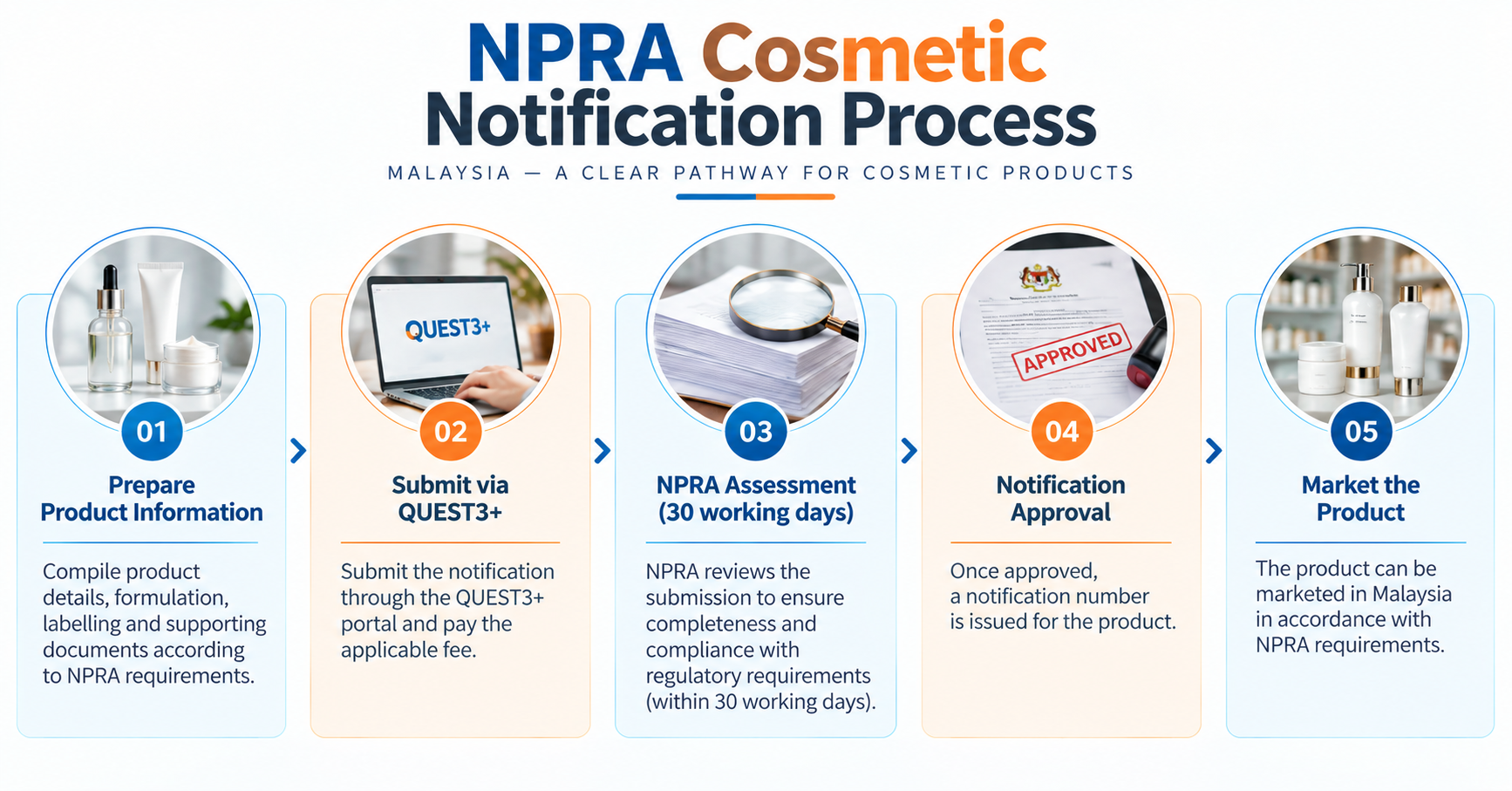
How to read this: Unlike pharmaceutical registration, the cosmetic notification process is significantly faster and less document-intensive. The most critical step is the first — confirming the product qualifies as a cosmetic under the ASEAN Cosmetic Directive. Any product making therapeutic, medicinal, or treatment claims cannot proceed through this route and must instead be registered as a pharmaceutical or traditional medicine with the DCA. Once the CNH submits via QUEST3+ and NPRA reviews the Product Information File, a Notification Note is issued. This note is the compliance document that must be kept on file — there is no product registration certificate for cosmetics in Malaysia.
The entity responsible for placing the cosmetic product on the Malaysian market must be a locally incorporated company registered with the SSM, with a scope of business related to health or cosmetic products. The CNH holds the QUEST3+ account and manages all notification submissions and post-market obligations.
The CNH prepares a Product Information File (PIF) covering ingredient safety, formulation, stability, and labelling compliance. The notification is submitted via QUEST3+ at RM 50 per product per variant. Upon NPRA review and approval, a Notification Note is generated, which is the document evidencing compliance.
Products making therapeutic, medicinal, or treatment claims cannot be notified as cosmetics. NPRA evaluates both formulation and claims. A product with anti-acne, anti-dandruff, or wound-healing claims may be reclassified as a pharmaceutical, triggering the full DCA registration process. Claims must be carefully reviewed before notification is submitted.
NPRA Post-Market Obligations After Registration
Registration approval is not the end of the regulatory journey. The PRH carries ongoing obligations for the full five-year validity of the registration — mirroring the post-market obligations that the MDA LAR carries for medical devices.
The PRH must report any serious adverse events associated with the registered product to the NPRA. Serious adverse events include unexpected drug reactions, product quality failures causing patient harm, and deaths or hospitalisations where the product is implicated. Reporting is submitted directly to NPRA — the PRH is the sole point of contact for all regulatory communications.
Any amendment to the particulars of a registered product — including changes to formulation, manufacturing site, labelling, or approved indications — must be submitted to the DCA as a formal variation application before the change is implemented. Implementing changes without prior DCA approval is a regulatory breach.
Product registrations are valid for five years. Re-registration applications must be submitted within six months before the expiry date. NPRA typically sends a reminder three months before expiry, but the responsibility to renew rests entirely with the PRH. Lapsed registrations cannot be reinstated — a new full registration application is required.
If the PRH decides to withdraw the product from the Malaysian market or is no longer authorised to hold the registration, the DCA must be formally notified. A registration once withdrawn cannot be reinstated. A new application is required if the product is to be re-registered at a later date.
Which Regulator Covers Your Product? 10 Common Cases
The line between NPRA and MDA jurisdiction is not always obvious, particularly for products that combine physical and pharmacological functions, make health claims, or are marketed differently across different markets. The following table covers the most commonly misclassified product types in Malaysia and which regulator applies.
| Product Type | Regulator | Reasoning |
|---|---|---|
| Blood glucose monitor (diagnostic) | MDA | Achieves intended purpose by physical/electrochemical measurement. Classified as an IVD medical device under Act 737. |
| Blood glucose test strips | MDA | In vitro diagnostic device — reagent-based strips that work alongside the monitor as part of the same device system. |
| TENS machine (pain relief) | MDA | Delivers electrical stimulation via physical means. Achieves its therapeutic effect mechanically, not pharmacologically. Active medical device. |
| Pulse oximeter | MDA | Measures blood oxygen saturation via optical sensors. Physical mode of action, diagnostic intended use. Medical device under Act 737. |
| Medicated wound dressing (with active drug) | Both (MDA leads) | Combination product. The device component (wound dressing) leads registration under MDA. The drug component requires NPRA input. Classification depends on primary mode of action. |
| Collagen supplement (oral capsule) | NPRA | Ingested health supplement. Achieves its purpose metabolically. Falls under DCA registration as a health supplement regardless of any structural support claims. |
| Collagen-containing wound dressing | MDA | Topical device applied externally. The collagen functions as a physical scaffold, not pharmacologically. Medical device under Act 737. |
| HIFU / medical laser (aesthetic) | MDA | Designated as a medical device under the Medical Device (Designated Medical Device) Order 2026, effective 1 June 2026. Previously unregulated aesthetic devices now fall under Act 737. |
| Herbal cream with therapeutic claims | NPRA | Topical product making therapeutic or medicinal claims (e.g. treats eczema, relieves joint pain). Cannot be notified as a cosmetic — classified as a traditional medicine or pharmaceutical under NPRA. |
| Digital health app (diagnostic decision support) | MDA (likely) | Software as a Medical Device (SaMD). If the app's primary purpose is diagnostic, monitoring, or therapeutic decision support, it is likely a medical device under Act 737. Wellness-only apps with no clinical claims may not require registration. |
NPRA Registration and TT Medical's Scope of Service
TT Medical's regulatory expertise and licensing covers medical device registration under the MDA and Act 737. NPRA registration for pharmaceuticals, health supplements, traditional medicines, and cosmetics falls under a separate regulatory framework and is not within TT Medical's direct service scope.
However, if you are unsure whether your product is classified as a medical device under Act 737 or a pharmaceutical/supplement under NPRA's framework, we can help you work through that classification question. The boundary between medical devices and other health product categories in Malaysia is not always immediately obvious, particularly for combination products, diagnostic kits, and wellness devices.
For products that are confirmed medical devices requiring MDA registration, read our guide on how to register a medical device in Malaysia or contact our team to discuss the registration process.
FAQ