In the context of medical device legislation in Malaysia, a Blood Glucose Monitoring System (BGMS) is a product that consists of components; thus, each of these components requires separate registration from the Medical Device Authority (MDA). Strips are Class C IVD (conformity assessment by CAB), the blood glucose meter is Class A IVD (direct submission to MDA), and the lancet is a medical device with a unique class.
As a manufacturer and distributor of blood glucose monitor systems (BGMS), you may already have noticed that getting registration of this type of product is more difficult than with some others at the Malaysia MDA. Why? Because a BGMS is actually a system of components, where every component is subject to its own classification rule according to the MDA IVD Classification Guidance (MDA/GD/0001). In other words, a product which appears to be one for a distributor, is, in fact, three or four separate devices each requiring their registration procedure, schedule, and documents.
Medical Device Act 2012 (Act 737) was implemented in its entirety in 2020 by the Malaysia MDA, and since then it has increased its scrutiny with regard to registration of IVD devices especially. BGMS products happen to be among those devices, which require more clarification from manufacturers due to their consistent lack of understanding of the component-by-component classification procedure. This paper reveals the exact rules of classification of every BGMS component according to Malaysian legislation, the registration pathway required for each component, the technical documents necessary for submission, and the common mistakes to avoid.
- A BGMS has multiple components; each requires its own MDA registration under Act 737.
- Test strips are Class C IVD they are intended for self-testing by lay users, which triggers the highest IVD risk class.
- The glucose meter/analyser is Class A IVD (Rule 5 instrument only, no intrinsic diagnostic function).
- Control solutions with an assigned value follow the strip's class (Class C); those without an assigned value are Class A.
- The lancing device is a general medical device, not an IVD, and is classified separately under Act 737 Schedule 1.
- Class C components require conformity assessment by an MDA-approved Conformity Assessment Body (CAB) before submission.
- The Instructions for Use (IFU) for self-testing BGMS devices must include a version in Bahasa Malaysia.
- A performance evaluation report (not a clinical evaluation report) is the core technical document for IVD registration.
What Counts as a BGMS Under Act 737?
Under the Medical Device Act 2012 (Act 737), a medical device is defined broadly as any instrument, apparatus, appliance, material, or other article whether used alone or in combination intended by the manufacturer for use in human beings for the purpose of, among other things, diagnosis, monitoring, or treatment of a disease or condition. A BGMS meets this definition multiple times over: each of its components independently meets the definition of a medical device and must therefore be registered in its own right.
This matters practically because manufacturers often ship BGMS components as a bundled kit meter, strips, control solution, lancing device, and lancets in a single retail box. Malaysian law does not recognise the kit as the unit of regulation. It looks at each component individually and asks: does this component meet the definition of a medical device? If yes, it needs its own registration. The table below summarises how each component is treated:
| Component | Device Type | MDA Class | CAB Required? |
|---|---|---|---|
| Test strips | IVD medical device | Class C | Yes |
| Glucose meter / analyser | IVD medical device | Class A | No |
| Control solution (no assigned value) | IVD medical device | Class A | No |
| Control solution (with assigned value) | IVD medical device | Class C | Yes |
| Lancing device (skin puncture device) | General medical device | Class A/B* | No (typically) |
*Class depends on specific features (e.g. sterile, measuring function). Most standard lancing devices are Class A or B general medical devices. Individual lancets supplied as standalone sterile products may also require their own separate registration.
How BGMS Components Are Classified
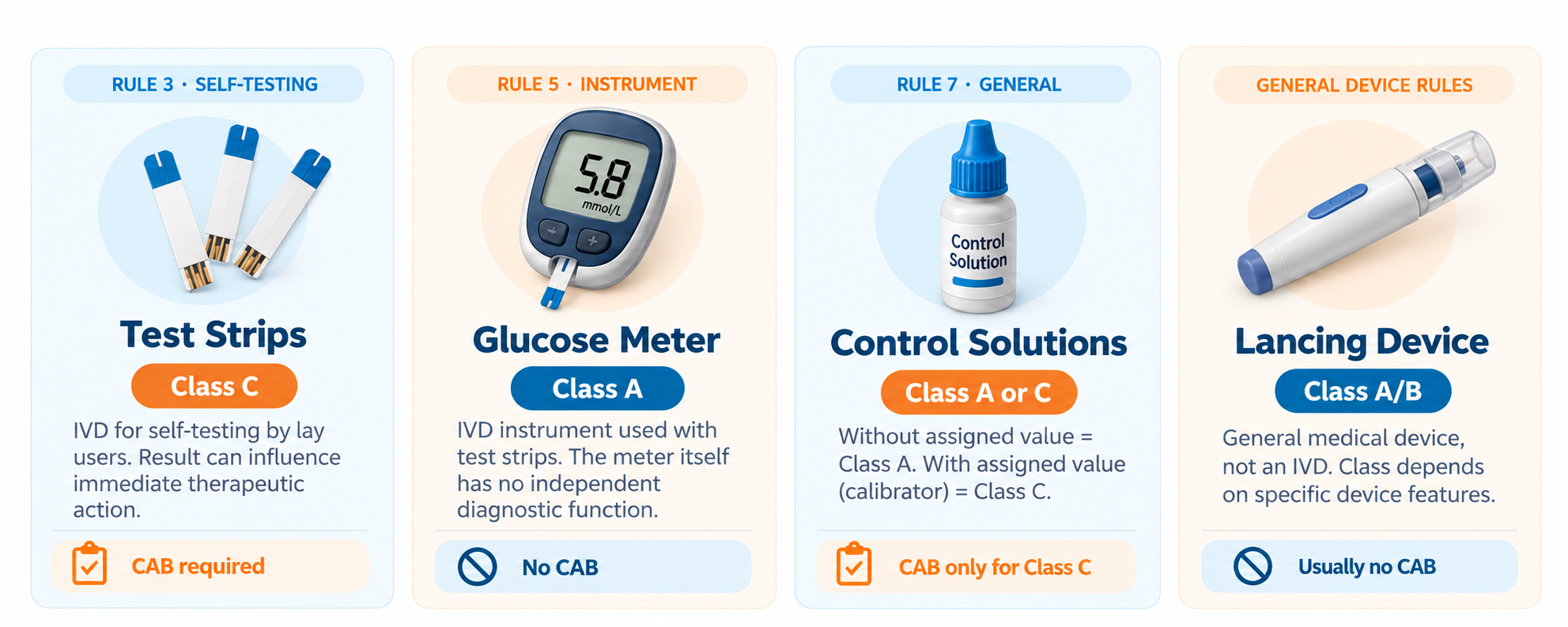
The IVD components are classified using the seven rules in MDA/GD/0001. Each rule targets a specific type of IVD based on its intended use, the population using it, and the consequences of an incorrect result. A manufacturer must work through the rules in order and apply the first rule that fits their device's intended use the rule that produces the highest class takes precedence if more than one applies. See our guide on IVD device classification in Malaysia for a full explanation of these rules. Here is how they apply to BGMS:
Strips are intended for self-testing by lay users to make immediate clinical decisions (insulin dosing). Rule 3 assigns Class C to IVDs intended for self-testing where the result influences an immediate therapeutic action. This is the critical classification driver for the BGMS system. The classification does not change simply because the strips are also used in clinical settings the self-testing intended use alone is sufficient to trigger Class C under Rule 3.
The glucose meter is an instrument it reads the electrochemical signal produced by the strip's enzymatic reaction and converts it into a displayed glucose value. The diagnostic function lies in the strip; the meter performs no independent diagnostic function of its own. Rule 5 places instruments used with IVD reagents in Class A unless they fall under a more specific rule, which they do not here. Despite the meter being the visible, branded part of the system, it carries the lower regulatory burden because it cannot generate a result without the strip.
Control solutions without an assigned value are classified Class A under Rule 7 (general rule for IVDs not covered by Rules 1–6) their function is to verify that the meter is operating, not to produce a result that drives a patient decision. Control solutions with an assigned value are calibrators they follow the strip's classification (Class C), because an incorrect calibrator value would cause the meter to report systematically wrong readings to a lay user making dosing decisions. Before classifying your control solution, confirm whether your product specification declares an assigned glucose value.
The lancing device performs a mechanical skin puncture to obtain a blood sample it does not analyse anything in vitro, so it does not meet the definition of an IVD under Act 737. It is classified as a general medical device under Act 737 Schedule 1. Most standard single-use lancing devices are Class A or B depending on whether the device is supplied sterile, whether it incorporates a measuring function, and whether it is intended for a single patient or shared use. Review your specific device design against Act 737 Schedule 1 criteria to confirm the applicable class.
How to Register a BGMS in Malaysia
The registration pathway depends on the component class. Class C IVD components (strips, assigned-value controls) go through a CAB before MDA submission. Class A components (meter, no-assigned-value controls) submit directly to MDA. The general device (lancing device) follows the general medical device registration route. Because the components are registered separately, you will be managing multiple concurrent submission tracks, each at its own stage.
-
Confirm Classification for Each Component
Prior to undertaking the submission process, classify each individual component by applying the classification criteria set out in the MDA/GD/0001 for each component independently based on its intended use and functionality. Don't take for granted the classification of one component, such as the class C classification of the test strips, when determining the classification of the rest of the components; the lancing device should be classified independent of the IVD classification process.
The purpose of this document is twofold; it acts as an outline for the rest of your preparation to register (what pathway and documents apply to what components) and is a document MDA or the CAB may request during technical review. If you are unsure about the class of a component especially where the control solution applies and the assigned value question is pivotal, consult a regulatory opinion before deciding on a pathway. Reclassification at the stage of submission will add a lot of time to your registration process.
-
Appoint a Local Authorised Representative (LAR)
A foreign manufacturer should appoint a Malaysian LAR before submitting its registration. The LAR is a legal entity listed as the authorised representative on the registration certificate of the MDA and has the liability regarding the compliance of the product in Malaysia. In the case where you have many components, one LAR can own all your registrations, but each registration is an individual document. Appointment of the LAR is done through a formal document of agreement between the two parties.
Read more on the details of what LAR means and how to appoint a LAR on our detailed guides.
-
Prepare Technical Documentation
Each component would need to have its own technical dossier. Among the basic documents include the following: performance evaluation report (for IVD component); Risk Management File (under ISO 14971); Quality Management System Certificate (under ISO 13485) including the manufacturing scope; Declaration of Conformity from the manufacturer; labeling and instructions for use (along with Bahasa Malaysia version for self-test strips); and Post-Market Surveillance Plan. Each of the documents above varies in detail according to the specific class of component; see the Documentation Requirement section below.
Having an entirely complete technical dossier before submitting any CAB and MDA process is the most critical determinant of no delays whatsoever. The CAB and MDA issue formal deficiency letters for the same reason, and each query round adds weeks or months to the entire process.
-
CAB Conformity Assessment (Class C Only)
Submit your Class C components (strips, assigned value controls) to a MDA-accredited CAB. CAB is an independent third-party organization authorized to conduct IVD technical dossiers assessment under Act 737, based on the applicable essential principles. After reviewing your technical file, the CAB will issue you a Conformity Assessment Certificate (CAC) after being convinced that the device meets all the criteria and standards. The entire process may take between 3-6 months, provided that your technical file is complete and well-organized, otherwise it may take longer than expected due to deficiency rounds. CAB certificate should be current at the time of MDA submission. Class A components do not require CAB process, they move to MDA directly.
-
Submit to MDA via MeDC@St
Submit all components through the MDA's online portal (MeDC@St). Each component is submitted as a separate application, even if submitted on the same day. Class A IVD and general device components submit directly without a CAB certificate. Class C components include the CAB Conformity Assessment Certificate in the submission package. Pay the applicable registration fees at this stage fees vary by device class and are set out in the Medical Device (Fees) Regulations.
MDA's official target review timeline is 180 days from the date of acceptance (not submission MDA first checks whether the application is administratively complete before accepting it into formal review). Keep records of submission dates and fee receipts, as these establish the start of MDA's review clock.
-
Respond to MDA Queries and Receive Certificates
MDA may raise technical queries during review. These are issued through MeDC@St and must be responded to within the timeframe specified typically 30 to 60 days. Failing to respond within the deadline can result in the application being placed on hold or rejected. Prepare your regulatory team or LAR to monitor MeDC@St actively throughout the review period.
Upon approval, each component receives its own MDA registration certificate with a unique registration number (MDA/XXXXXX/XXXX). Registration is valid for five years and must be renewed before expiry. Keep a calendar reminder well ahead of each component's expiry date particularly when managing multiple components with different approval dates as failing to renew on time requires a fresh registration application.
Documentation Requirements
The preparation of the complete technical dossier is the most labour-intensive procedure in the registration of BGMS, and the quality of your documentation will affect how easily the CAB evaluation and MDA assessment process will go. There is one particular difference between the documentation requirements for IVD devices and general medical devices while general devices need a clinical evaluation report, IVDs require a performance evaluation report. The performance evaluation report includes data on the analytical performance (accuracy, precision, linearity, interference) and the clinical performance (comparison to reference methods) of the device, and usability data for lay user self-testing devices. The list of the specific documents to be submitted depends on the class of component as shown in the table below.
| Document | Class A IVD | Class C IVD | Notes |
|---|---|---|---|
| Performance Evaluation Report | Required | RequiredReviewed by CAB | For IVDs, performance data (analytical and clinical) replaces the clinical evaluation report used for general devices. For BGMS strips, this must include analytical performance studies (precision, accuracy vs. reference method, linearity, interference from common substances such as haematocrit and common medications), clinical performance data from a multi-site accuracy study aligned with ISO 15197, and a lay user study demonstrating that untrained users can obtain accurate results by following the IFU alone. For the glucose meter (Class A), the performance evaluation is simpler and focuses on instrument accuracy relative to the strips it is designed to use. |
| ISO 13485 Certificate | Required | RequiredReviewed by CAB | Scope should cover the manufacturing of BGMS. The certificate must be issued by an accredited certification body and must explicitly cover the manufacturing scope of the component being registered a certificate scoped to "IVD instruments" does not automatically cover test strip manufacture. Certificates from internationally accredited bodies are generally accepted. Ensure the certificate is current at the time of submission and throughout the review period. |
| Declaration of Conformity (DoC) | Required | Required | Signed by the manufacturer (not the LAR) declaring compliance with the relevant Essential Principles under Act 737. Separate DoC for each component. The document must identify the device clearly (name, model, intended use), list the Essential Principles being declared, and identify the standards used to demonstrate conformity commonly ISO 15197, ISO 13485, ISO 14971, and IEC 62366. |
| Risk Management File | Required | RequiredReviewed by CAB | ISO 14971 risk management process and summary. The risk management exercise should address BGMS-specific hazards: inaccurate glucose readings due to interference, incorrect use or reagent degradation; dosing errors by lay users acting on incorrect results; inadequate IFU clarity for non-clinical users; and environmental factors affecting strip stability. The risk management report summary a condensed version presenting the overall risk-benefit conclusion is typically included in the DoC package. |
| Labelling and IFU | Required | RequiredReviewed by CAB | User IFU for self-testing strips should be in Bahasa Malaysia language this is a hard requirement, not a recommendation. English-only labelling for a self-testing strip is one of the most common deficiencies raised during MDA review. The BM IFU must be a full translation, written at a reading level appropriate for lay users. IFU for the meter in English is acceptable but the BM IFU will strengthen your application and reduce query risk. |
| Post-Market Surveillance Plan | Required | RequiredReviewed by CAB | Explanation of how you plan to acquire and manage post-market performance data in Malaysia. The plan must describe the mechanism for receiving and processing complaints and adverse event reports, frequency of periodic safety update reviews, threshold criteria for initiating a field safety corrective action, and reporting obligations to MDA under Act 737's vigilance provisions. Post-market surveillance plan for Class C BGMS is carefully reviewed at CAB stage a generic, one-page statement is unlikely to satisfy Class C requirements. |
Common Mistakes in BGMS Registration
The following mistakes are drawn from the types of deficiencies and delays that regularly arise when manufacturers encounter issues with their BGMS submissions. Understanding these patterns upfront can save months of back-and-forth with MDA and CABs.
-
Registration of BGMS as one product
Manufacturers often assume one registration number covers the kit. Under Act 737, the strip, meter, controls, and lancing device each require separate registration the MDA registers devices, not kits. Submitting them as a single device will delay or invalidate the application.
The practical consequence of getting this wrong is that a manufacturer may go through the full registration process for the meter and discover, months later, that the strips require a separate Class C registration with CAB conformity assessment adding another 9–18 months before the complete kit can be legally sold in Malaysia.
-
Classifying the meter as Class C
Because the strips are Class C, some assume the meter must be too. The meter is an instrument (Rule 5 Class A) its class is determined by its own function, not by the class of the strips it reads. Applying the wrong class triggers unnecessary CAB assessment for the meter, wasting time and cost.
Submitting the meter as Class C means engaging a CAB, compiling a Class C technical file, paying Class C registration fees, and waiting through the conformity assessment process all for a device that should have been a direct MDA submission. Correcting this error mid-process requires withdrawing and restarting the application.
-
Missing the Bahasa Malaysia IFU requirement
Self-testing devices intended for lay users must have an IFU in Bahasa Malaysia. Submitting English-only labelling for the test strips is a common deficiency that triggers MDA queries and delays. The MDA considers language accessibility part of the device's essential safety requirements, given that the patient population using BGMS at home includes Malay-speaking users who may not read English fluently.
The fix is straightforward commission a proper BM translation of the full IFU but discovering the gap during CAB assessment or MDA review adds weeks of translation and revision time, along with the administrative overhead of resubmitting corrected labelling documents.
-
Using a clinical evaluation report instead of a performance evaluation report
IVDs require performance evaluation data (analytical performance, clinical performance study, lay user study). A clinical evaluation report structured for general medical devices typically based on a literature review of clinical outcomes does not satisfy the IVD requirements and will be rejected by the CAB and MDA.
Building a proper performance evaluation report for a Class C IVD can take several months if the underlying studies need to be commissioned or consolidated from scattered data sources. Identifying this gap early before engaging a CAB is critical to keeping the overall timeline on track.
-
Starting CAB assessment without a complete technical file
Submitting an incomplete file to the CAB triggers rounds of deficiency letters that extend the assessment timeline by months. Some manufacturers submit a partial file to start the clock earlier in practice, this almost always backfires. Each round of queries typically adds 4–8 weeks to the timeline as the CAB allocates assessment capacity to reviewing responses.
The correct approach is to treat the CAB submission as a final, complete package: the performance evaluation report fully written, the risk management file comprehensive, the IFU in both English and Bahasa Malaysia, and the DoC properly signed and scoped. Front-loading the preparation work is consistently faster than repairing a submission in progress.
BGMS Registration Support
TT Medical Management provides end-to-end registration support for BGMS manufacturers entering the Malaysian market. BGMS registration is one of the more demanding exercises a manufacturer can undertake multiple components, multiple classes, a CAB conformity assessment step, and strict documentation requirements that differ in important ways from general medical device registrations. Our services include:
If you are planning your Malaysian market entry or have already encountered a registration issue, speak with our team to understand the realistic timeline and documentation requirements for your specific BGMS product range.
Discuss Your BGMS RegistrationFrequently Asked Questions
Does a BGMS need one registration or multiple registrations in Malaysia?
Multiple registrations. Under Act 737, each component of the BGMS system test strips, glucose meter, control solutions, and lancing device must be registered separately with the MDA. Each receives its own registration certificate and registration number. The MDA registers individual devices, not kits or systems, so a bundled retail pack containing an unregistered component is still non-compliant even if the other components in the pack are registered.
Selling any component without a valid MDA registration number is a criminal offence under the Act. Ensure all components are registered and their certificates current before placing any BGMS product on the Malaysian market.
Why are test strips Class C when the glucose meter is only Class A?
The classification difference comes from MDA/GD/0001 Rule 3. Test strips are intended for self-testing by lay users, and the result directly drives an immediate clinical action (insulin dose adjustment). This high individual risk places them in Class C. The glucose meter is merely an instrument that reads the strip's result it cannot produce a glucose reading independently. Rule 5 assigns instruments to Class A unless a more specific rule applies, which it does not here.
The practical effect is significant: despite the meter being the visible, branded part of the system, it avoids the CAB conformity assessment step entirely and can be submitted directly to MDA, saving considerable time and cost.
Do control solutions always require CAB assessment?
It depends on the type. Control solutions without an assigned value (sometimes called check solutions or function-check solutions) are Class A IVD under Rule 7 their function is simply to verify that the meter is producing a reading, not to provide a declared target concentration. These submit directly to MDA without CAB assessment.
Control solutions with an assigned value declare a specific target glucose concentration, making them calibrators. If their stated value is incorrect, the meter will report systematically wrong results to a patient making dosing decisions. For this reason they follow the strips' Class C classification and require CAB conformity assessment. Check your product specification carefully to confirm which category applies even a minor difference in the intended use statement can shift a control solution from Class A to Class C.
Is the lancing device registered as an IVD?
No. The lancing device is a general medical device, not an IVD, because it does not perform an in vitro test it makes a skin puncture to obtain the blood sample. The IVD classification rules in MDA/GD/0001 do not apply to it. It is classified under the general medical device classification rules in Act 737 Schedule 1, typically as Class A or B depending on its features (e.g. sterile, single-use, measuring function).
Sterile lancets (the individual needles) are a separate device from the lancing device mechanism and may require their own registration if supplied as standalone products. Confirm the correct class and registration requirement for each component in your specific product configuration.
How long does BGMS registration take in Malaysia?
For Class C components (strips), the CAB conformity assessment alone typically takes 3–6 months, followed by MDA review of approximately 6–12 months for a complete and well-prepared submission. Class A components (meter, Class A controls, lancing device) go directly to MDA and typically take 3–6 months. Because the components must be registered separately, registration of a full BGMS kit often spans 12–18 months from start to final approval. Incomplete technical files significantly extend these timelines.
Because different components move at different speeds through the process, you may receive MDA registration certificates at different times. Plan to stage your market entry accordingly each component must have its own valid certificate before it can be sold in Malaysia, regardless of the status of the other components in the kit.
Where can I find more information or get help with my BGMS registration?
For official guidance, visit the MDA website at mda.gov.my. The MDA website also publishes the list of approved CABs, fee schedules, and application forms accessible through MeDC@St.
For hands-on registration support including component classification review, CAB submission, and technical file preparation contact TT Medical Management. Our team manages BGMS registrations regularly and can advise on your specific product and timeline.