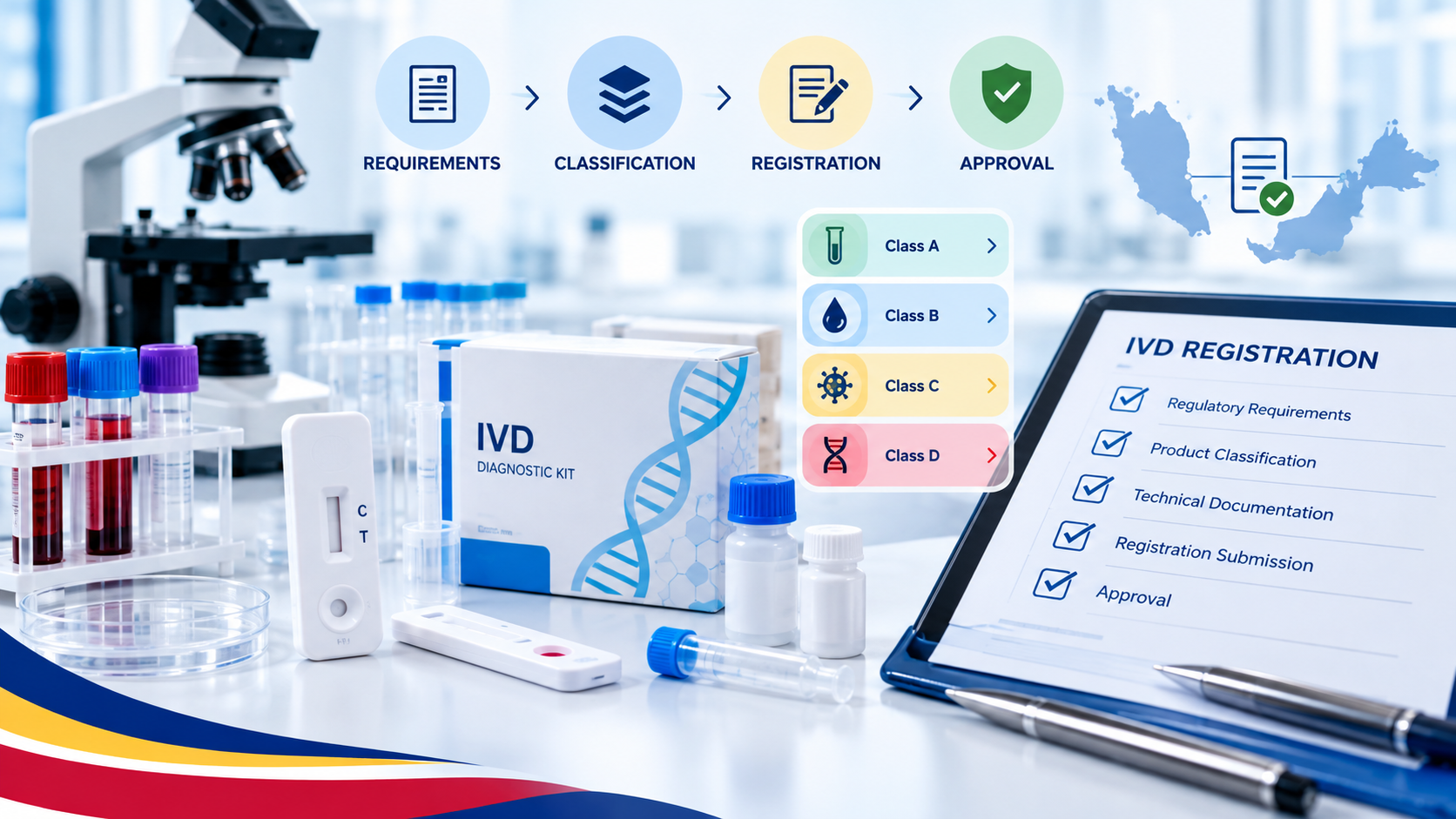
IVD (in vitro diagnostic) medical devices are regulated by the MDA under the Medical Device Act 2012 (Act 737) and must be registered before they can be imported or sold in Malaysia. IVDs use their own 4-class risk classification system based on two axes: individual risk and public health risk. Class A IVDs (low risk) can be submitted directly to the MDA without a CAB assessment. Class B, C, and D IVDs require conformity assessment by a registered CAB before MDA submission. The IVD CSDT differs from general device documentation in one significant way: it requires a performance evaluation report rather than a clinical evaluation report. A Local Authorised Representative (LAR) is required for all foreign manufacturers.
IVD devices exist in a unique regulatory category within the broader regulation of medical devices in Malaysia. The devices are categorized as medical devices and regulated under the Medical Device Act (Act 737) by MDA, but they follow their own categorization criteria, their own documentation requirements, and their own risk assessment process, which is not the same as general medical devices. An organization that assumes IVD registration to be the same as general device registration will surely face difficulties.
This guide deals with all aspects of IVD registration in Malaysia: what constitutes an IVD device under Act 737, how does 4-class IVD categorization work, what does it mean to classify under the 7 categorization criteria, what documents do you need, and how does the process flow from categorization to approved registration? For a more detailed discussion about the 4-class categorization criteria and examples, read our guide on IVD device classification in Malaysia.
Key Takeaways
- IVDs are medical devices regulated by the MDA under Act 737. The NPRA does not regulate IVD devices.
- IVD classification uses its own 4-class system (Class A to D) based on individual risk and public health risk, a dual-axis system different from general device classification.
- 7 classification rules determine which class an IVD falls into. The rules are defined in MDA/GD/0001 (Second Edition, December 2020).
- Class A IVDs can be submitted directly to the MDA without CAB assessment. All other classes require CAB conformity assessment first.
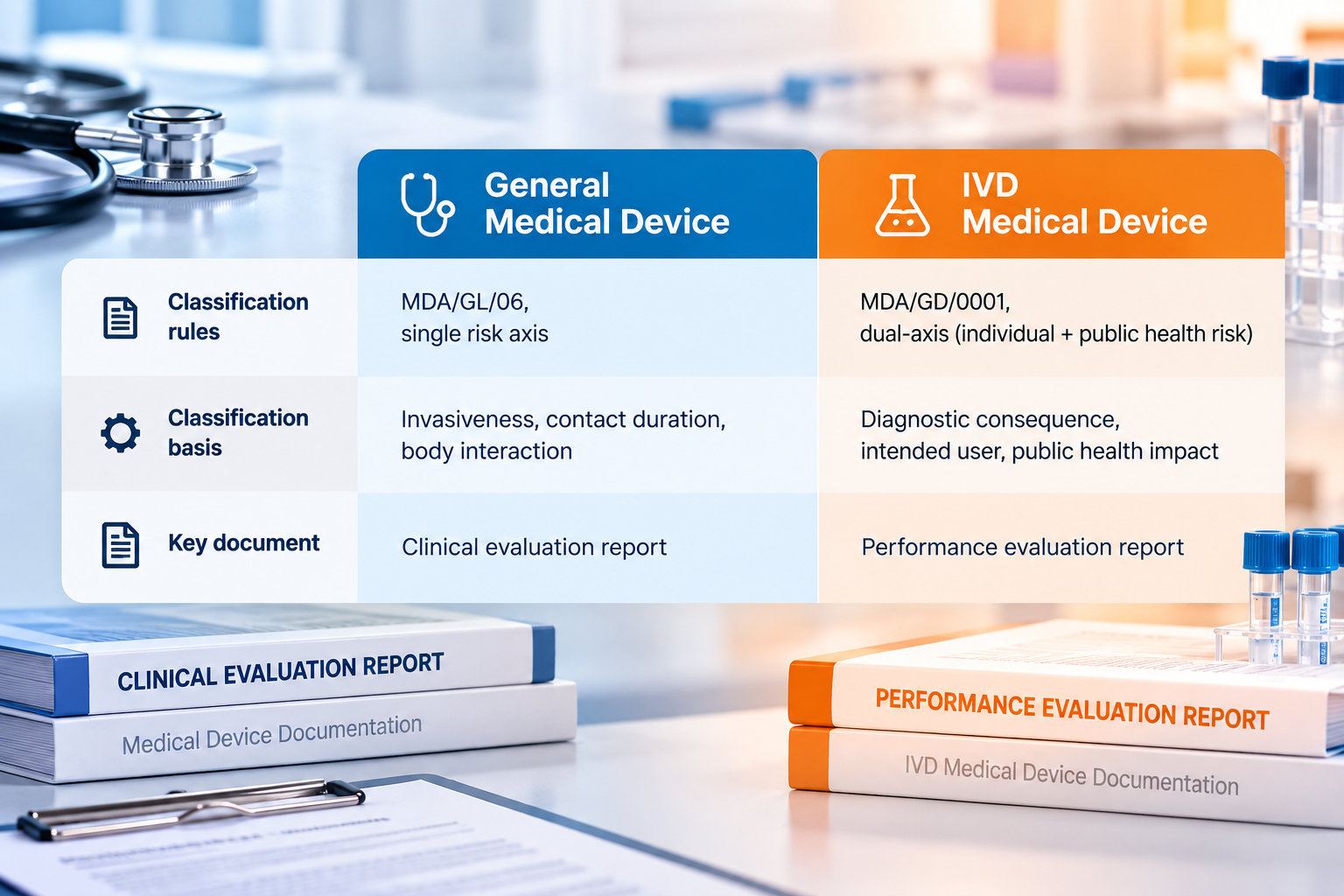
- IVD registration requires a performance evaluation report, not a clinical evaluation report. This is the single most important documentation difference from general device registration.
- IVD products can be grouped into Single, Family, System, Set, IVD Test Kit, or IVD Cluster categories, allowing multiple related products to be registered under one submission.
- Foreign manufacturers must appoint a Malaysian Licensed Local Authorised Representative before any IVD registration submission can be made.
What Is an IVD Medical Device Under Act 737?
Under Section 2 of Act 737, a medical device includes any in vitro reagent or calibrator intended by the manufacturer for the in vitro examination of specimens derived from the human body. This definition covers a wide range of products, from simple pregnancy test kits to complex laboratory analysers and HIV diagnostic assays.
IVD medical devices include reagents, reagent products, calibrators, controls, kits, instruments, apparatus, equipment, and software intended to be used for the in vitro examination of specimens derived from the human body, including blood, urine, tissue, and other biological samples. The information generated is used for diagnostic, monitoring, or compatibility purposes.
An accessory to an IVD, an item not itself an IVD but intended by the manufacturer to be used with an IVD to enable that device to be used as intended, is also regulated as an IVD under Act 737. IVD analysers (instruments used with IVD reagents) are classified separately from the assay they are used with, unless the instrument is Class A.
IVDs intended for self-testing, devices intended to be used by lay persons in a home setting rather than by healthcare professionals, carry specific regulatory considerations. The intended user (layperson vs healthcare professional) is a classification factor and affects which class the device falls into. Self-testing devices are generally classified at a higher risk level than equivalent professional-use devices.
IVDs are medical devices and are regulated by the MDA, not the NPRA. Reagents, calibrators, and diagnostic kits that work in vitro are within the MDA's scope regardless of their chemical or biological nature. This is a common point of confusion for manufacturers whose products span both diagnostic and pharmaceutical categories. For products that are genuinely borderline, see our guide on the difference between MDA and NPRA.
IVD Classification in Malaysia: The 4-Class System
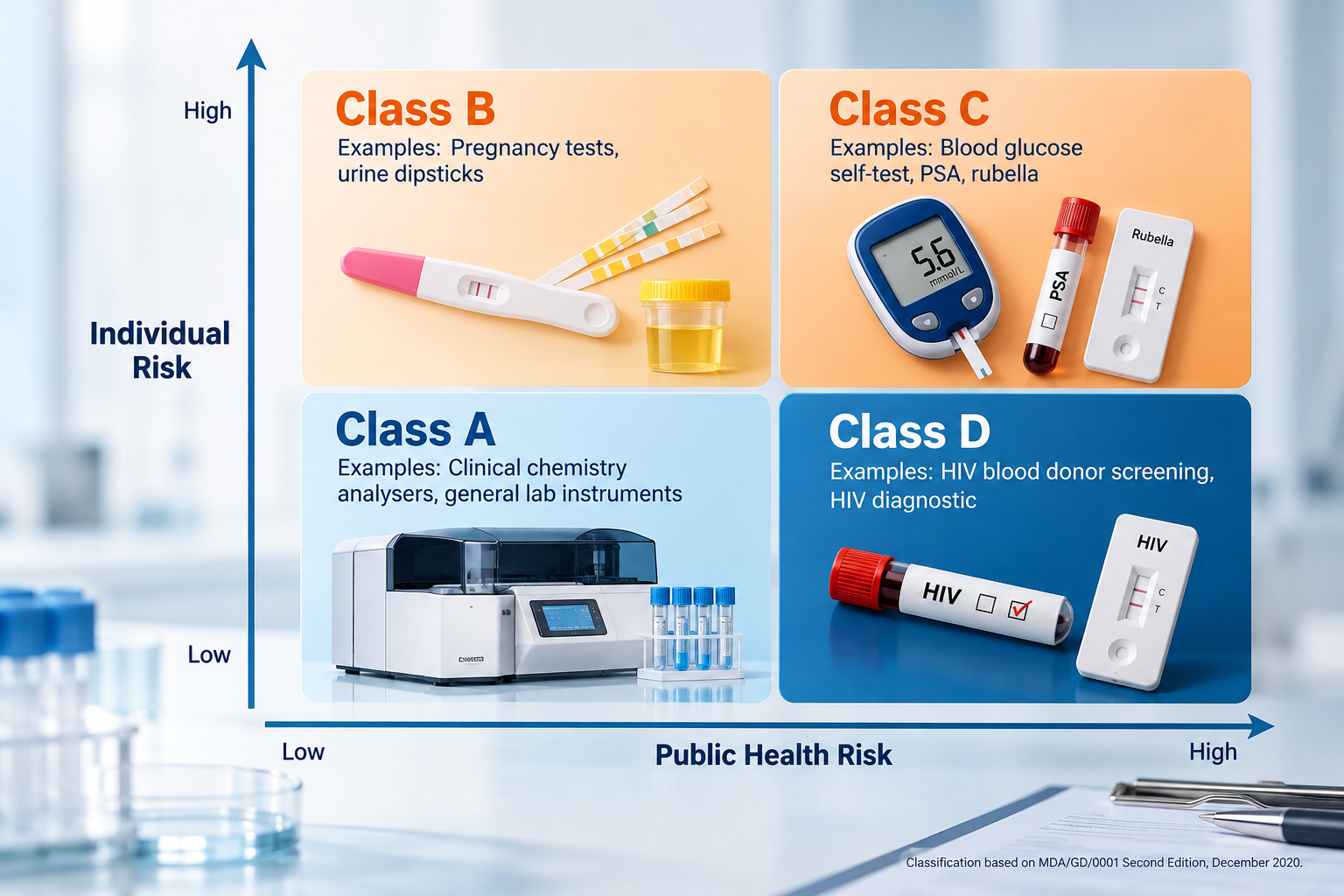
Malaysia's IVD classification system is governed by MDA/GD/0001 (Second Edition, December 2020). Unlike general medical device classification, which is based on a single risk axis, IVD classification uses two axes simultaneously: the risk to the individual patient, and the risk to public health. Both must be assessed to determine the correct class.
| Class | Risk Profile | CAB Required | Examples |
|---|---|---|---|
| Class A | Low personal risk, no public health risk | No, direct MDA submission | Clinical chemistry analysers, general laboratory instruments, specimen containers, staining solutions |
| Class B | Moderate individual risk, low public health risk | Yes | Pregnancy self-tests, urine dipsticks, Vitamin B12 testing, antinuclear antibody (ANA) tests |
| Class C | High individual risk, moderate public health risk | Yes | Blood glucose self-testing, HLA typing, PSA screening, rubella testing, hepatitis C antibody |
| Class D | High individual risk, high public health risk | Yes | HIV blood donor screening, HIV diagnostic tests, hepatitis B surface antigen (blood donor), HTLV |
How to Classify an IVD: The 7 Rules
IVD classification in Malaysia is determined by applying 7 rules defined in MDA/GD/0001. The rules are applied in order, and where more than one rule applies to a device, the higher class takes precedence.
Check what the IVD is meant to detect, who will use it, and whether a wrong result could affect an individual patient or the wider public.
Review Rules 1 to 7 one by one. Some products may appear to fit more than one rule, so the sequence matters.
If more than one rule can apply, the higher-risk class takes precedence. This helps avoid under-classifying the device.
Applies to IVDs used to detect transmissible agents in blood, blood components, cells, tissues, or organs, where a false positive or false negative could compromise the blood supply, organ recipient, or lead to a life-threatening outcome.
Applies to IVDs used in blood grouping (except ABO and Rh), tissue typing, or detecting infectious agents where an incorrect result could lead to patient-management decisions with life-threatening or serious consequences.
Applies to self-testing IVDs used by lay persons where a false result could lead to significant patient-management decisions and serious health consequences for the individual.
Applies to self-testing IVDs not covered by Rules 1, 2, or 3. It also covers IVDs for sexually transmitted agents where a false negative result would pose moderate individual risk but relatively low public health risk.
Applies to IVD instruments and equipment intended specifically for IVD procedures that are not otherwise covered by Rules 1 to 4.
Applies to IVDs that do not fall under Rules 1 to 5. It ensures every IVD still receives a classification even if it does not meet the higher-risk criteria above.
Applies to IVD controls without a quantitative or qualitative assigned value, used to verify whether a measurement system is operating within acceptable limits rather than to make a direct diagnostic decision.
IVD Product Grouping: What It Means and Why It Matters
Before submitting an IVD registration application, manufacturers must determine how their products are grouped. Grouping affects how many registration applications are needed and therefore directly impacts cost and timeline. MDA/GD/0054 (Second Edition, January 2021) governs IVD product grouping in Malaysia.
The right grouping structure can reduce the number of submissions, shorten preparation time, and prevent avoidable MDA query rounds. The six common grouping types below are the main structures used for IVD registration in Malaysia.
One product with one configuration.
Products sharing the same generic name, manufacturer, and intended purpose but differing in size, format, or concentration.
A combination of IVD components intended to be used together to achieve a specific intended purpose.
A group of components packaged together to perform a specific examination.
A kit where all components are necessary together to perform the test.
Multiple IVD products grouped under one registration where the products share common characteristics defined by MDA.
How to Register an IVD in Malaysia: Step by Step
Apply the 7 classification rules from MDA/GD/0001 to determine the device class. Where more than one rule applies, the higher class takes precedence. Separately determine the appropriate grouping under MDA/GD/0054. Both classification and grouping must be confirmed before documentation preparation begins, errors at this stage propagate through the entire submission.
Foreign manufacturers must appoint a Malaysian LAR who holds a valid MDA Establishment Licence and GDPMD certificate before any IVD registration submission can be made. The LAR holds the MeDC@St account and manages all MDA communications. All IVD registrations are held under the LAR's licence. For full post-approval obligations, see our guide on LAR post-approval responsibilities. See our guide on how to appoint a LAR in Malaysia for the full appointment process.
The Common Submission Dossier Template for IVDs (MDA/GD/0004) differs from the general device CSDT in one critical area: it requires a performance evaluation report rather than a clinical evaluation report. The performance evaluation covers analytical performance (precision, accuracy, sensitivity, specificity, reference intervals) and clinical performance (diagnostic sensitivity and specificity). All other CSDT sections, device description, risk management, labelling, QMS, follow the same structure as general devices.
Class B, C, and D IVDs must undergo conformity assessment by a registered Conformity Assessment Body before MDA submission. The CAB reviews the IVD CSDT and issues a conformity assessment certificate. Class A IVDs are exempt from CAB assessment and can be submitted directly to the MDA. The assessment route (full vs verification) applies to IVDs the same way it applies to general devices, verification is available where the device has prior FDA, CE, HSA, or equivalent approval.
The LAR submits the complete IVD registration application through MeDC@St 2.0+. The submission package includes the IVD CSDT, Declaration of Conformity, CAB certificate (for Class B, C, D), ISO 13485 certificate, IVD labelling and Instructions for Use, and the application form specifying device type as IVD, class, category (chemistry, microbiology, immunology, haematology, pathology, or clinical toxicology), and grouping.
The MDA reviews the IVD registration application. Query response timeframes and the MDA review process are the same as for general medical devices. On approval, the IVD is listed in the Malaysia Medical Device Register (MMDR) and a registration certificate is issued, valid for five years. IVD registrations are subject to the same post-market obligations as general medical devices, PMS, vigilance reporting, renewal, and change notifications.
IVD Documentation: How It Differs from General Device Registration
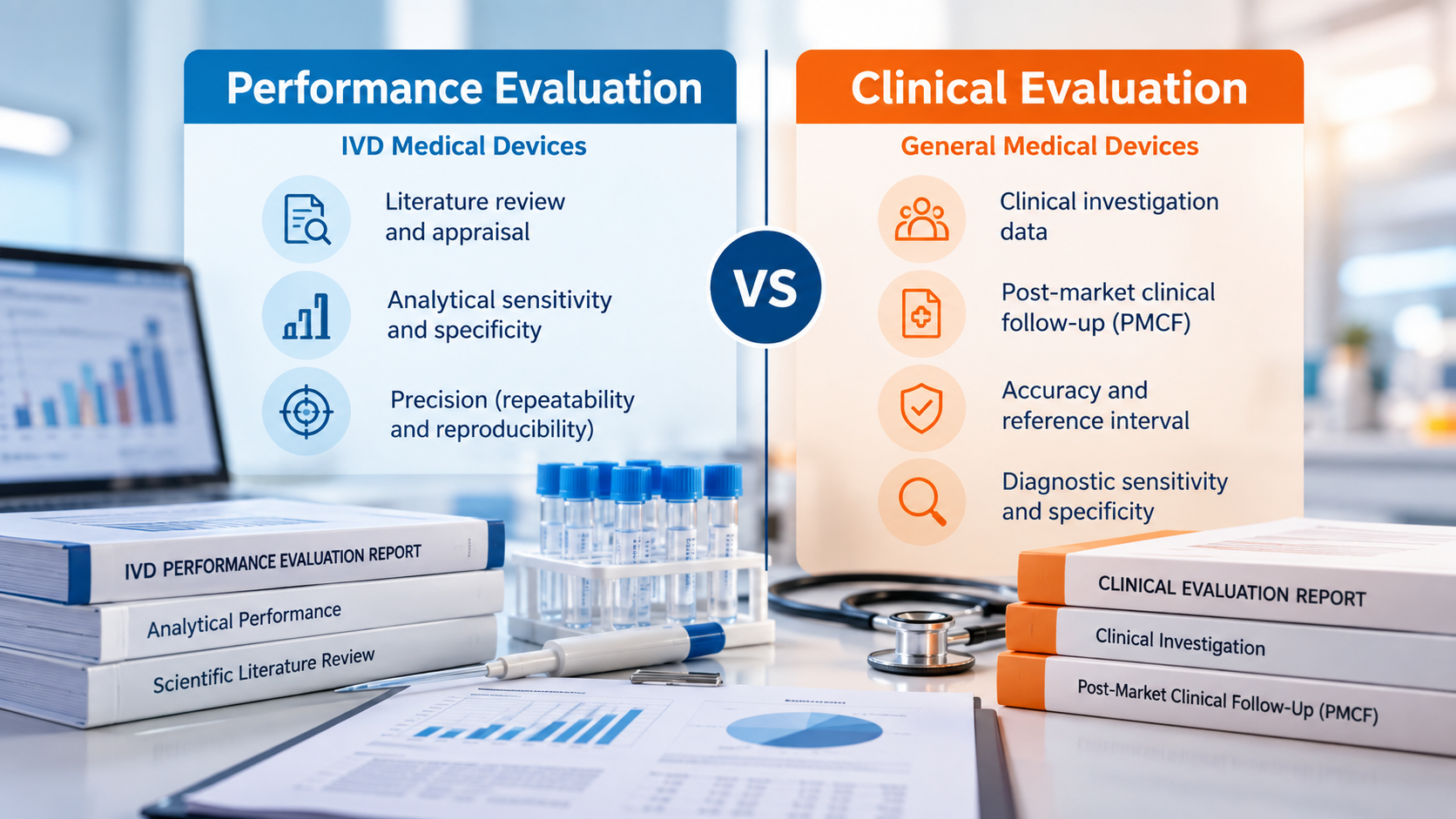
| Clinical evaluation | General devices require a clinical evaluation report. IVDs require a performance evaluation report instead, covering analytical and clinical performance data specific to the assay. |
| Performance evaluation | The IVD performance evaluation must cover: precision (repeatability and reproducibility), accuracy (trueness), analytical sensitivity, analytical specificity, linearity/measuring range, reference intervals, and for clinical performance: diagnostic sensitivity and diagnostic specificity. |
| Device category | The MeDC@St application form requires the IVD category to be specified: chemistry, microbiology, immunology, clinical toxicology, haematology, pathology, or other. This is unique to IVD applications and not required for general device submissions. |
| EPSP reference | IVDs reference the Essential Principles of Safety and Performance for IVD Medical Devices (MDA/GD/0002), not the general EPSP document used for other devices. The EPSP checklist must reference this IVD-specific guidance. |
| Labelling requirements | IVD labelling must comply with the Sixth Schedule of the Medical Device Regulations 2012 with IVD-specific requirements, including lot number, expiry date, storage conditions, and Instructions for Use that are tailored for in vitro use rather than patient contact. |
| CSDT guidance document | The IVD CSDT follows MDA/GD/0004 (First Edition, July 2013), not the general CSDT guidance used for other devices. Always reference the correct guidance document for IVD submissions. |
Common IVD Registration Mistakes in Malaysia
The most common IVD-specific documentation error. Clinical evaluation reports are for general medical devices. IVDs require a performance evaluation report covering analytical and clinical performance data. Submitting the wrong document type will result in an MDA query at best, and rejection at worst.
IVD classification uses 7 rules from MDA/GD/0001, not the general device classification rules from MDA/GL/06. A manufacturer who applies general device rules to an IVD will arrive at the wrong class. Blood glucose monitors are Class C IVDs, not Class B general devices. The classification logic is fundamentally different.
Family grouping requires the same generic name, same manufacturer, and same intended purpose. Variations in assay principle, target analyte, or intended use, even subtle ones, may disqualify products from family grouping. Submitted incorrectly, the MDA will query the grouping and require resubmission.
All IVDs, including Class A, must be registered with the MDA before they can be imported or sold in Malaysia. Class A is exempt from CAB assessment, not from registration. Class A IVD manufacturers sometimes believe that the lower risk class means no registration obligation. It does not.
The intended user, layperson or healthcare professional, is a classification factor. A blood glucose test marketed for home self-testing is classified differently from the same assay marketed exclusively for professional laboratory use. If the product's labelling or marketing allows home use, it must be classified as a self-testing device, which typically results in a higher class.
IVD Registration Support from TT Medical
TT Medical provides end-to-end IVD registration support as your Licensed Local Authorised Representative. We confirm IVD classification using the 7-rule system, determine the correct grouping under MDA/GD/0054, prepare the IVD CSDT including performance evaluation coordination, manage the CAB conformity assessment, and submit the registration application via MeDC@St 2.0+.