
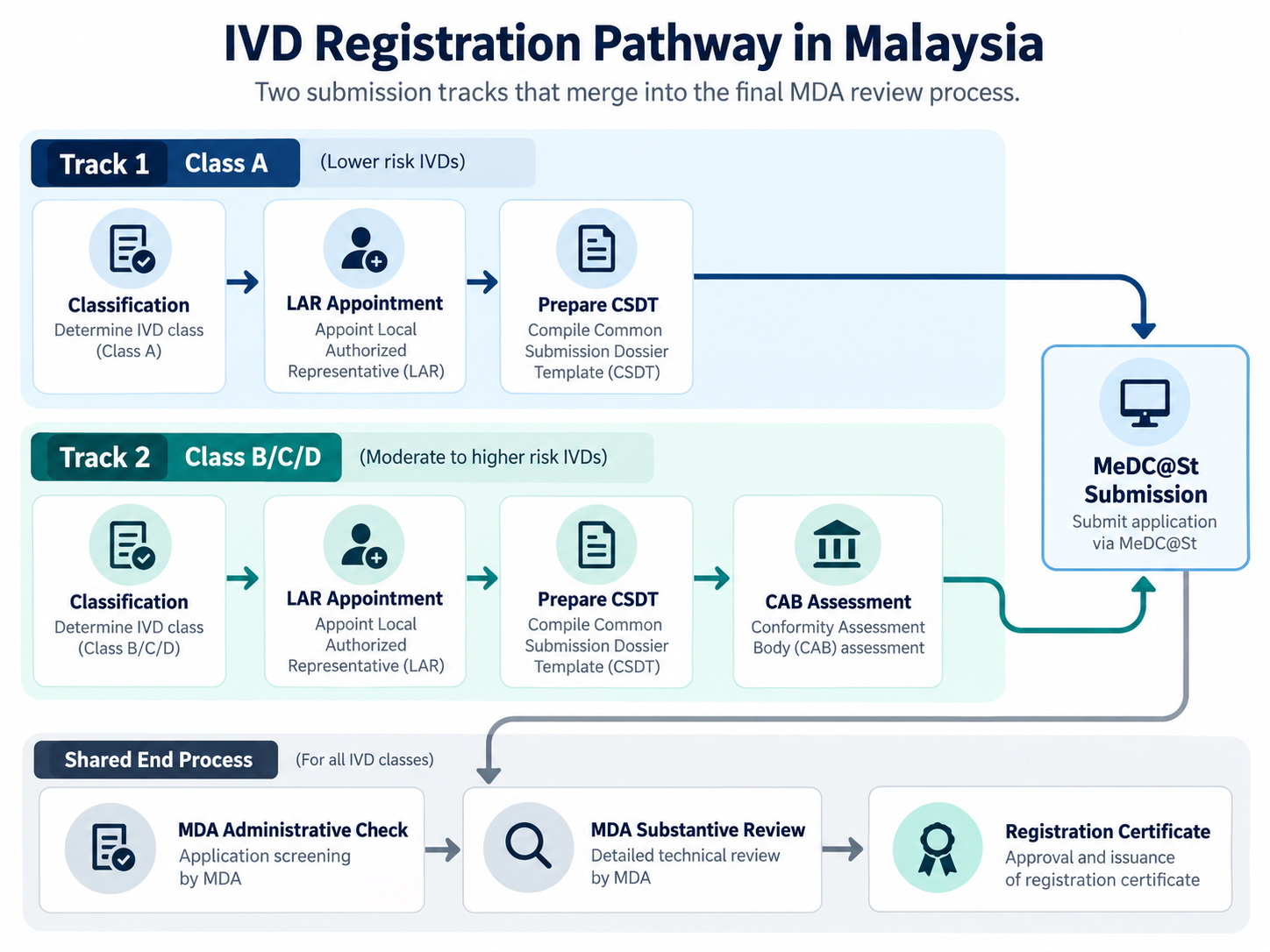
To register an IVD in Malaysia, the manufacturer or their appointed Local Authorised Representative (LAR) must classify the device, prepare a technical dossier (CSDT), complete CAB conformity assessment if Class B, C or D, then submit the application through the MeDC@St portal. The MDA target review timeline is 180 days from application acceptance.
Registering an in vitro diagnostic (IVD) device in Malaysia involves more steps than many manufacturers expect. Every submission must go through a licensed Local Authorised Representative (LAR) who holds an active MeDC@St account. Class B, C, and D IVDs must also pass CAB conformity assessment before MDA will formally accept the application, and the technical documentation required for IVDs differs from the standard medical device pathway in several important ways.
This guide walks through every stage of the IVD registration process in Malaysia in the order you will encounter them, from confirming your device's classification through to receiving your registration certificate. It is written for manufacturers preparing their first Malaysian IVD registration and for those who have encountered delays and want to understand where the process typically breaks down.
- IVD registration in Malaysia must be submitted by a licensed LAR via MeDC@St. Foreign manufacturers cannot submit directly to MDA.
- Class A IVDs submit directly to MDA. Class B, C, and D IVDs must complete CAB conformity assessment before MDA will accept the application.
- The core technical document for IVDs is a performance evaluation report. A clinical evaluation report used for general medical devices does not satisfy IVD requirements.
- MDA's 180-day review target starts from the date of application acceptance, not the date of submission. Administrative deficiencies at the completeness check stage delay this clock.
- All documents submitted through MeDC@St must be consistent in device name, intended use, and manufacturer details. Inconsistencies trigger deficiency notices before substantive review begins.
- Registration certificates are valid for five years. Renewal must be initiated before expiry. A lapsed certificate requires a full new application rather than a renewal.
Prior to Submitting: What Must Be Done First
There are a number of factors that need to be confirmed or done prior to preparing the first page of the MDA submission. The main mistake that causes delay in this process is trying to skip this step since the submission will not pass the administrative completeness check and will not be reviewed.
-
Establish Classification of IVD
Based on the seven IVD classification rules in MDA/GD/0001, classify your product as A, B, C or D. Classification determines the registration route, conformity assessment, and registration fee. When several rules apply to your device, then you must take the highest of all applicable rules into consideration. It is recommended to keep the record of your rationale behind the IVD classification, which MDA and CAB can ask you for during the review process.
Some of the key factors for IVD classification are self-testing by layperson (Rule 3, Class C), if the product is a companion diagnostic (Rule 4, Class D), if the product is general laboratory instrument (Rule 5, Class A), and if it includes reagents for blood grouping or tests dangerous life threatening infectious diseases (Rules 1 & 2, Class C/D).
-
Appoint a Licensed Local Authorised Representative (LAR)
A foreign manufacturer must appoint a Malaysian entity that holds a valid MDA Establishment Licence and a Good Distribution Practice for Medical Devices (GDPMD) certificate to act as LAR. The LAR holds the MeDC@St account, submits all applications on the manufacturer's behalf, and is legally responsible for the device's compliance in Malaysia. All registration certificates are issued in the LAR's name.
The appointment must be formalised through a written agreement before any submission is made. See our full guides on what a LAR is and how to appoint one for the complete process.
-
Prepare the IVD CSDT Technical Dossier
The Common Submission Dossier Template for IVDs (MDA/GD/0004) is the required format for the technical documentation submitted to MDA. It follows the same general structure as the standard CSDT but requires a performance evaluation report in place of a clinical evaluation report, and references the IVD-specific Essential Principles document (MDA/GD/0002) rather than the general EPSP.
The IVD CSDT must be substantially complete before submission. MDA will not accept a partial dossier into formal review. Preparing the dossier to a standard that will pass CAB and MDA scrutiny typically takes several months, particularly if performance evaluation studies need to be commissioned or consolidated from multiple sources.
-
Complete CAB Conformity Assessment (Class B, C, D Only)
Class B, C, and D IVDs must be assessed by an MDA-approved Conformity Assessment Body (CAB) before MDA will accept the registration application. The CAB reviews the IVD CSDT against the Essential Principles and issues a Conformity Assessment Certificate (CAC) on successful completion. Class A IVDs are exempt and submit directly to MDA.
The CAB assessment route available depends on whether the device holds a prior approval from a reference regulatory authority (FDA, CE, HSA, PMDA, TGA, or Thai FDA as of 2026). Full assessment involves a comprehensive review of all technical documentation. The verification route is available for devices with a recognised reference approval and is typically faster, but still requires a complete technical dossier. Full CAB assessment typically takes three to six months for a well-prepared submission; deficiency rounds can extend this significantly.
How to Submit an IVD Registration via MeDC@St
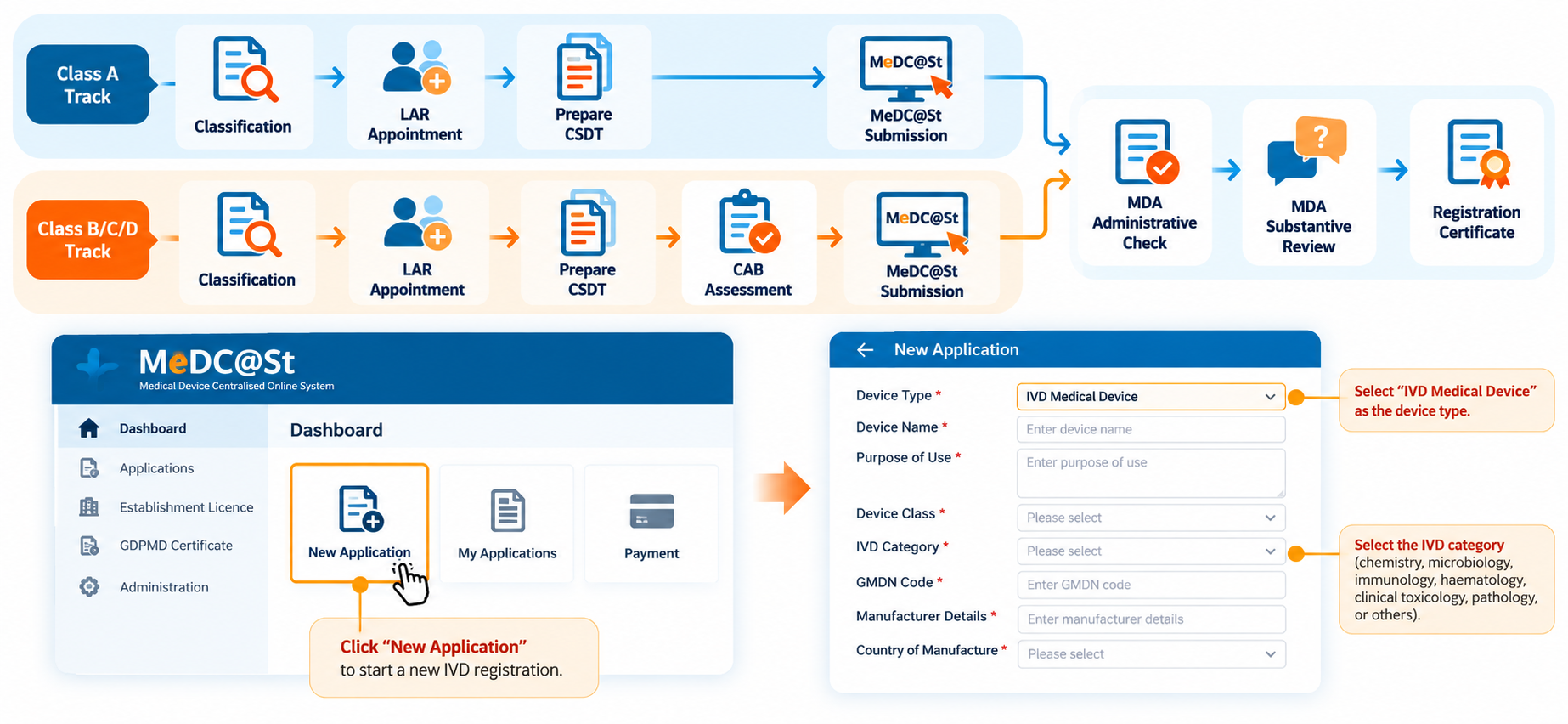
All IVD registration applications in Malaysia are submitted through MeDC@St, the MDA's online medical device registration portal. The LAR manages the account and is the only party who can initiate and manage submissions. The portal handles the full application lifecycle: submission, fee payment, query responses, and certificate download.
-
Login to MeDC@St as LAR
LAR logs into MeDC@St using the login credentials used during registration. Only those organizations having a valid MDA Establishment Licence and GDPMD certificate are eligible to have a MeDC@St account. In case the LAR does not have an up-to-date MDA Licence and GDPMD certificate, no new application would be possible. Ensure that these are valid before initiating any application.
-
Create a new IVD registration application
While creating a new IVD application, choose "IVD Medical Device" as the device type. This would populate the relevant fields for an IVD instead of the general medical device application. Enter the details of the device such as name of the device, purpose of use, device class, IVD category (chemistry, microbiology, immunology, haematology, clinical toxicology, pathology, or others), GMDN code, manufacturer details and country of manufacture.
Device name and purpose of use entered in MeDC@St should match that of the device label, IFU and technical dossier. Any discrepancies in these are often one of the major reasons for administrative clarifications required during acceptance check.
-
Upload the Required Documents
Upload the complete application package to MeDC@St. All documents must be in PDF format. File naming should be clear and consistent with the dossier index. The mandatory documents for each class are set out in the documentation table below. For Class B, C, and D IVDs, the CAB Conformity Assessment Certificate must be current and valid at the time of MDA submission.
-
Pay the Registration Fee
Registration fees are paid through MeDC@St at the time of submission. Fees are set under the Medical Device (Fees) Regulations and vary by device class. The table below sets out the current registration fees by class. Keep records of all fee receipts as they establish the date of submission and may be needed to resolve any administrative disputes about the start of MDA's review clock.
Device Class Registration Fee (RM) Notes Class A RM 500 Increased from previous rate effective 2026. Submits directly to MDA with no CAB fee. Class B RM 1,500 CAB conformity assessment fee is separate and charged by the CAB directly. Class C RM 3,000 CAB conformity assessment fee is separate and charged by the CAB directly. Class D RM 5,000 CAB conformity assessment fee is separate and charged by the CAB directly. -
MDA Administrative Completion Check
The MDA carries out administrative completion check before processing the application to substantiate review. Should there be any deficiencies in documents or inconsistencies and/or improper formatting of documentation, MDA will issue you with deficiency letter, and your application will be reviewed after the deficiencies are corrected. The 180-day review clock starts counting time only upon acceptance of the application by the MDA. Your application may stay pending at the administrative completion check stage for several weeks due to deficiencies raised, and that is why document consistency before submission is crucial.
-
Answer MDA Technical Queries
During substantive review, MDA may raise questions through MeDC@St. The LAR receives notifications of such queries via the portal and email. The responses must be given within the time frame specified in the queries, normally 30 to 60 days. Monitoring of MeDC@St regularly is essential during review period since failure to respond to queries may result in delay of review process and even rejection of the application.
Your answers to queries must cover all the issues. In case MDA requests for revisions of the labeling and additional performance data, make sure they remain consistent with the initial dossier.
-
Receive the Registration Certificate
On approval, the MDA issues a registration certificate for the device, which is downloadable from MeDC@St. The certificate lists the device name, registration number (MDA/XXXXXX/XXXX), the LAR, the manufacturer, and the registration expiry date. Registration is valid for five years from the date of issue. The device is simultaneously listed in the Malaysia Medical Device Register (MMDR), which is publicly searchable.
Set a calendar reminder to initiate renewal well before the expiry date. A registration that lapses requires a fresh full registration application rather than a renewal, which significantly increases both the timeline and cost of returning the device to the Malaysian market.
IVD Registration: Documentation Requirements by Class
The documentation requirements for IVD registration are largely consistent across classes, with the key difference being that Class B, C, and D submissions are reviewed by a CAB before MDA, and the depth of documentation expected increases with device class. The table below sets out the core documents required and their applicability by class.
| Document | Class A | Class B / C / D | Notes |
|---|---|---|---|
| IVD CSDT (MDA/GD/0004) | Required | Required | The complete technical dossier as per MDA/GD/0004. It is the main document of the application. In case of class B, C and D, it is submitted first to the CAB, while in class A it is submitted to the MDA. |
| Performance Evaluation Report | Required | Required | Replacement for the Clinical Evaluation Report as per general medical devices. Should contain the analytical performance (accuracy, precision, linearity, sensitivity, specificity, reference intervals) and the clinical performance (diagnostic sensitivity and specificity). In the case of self-testing IVD, a study with lay users should also be conducted. |
| ISO 13485 Certificate | Required | Required | It should be within the scope of the manufacture of the product to be registered. Internationally recognized certificates will be accepted. Ensure the validity period covers the whole evaluation period and specifies the scope of the product. |
| Declaration of Conformity | Required | Required | Manufacturer (and not LAR) must sign DoC stating conformity to the IVD essential principles (MDA/GD/0002). Must include the standards used to achieve conformity along with the name, model, and usage of the device. |
| Risk Management File (ISO 14971) | Required | Required | Risk management procedure and risk/benefit assessment as per ISO 14971. For IVDs, the hazards must consider the impact of erroneous diagnosis, misuse, and deterioration of reagents. The summary of the risk management report can be found within the DoC document. |
| Labelling and Instructions for Use | Required | Required | For self-testing IVDs intended for lay users, a Bahasa Malaysia version of the IFU is mandatory. English-only labelling for a self-testing device is one of the most common deficiency reasons raised during MDA review. |
| CAB Conformity Assessment Certificate | Not required | Required | Applicable to Class B, C, and D only. Must be current and valid at the time of MDA submission. Issued by an MDA-approved CAB following review of the IVD CSDT. |
| Reference Regulatory Approval (verification route only) | Not applicable | Where applicable | Devices that have FDA, CE, HSA, PMDA, TGA, or Thai FDA approvals may qualify under the verification route. The reference approval certificate and its associated approved labelling should also be submitted. HSA acceptance has been permanently validated as of 1 March 2026. |
Timeline for IVD Registration in Malaysia
The target time for MDA review is 180 days from acceptance, but the entire process takes considerably longer than that, beginning from preparation up to receiving the certificate. The processes that take the most time are the preparation of technical dossier and CAB conformity assessment, which depend on the quality of the dossier.
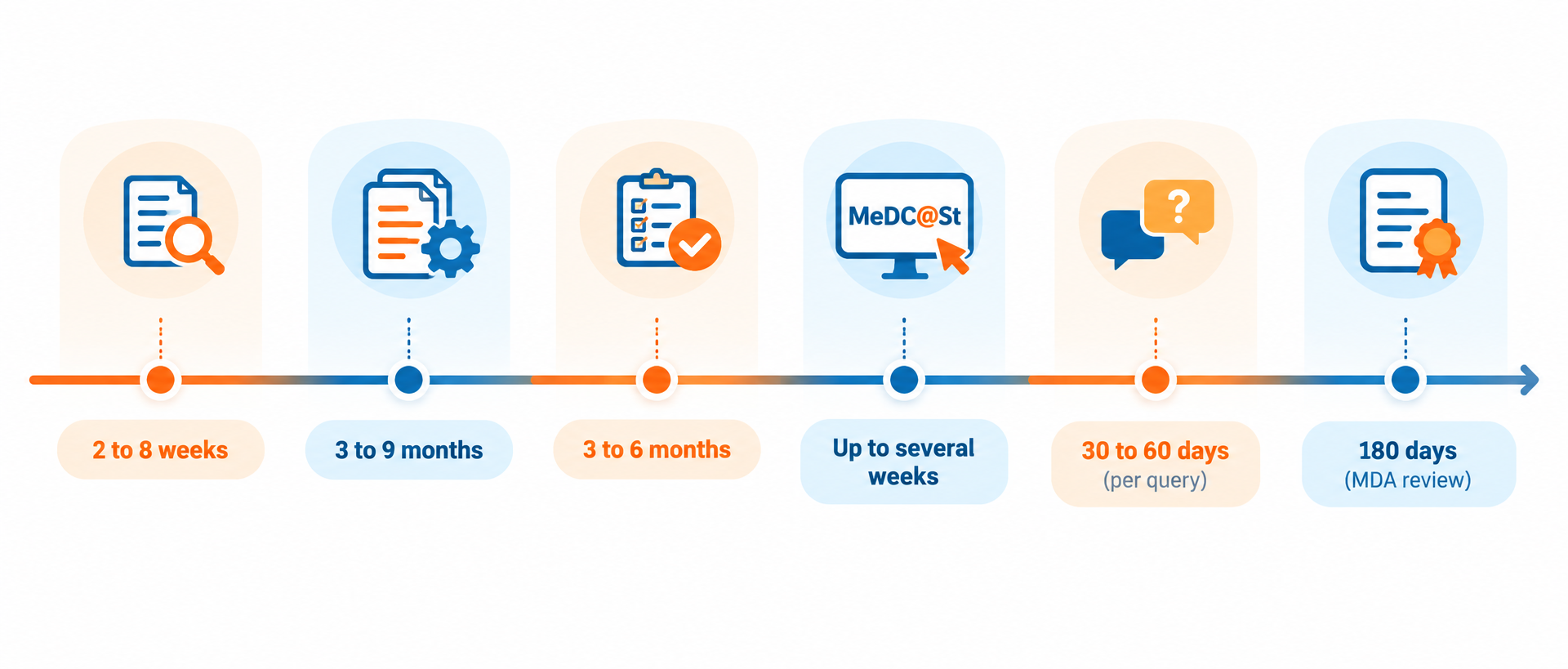
Determination of classification and arrangement of LAR appointment. The duration depends on how soon an appropriate LAR can be found and agreement reached.
Compilation of IVD CSDT, performance evaluation report, risk management file, and other documents. The performance studies that are required to be conducted or compiled take the most time.
Shorter for the verification route with a strong reference approval. Longer where deficiency rounds are triggered. Class A IVDs skip this stage entirely and submit directly to MDA.
The review clock starts from MDA acceptance, not the date of submission. Administrative deficiencies at the completeness check stage can delay the start of this clock by several weeks.
Valid for five years from date of issue. Device listed in the Malaysia Medical Device Register (MMDR). Renewal must be initiated before expiry.
Common Mistakes That Delay IVD Registration
-
Submitting a performance evaluation report that does not meet IVD standards
The most frequently flagged deficiency. A clinical evaluation report structured for a general medical device, based on literature review of clinical outcomes, does not satisfy IVD requirements. The performance evaluation must cover precision, accuracy, linearity, analytical sensitivity and specificity, and for clinical IVDs, diagnostic sensitivity and specificity from a properly conducted study.
For self-testing devices, a lay user study is additionally required to demonstrate that untrained users can achieve accurate results following the IFU without assistance. Identifying this gap before CAB submission rather than during it avoids significant delays.
-
Missing or inadequate Bahasa Malaysia IFU for self-testing devices
Self-testing IVDs require an IFU in Bahasa Malaysia. Submitting English-only labelling is a standard deficiency that triggers delays at both CAB and MDA stages. The BM IFU must be a complete translation at a reading level appropriate for lay users, not a summary or a partial adaptation.
-
ISO 13485 certificate scope does not match the device being registered
A certificate scoped to "IVD instruments" does not automatically cover test strip or reagent manufacture. MDA and CABs check that the scope explicitly covers the product type. Where the scope is ambiguous, contact the certification body for a scope confirmation letter before submission.
-
Inconsistencies between documents submitted in MeDC@St
Device name, intended use, manufacturer details, and model identifiers must be identical across the application form, DoC, labelling, and CSDT. Any inconsistency triggers an administrative deficiency and delays the start of the 180-day review clock. A pre-submission cross-check of all documents against a single reference list of device details eliminates most of these deficiencies before they are raised.
-
CAB certificate lapses between assessment and MDA submission
CAB certificates have a defined validity period. If the MDA submission is delayed after CAB assessment, for example while other components of a multi-device submission are being finalised, the CAB certificate may expire before MDA acceptance. Confirm the CAB certificate validity period and plan the MDA submission timeline to ensure the certificate remains current at the point of submission.
Variation Applications After Registration
Once a device is registered, any change to the approved information must be notified to MDA through a variation application filed via MeDC@St. Proceeding with a change without filing a variation is a compliance violation. Understanding which changes require a variation and which are administrative updates prevents manufacturers from inadvertently breaching the terms of their registration.
Changes that require a variation application include: amendments to the device name or brand, changes to the intended use or indications, adding or removing device models covered under the registration, changes to the manufacturer name or manufacturing site, changes to the labelling or IFU that affect safety information, and changes to the technical specifications or materials that affect performance or safety. Changes to the LAR require a separate LAR change application rather than a standard variation.
Variation applications are submitted and managed through MeDC@St in the same way as the original registration. The review timeline for a variation depends on the type and significance of the change. Major variations that affect safety or performance are reviewed substantively and may require updated technical documentation. Minor variations are typically processed more quickly.
Post-Registration Obligations for IVD Manufacturers
Receiving the registration certificate is not the end of the compliance journey. Manufacturers and their LARs carry ongoing obligations throughout the life of the registration. Failure to meet these obligations can result in suspension or cancellation of the registration.
-
ePermit for Every Import and Export Shipment
From 2 January 2026, an ePermit is mandatory for every import or export shipment of a registered medical device, including IVDs. The ePermit application is submitted through the MeDC@St portal by the LAR before each shipment. Operating without a valid ePermit for a shipment is a violation under the Medical Device Act 2012, regardless of whether the device itself holds a valid registration certificate.
-
Adverse Event Reporting
The LAR is responsible for reporting serious adverse events and field safety corrective actions (FSCAs) involving the registered IVD to MDA within the timeframes set under the Medical Device Regulations. Serious adverse events that result in death or serious deterioration of health must be reported within 30 days. Immediate threats to public health must be reported within two days. Adverse event reports are submitted through MeDC@St.
-
Post-Market Surveillance
Manufacturers are required to maintain an active post-market surveillance system for registered IVDs. This includes systematic collection and review of performance data from the field, complaint handling, and periodic safety update reports for higher-risk devices. Post-market surveillance records must be available for MDA inspection. For Class C and D IVDs, a post-market performance follow-up plan is expected as part of the ongoing technical file.
-
Registration Renewal
IVD registration certificates are valid for five years. A renewal application must be submitted through MeDC@St before the expiry date to maintain continuous market authorisation. MDA does not issue automatic reminders. If the certificate lapses, the device must go through a full new registration rather than a renewal, which resets the entire timeline and cost. Set calendar reminders at 12 months and six months before each expiry date.
IVD Registration Support
TT Medical Management provides end-to-end IVD registration support for manufacturers entering the Malaysian market. Whether you are classifying your device for the first time, preparing a performance evaluation report, managing CAB submission, or navigating MeDC@St, our team handles the process on your behalf.
Contact us to discuss your device, its classification, and the most efficient registration route for your situation.
Discuss Your IVD RegistrationFrequently Asked Questions
Can a foreign manufacturer submit an IVD registration directly to MDA in Malaysia?
No. All IVD registration applications must be submitted through a Malaysian Local Authorised Representative (LAR) who holds a valid MDA Establishment Licence and GDPMD certificate. The LAR manages the MeDC@St account, submits all applications, and is the registered point of contact for MDA. Foreign manufacturers cannot hold a MeDC@St account directly.
The LAR is also legally responsible for the device's post-market compliance in Malaysia, including adverse event reporting, recall management, and registration renewal. Appointing a LAR with relevant IVD experience and an active MeDC@St account is the first practical step in any Malaysian IVD registration project.
How long does IVD registration take in Malaysia?
MDA's official target review period is 180 days from the date of application acceptance (not submission). However, the total time from starting preparation to receiving the certificate is typically 12 to 18 months for a Class C IVD going through full CAB assessment. This includes three to nine months for dossier preparation, three to six months for CAB conformity assessment, and the MDA review period.
Class A IVDs, which skip the CAB stage, can achieve registration in six to nine months with a complete dossier. Devices eligible for the verification route (with prior FDA, CE, or HSA approval) generally fall in between, with shorter CAB assessment timelines.
What is the difference between the full assessment route and the verification route for IVDs?
Both routes require a complete IVD CSDT technical dossier. The difference lies in how the CAB evaluates it. Under the full assessment route, the CAB conducts a comprehensive review of all technical documentation. Under the verification route, the CAB confirms that the device holds a valid prior approval from a recognised reference regulatory authority (FDA 510(k) or PMA, CE marking, HSA approval, PMDA, TGA, or Thai FDA as of 2026) and that the Malaysian submission is consistent with the approved version.
The verification route is typically faster and less document-intensive, but still requires a substantially complete dossier. It is not available for all IVD classes or device types. Confirm with your intended CAB whether your device qualifies before building your submission timeline around this route.
Does every IVD need CAB conformity assessment in Malaysia?
No. Class A IVDs are exempt from CAB conformity assessment and can be submitted directly to MDA via MeDC@St. Class B, C, and D IVDs must undergo CAB assessment and obtain a Conformity Assessment Certificate before MDA will accept the registration application.
The class of a device is determined by applying the seven classification rules in MDA/GD/0001 to the device's specific intended use. Confirming the correct class before starting dossier preparation is important. An incorrect classification, such as treating a Class C device as Class A, will result in rejection at a late stage in the process and require a full re-submission through the correct pathway.
What happens if an MDA registration certificate expires?
An expired registration certificate means the device no longer has a valid MDA registration. Continued sale, supply, or import of the device after expiry is a compliance violation under the Medical Device Act 2012 (Act 737). The MDA does not provide a grace period for expired registrations.
Renewal applications must be submitted through MeDC@St before the expiry date. If the certificate lapses, a full new registration application is required rather than a renewal, which significantly increases both cost and lead time. Set calendar reminders at 12 months and six months before each certificate's expiry date to ensure renewal is initiated with sufficient lead time.
Does Malaysia accept CE marking or FDA approval for IVD registration?
Yes, but not as a substitute for registration. CE marking and FDA clearance/approval can support the verification route for CAB conformity assessment, which may reduce the depth of assessment and shorten the CAB timeline. From 1 March 2026, HSA Singapore approval was permanently recognised as a reference authority for this purpose, as were PMDA (Japan), TGA (Australia), and Thai FDA.
The device must still be registered with MDA via MeDC@St and receive a Malaysian registration certificate before it can be legally sold or imported into Malaysia. CE or FDA approval alone does not confer Malaysian market authorisation.