The wheelchair to be marketed in Malaysia falls under Class A medical device according to the MDA classification criteria established by the Medical Device Regulations 2012. Registration of a Class A medical device is mandatory according to Act 737 and should be done using the MeDC@St portal via a licensed Local Authorised Representative (LAR). CAB conformity assessment is not required for Class A devices, but the LAR should have a valid MDA Establishment Licence and GDPMD certificate prior to submitting any registration request.
Wheelchairs are one of the most frequently imported and distributed medical devices in Malaysia, but registration mistakes and misclassifications are always a common problem for manufacturers and distributors who enter the Malaysia market. A wheelchair is a non-active, non-implantable medical device according to the risk-based classification system in Malaysia, but the actual classification result will depend on the type of the wheelchair and its features. Classification of a manual folding wheelchair and a power-assisted scooter-type mobility aid is totally different, despite both serving the same user group.
It is also important to understand what "registered" means in the Malaysian context. A device that is registered with the MDA has been reviewed and listed in the Malaysian Medical Device Register (MMDR). This is not the same as simply holding a foreign approval. CE marking or FDA registration in the United States does not automatically satisfy Malaysian requirements. Each market has its own process, and a supplier's claim about certification should always be verified against the MDA register. Ascertaining the proper classification and registration of the wheelchair prior to its distribution in Malaysia is therefore the primary and most important step.
This article details the classification of wheelchairs in Malaysia under the medical device regulations, the registration requirements to comply with, the necessary documents to be submitted, and the labeling requirements to fulfill by manufacturers/LARs to ensure compliance and lawful supply of wheelchairs in Malaysia.
- Manual wheelchairs fall into Class A medical devices under the risk-based classification system of Malaysia. Powered wheelchairs equipped with an electronic/electrical drive system will be considered Class B medical devices.
- CAB conformity assessment is not required for Class A registration; instead, the LAR files a complete technical dossier at MDA through the MeDC@St portal.
- The technical dossier should follow the CSDT format (MDA/GD/0003) and contain a risk management file, clinical evaluation report, and Declaration of Conformity in line with the Essential Principles (MDA/GD/0002).
- The LAR's name and Malaysian address should appear on all labels and Instructions for Use of wheelchairs. Only English language labels are accepted for Class A devices; however, Bahasa Malaysia translation is highly recommended for IFUs.
- Only a licensed LAR holding an MDA Establishment Licence and GDPMD certificate can submit a registration application. Foreign manufacturers cannot apply directly to MDA.
- As of 2 January 2026, ePermit is mandatory for all imports of registered medical devices, including wheelchairs, into Malaysia.
How Wheelchairs Are Classified in Malaysia
The device classification scheme in Malaysia relies on the risk-based approach outlined in the Medical Devices Regulations 2012, which categorizes devices into four classes (A, B, C and D) based on the risk presented to the patient or user. The risk-based classification of the device can be made based on its intended purpose, mode of operation, as well as the active/inactive and invasive/implanted nature of the device.
Class A: Standard Manual Wheelchair
The standard manual wheelchair is defined as the wheelchair propelled by the efforts of the user or caregiver (by pushing the chair). Such device is classified as an inactive, non-invasive and non-implanted device. Moreover, such device does not deliver any energy to the patient; it neither interacts with biological tissues nor is used to deliver any substance to the body. According to the Malaysian classification criteria, the device that presents minimal risk is to be classified as Class A device.
Class A is the least risky category. It does not require conformity assessment by a Conformity Assessment Body (CAB) before submission. The LAR submits the technical dossier directly to MDA through MeDC@St for review.
Class B: Powered and Electrically Driven Wheelchairs
A powered wheelchair comprises an active element which supplies energy to the user and is used to drive the movement. This leads to reclassification of the device. Non-invasive but actively interacting with the user's body, non-implantable active therapeutic or mobility devices are categorised as Class B in Malaysia.
When a Wheelchair Might Be Classified Higher
Wheelchairs that have additional therapeutic purposes can get a higher classification. If the wheelchair uses an active pressure injury prevention system via active alternating pressure therapy, has an active built-in monitoring component, or has an active component supplying a therapeutic agent, it may result in a higher classification due to the primary purpose of the device and the classification criteria applied. In cases where several classification criteria apply to one device, the highest of them is used for classification. Document and verify the classification rationale for any multi-function wheelchair before preparing the technical dossier.
Regulatory Framework Applicable to Wheelchair Registration in Malaysia
There are several acts and documents that regulate the registration process of wheelchairs in Malaysia. These are listed in the table below along with the relevant aspects of these documents.
| Instrument | Description | Relevant Aspect |
|---|---|---|
| Act 737 (Medical Device Act 2012) | Main Act governing the regulation of medical devices in Malaysia | Mandatory registration of all medical devices prior to supply/import into Malaysia; wheelchairs fall under medical devices of Act 737. |
| Medical Device Regulations 2012 | Rules for classification, registration, fees and enforcement of the Act 737 | Contains the classification rules for deciding upon the class of a wheelchair (Class A or Class B). |
| MDA/GD/0002 (Essential Principles) | Safety/performance requirements that all medical devices should meet prior to registration | Declaration of Conformity in the technical dossier needs to refer to compliance to MDA/GD/0002. |
| MDA/GD/0003 (CSDT for General Medical Devices) | Format and contents of Common Submission Dossier Template | Prescribes the format of the technical dossier submitted by the LAR for the registration of wheelchairs. |
| ISO 13485:2016 | An international standard for quality management system of manufacturers | Declaration of Conformity and ISO 13485 is usually included in the technical dossier. |
Wheelchair Registration Requirements in Malaysia
All wheelchairs which are manufactured or imported into Malaysia have to be registered with the MDA prior to being marketed. It is the job of the Local Authorised Representative (LAR) to handle the registration, as he serves as the bridge between the foreign manufacturer and the MDA.
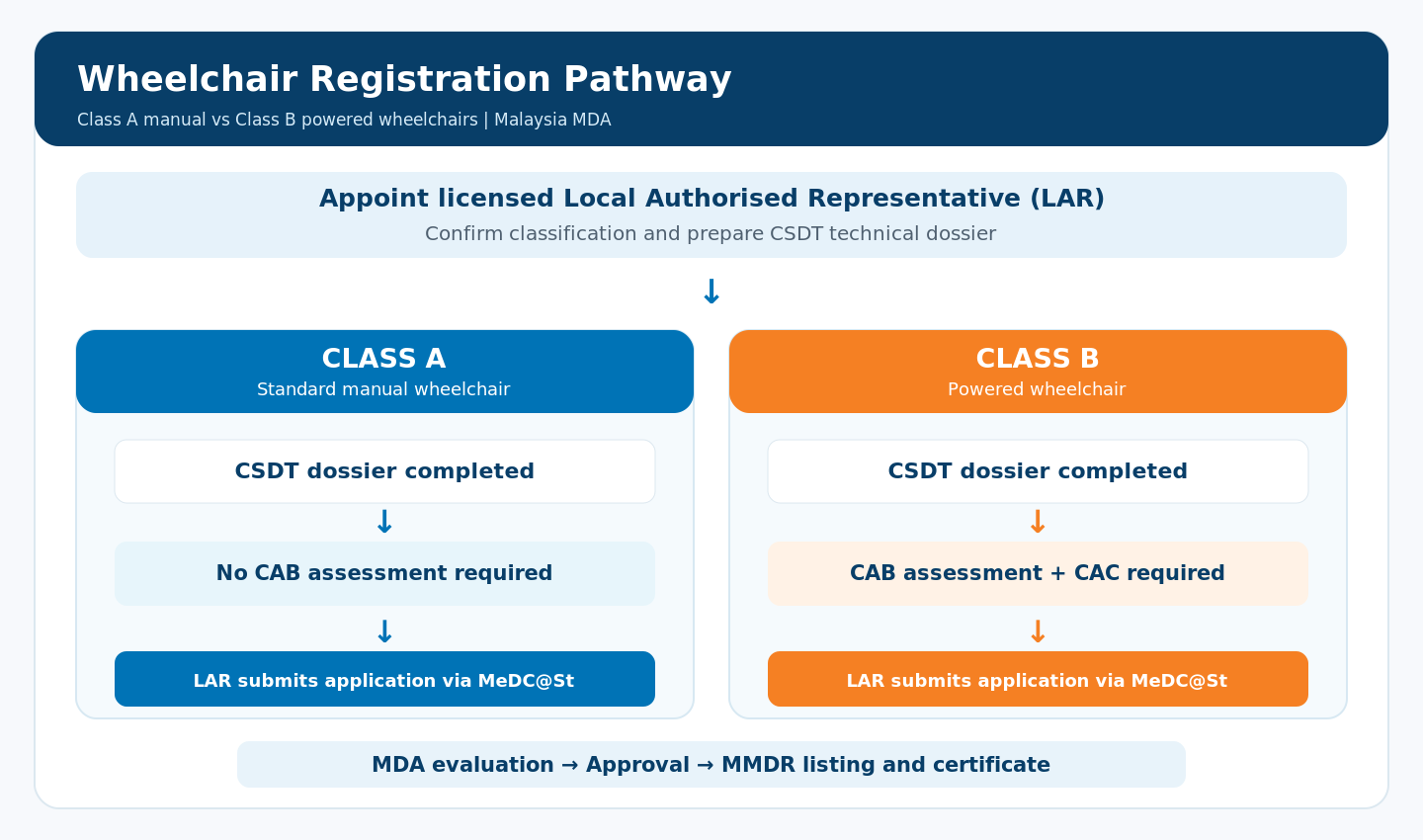
The Registration Procedure Step-by-Step
-
Appoint a Licensed LAR
A foreign manufacturer does not have the right to file for wheelchair registration with the MDA himself. It should be filed by an entity from Malaysia with a valid MDA Establishment Licence (Medical Device Establishment) and GDPMD (Good Distribution Practice of Medical Devices).
Confirm that the LAR's Establishment Licence covers the correct device category and that the GDPMD certificate is current before proceeding.
-
Determine the Correct Classification
Confirm whether the wheelchair is Class A (manual) or Class B (powered or electrically assisted). Document the classification rationale in writing, referencing the specific rule applied and the device's intended use. This written rationale forms part of the technical dossier and may be reviewed by MDA during the substantive assessment.
-
Prepare the Technical Dossier (CSDT)
The technical dossier must follow the structure set out in MDA/GD/0003, the Common Submission Dossier Template for general medical devices. Required documents include:
- Device description and specifications (including GMDN code)
- Classification rationale
- Declaration of Conformity referencing MDA/GD/0002 (Essential Principles)
- ISO 13485 certificate from an accredited certification body
- Risk management file (aligned with ISO 14971)
- Clinical evaluation report
- Performance and safety testing data (applicable ISO standards: ISO 7176 series for wheelchairs)
- Labelling and Instructions for Use
- Post-market surveillance plan
-
CAB Conformity Assessment (Class B Only)
For Class B powered wheelchairs, the LAR must engage an MDA-recognised Conformity Assessment Body (CAB) to conduct a conformity assessment of the technical dossier before submitting to MDA. The CAB issues a Conformity Assessment Certificate (CAC) upon satisfactory assessment, which must be included in the MeDC@St application. Class A wheelchairs are exempt from this step.
-
Submit via MeDC@St
The LAR submits the completed registration application through the MeDC@St portal. The application includes the full technical dossier, payment of the registration fee (RM 500 for Class A; RM 1,500 for Class B), and all supporting documents. Prior to a substantive review, MDA performs a completeness check of documentation.
-
MDA Evaluation and Issue of Certificate
During evaluation, MDA may raise technical questions. The review target for Class A devices is 90 days from acceptance of the dossier, while Class B devices have a review target of 180 days. Upon approval, the wheelchair will be listed in the Malaysian Medical Device Register (MMDR) and the registration certificate is issued to the LAR. This certificate is valid for five years and should be renewed before its expiration date. An expired registration certificate can no longer be renewed; it requires a fresh application.
Documentation Requirements
For wheelchair registration, the technical dossier shall conform to the CSDT format stated in MDA/GD/0003. The table below summarises the key documents required, their purpose, and whether they are mandatory for Class A, Class B, or both.
| Document | Purpose | Class A | Class B |
|---|---|---|---|
| Device Description & Specifications | States the name of the device, its purpose, GMDN code, and device specification | Required | Required |
| Rationale for Classification | Written explanation of the reasons why the classification rule is applicable and what classification the device falls into | Required | Required |
| Declaration of Conformity | Manufacturer's Declaration that the device conforms to MDA/GD/0002 Essential Principles | Required | Required |
| ISO 13485 Certificate | Document showing that the manufacturer has a conformant Quality Management System | Required | Required |
| Risk Management File (ISO 14971) | Documentation demonstrating the identification, assessment and mitigation of risks associated with the device | Required | Required |
| Clinical Evaluation Report | Documentation demonstrating the clinical performance and the safety in use of the device | Required | Required |
| Performance and Safety Testing Results (ISO 7176 series) | Demonstration that the wheelchair complies with performance and safety requirements for stability, strength, durability and EMC (if powered) | Required | Required |
| Labelling & Instructions for Use | Device label and IFU in formats compliant with MDA labelling requirements | Required | Required |
| Post-Market Surveillance Plan | Plan for ongoing monitoring of device safety and performance after registration | Required | Required |
| Conformity Assessment Certificate (CAC) | Certificate issued by an MDA-recognised CAB following successful conformity assessment | Not Required | Required |
| Free Sale Certificate / Foreign Approval | Regulatory approval from a reference authority (CE, FDA, HSA, TGA, PMDA, Thai FDA) may be used to support the verification route for Class B | Optional | Optional (verification route) |
Labelling Requirements for Wheelchairs
Labelling and Instructions for Use (IFU) for wheelchairs shall comply with labelling requirements established under Act 737 and the Medical Device Regulations 2012. Labels shall allow the device to be identified, tracked and properly used. MDA may issue a deficiency notice at any stage of the review process.
The following items must appear on the wheelchair label or IFU:
- Device name and model designation
- Intended use in plain language
- Name and address of the manufacturer
- Name and Malaysian address of the Local Authorised Representative (LAR)
- GMDN code or equivalent device identifier
- Lot number, batch number, or serial number
- Manufacturing date (and expiry date if applicable)
- Maximum user weight capacity
- Storage and handling conditions
- Instructions for safe use, modification, and maintenance
- Warnings and contraindications that pertain to the population using the device
- For electrically-powered wheelchairs: battery specifications and information for charging as well as electromagnetic compatibility warnings
Estimated Registration Timeline
The total time from starting dossier preparation to receiving the registration certificate depends primarily on how complete the technical dossier is and whether a CAB assessment is required. MDA's review target runs from the date of application acceptance, not from the date of submission.
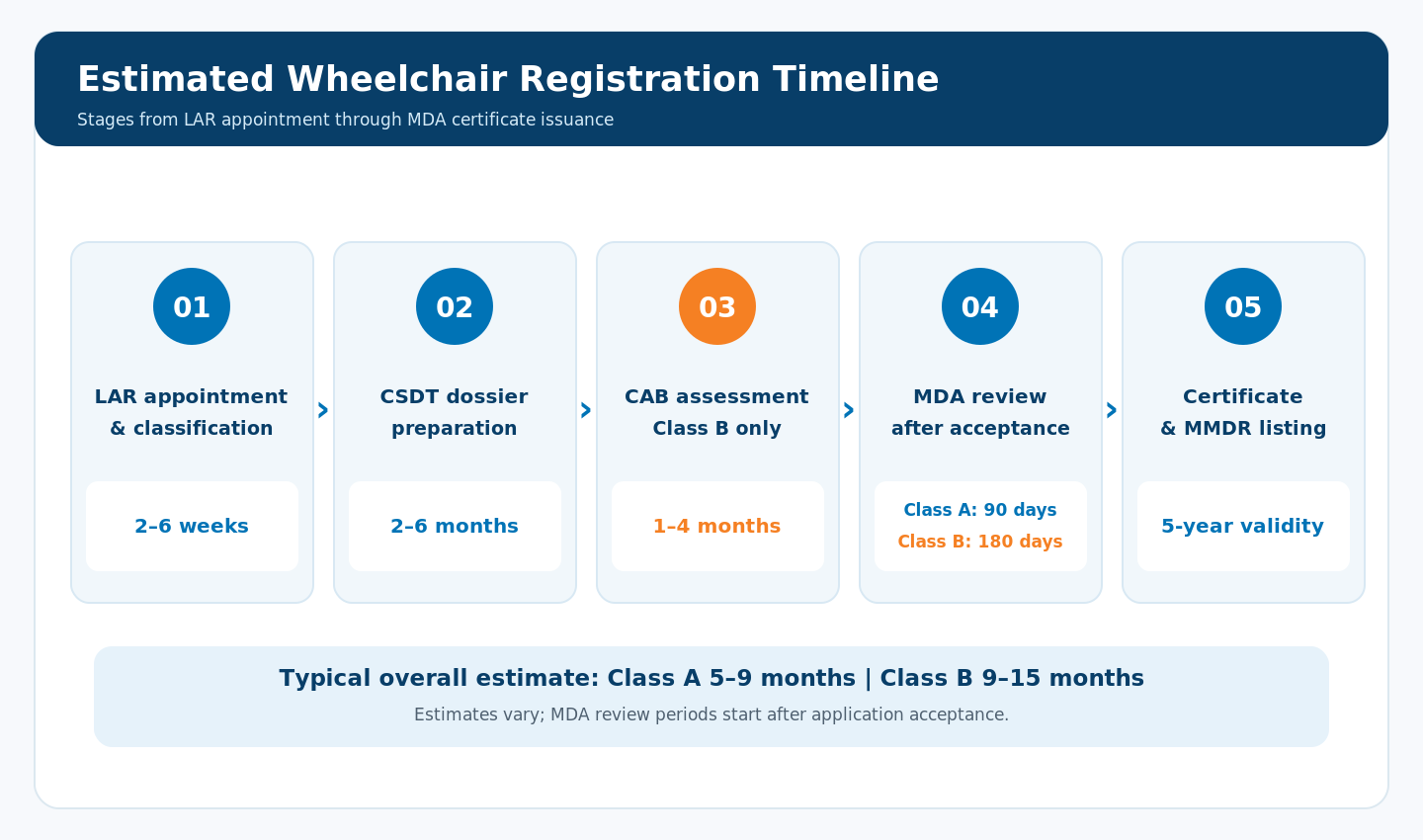
Identify and appoint a licensed LAR with valid MDA Establishment Licence and GDPMD certificate. Confirm whether the wheelchair is Class A (manual) or Class B (powered) and document the rationale in writing before dossier preparation begins.
Compile all CSDT sections, including risk management file, clinical evaluation report, ISO 7176 test data, Declaration of Conformity, and labelling. Test data gaps are the most common cause of delays. Manufacturers that already hold CE or FDA approval typically have most documents available and can prepare faster.
Class B powered wheelchairs must obtain a Conformity Assessment Certificate from an MDA-recognised CAB before submission to MDA. Class A manual wheelchairs skip this step entirely.
MDA performs an administrative completeness check before the review clock starts. Technical queries during the substantive review can extend the total timeline beyond the target. The 90-day target applies to Class A; the 180-day target applies to Class B. Submitting a complete, well-organised dossier is the most effective way to avoid queries and extensions.
The wheelchair is listed in the MMDR. The certificate is valid for five years. ePermit is required for every import shipment from 2 January 2026.
Common Mistakes in Wheelchair Registration
-
Misclassifying a powered wheelchair as Class A
Manufacturers and distributors sometimes classify all wheelchairs as Class A to avoid the cost and time of CAB assessment. A powered wheelchair with an integrated electric drive system is an active device and must be classified as Class B. Submitting a Class B device under a Class A application will result in rejection during MDA's administrative review or, if discovered post-registration, enforcement action.
Always confirm the classification against the specific device before submission, not by analogy with other products in the range.
-
Submitting a clinical evaluation report that relies only on literature
A clinical evaluation report that consists solely of published literature without any device-specific performance or clinical data does not adequately demonstrate safety and performance for the specific wheelchair being registered. MDA expects the clinical evaluation to include data relevant to the particular device model, including post-market clinical data where available.
Structure the clinical evaluation report around the device itself, not the product category.
-
Missing or incorrect LAR details on the label
The LAR's name and Malaysian address must appear on the device label or in the IFU. Labels that carry only the manufacturer's details, or that list a Malaysian distributor who is not the registered LAR, are non-compliant. MDA treats labelling deficiencies as a reason to issue a query or reject the application at the administrative check stage.
Verify that the LAR details on the label exactly match the name and address recorded in the MDA Establishment Licence.
-
Incomplete ISO 7176 test coverage
The ISO 7176 series spans more than 25 parts. Submitting test data for only a subset of applicable parts, for example covering static stability but not dynamic stability or fatigue, creates gaps that MDA may query during review. Each wheelchair model should be evaluated against all ISO 7176 parts relevant to its design and intended use. Confirm test coverage with the manufacturer's quality team before finalising the dossier.
-
Assuming registration covers all variants and accessories
A wheelchair registration covers the specific model and configuration described in the application. This means the model name, battery type (for powered chairs), reclining function, and maximum weight capacity as stated on the label must match what is documented in the registered dossier exactly. Variants with different frame materials, seating configurations, or weight ratings, as well as powered add-on accessories that change the device's classification, may require separate registrations or formal registration amendments.
Map the full product range against the registered dossier before distributing any variant. Supplying a configuration not covered by the registration is a regulatory offence under Act 737.
Registering a Wheelchair in Malaysia?
TT Medical provides end-to-end LAR and registration support for medical device manufacturers entering the Malaysian market. Our team handles dossier preparation, MeDC@St submissions, and ongoing compliance so your product reaches the market without regulatory delays.
Frequently Asked Questions
Is a wheelchair a medical device in Malaysia?
Yes. A wheelchair meets the definition of a medical device under Malaysia's Medical Device Act 2012 (Act 737) because it is intended to support or assist a person with a physical impairment. All medical devices must be registered with the MDA before they can be lawfully supplied, imported, or distributed in Malaysia.
What class is a manual wheelchair in Malaysia?
A standard manual wheelchair is classified as Class A under the Medical Device Regulations 2012. Class A is the lowest risk class, and manual wheelchairs fall into it because they are non-active, non-invasive, and non-implantable devices that present a low level of risk to the user. Class A registration does not require CAB conformity assessment.
What class is a powered or electric wheelchair?
A powered wheelchair with an integrated electric drive system is classified as Class B. It is an active device because it uses electrical energy to drive movement. Class B registration requires a Conformity Assessment Certificate (CAC) from an MDA-recognised CAB before the LAR can submit the application to MDA. The Class B registration fee is RM 1,500.
Can a foreign manufacturer register a wheelchair directly with MDA?
No. All medical device registration applications in Malaysia must be submitted by a licensed Local Authorised Representative (LAR). The LAR must be a Malaysian entity holding a valid MDA Establishment Licence and GDPMD certificate. The LAR enters into a formal agreement with the foreign manufacturer and takes on regulatory responsibility for the device in Malaysia. Foreign manufacturers cannot apply directly to MDA.
What technical standards apply to wheelchair registration in Malaysia?
The primary international standard series for wheelchair performance and safety is ISO 7176, which covers static stability, dynamic stability, dimensions, strength, fatigue, flammability, and, for powered chairs, electromagnetic compatibility. The quality management system standard is ISO 13485:2016, and risk management must follow ISO 14971. The Declaration of Conformity references the Essential Principles (MDA/GD/0002).
How long does wheelchair registration in Malaysia take?
The realistic total timeline is 5 to 9 months for a Class A manual wheelchair and 9 to 15 months for a Class B powered wheelchair, measured from the start of dossier preparation to certificate issuance. MDA's review target is 90 days for Class A and 180 days from application acceptance for Class B. Technical queries during review, or incomplete dossier documents, can extend the total timeline. Manufacturers with existing CE or FDA approval and complete ISO 7176 test data typically complete registration faster.
Is ePermit required for importing wheelchairs into Malaysia?
Yes. From 2 January 2026, ePermit is mandatory for every import shipment of registered medical devices into Malaysia, including wheelchairs. The ePermit is applied for through the MeDC@St portal by the LAR before each shipment. Import of a registered medical device without a valid ePermit is a regulatory offence under Act 737.
Does a wheelchair registration in Malaysia need to be renewed?
Yes. All medical device registrations in Malaysia are valid for five years. The LAR must submit a renewal application before the registration expires. A registration that lapses cannot be renewed; a fresh registration application is required. The wheelchair cannot be lawfully supplied or imported during any period when the registration is not current.