No — not all medical devices in Malaysia require CAB conformity assessment. Class A devices are exempt from CAB assessment under the Medical Device (Exemption) Order 2024 and submit directly to the MDA via MeDC@St. Class B, C, and D devices must undergo CAB conformity assessment before MDA submission — this is mandatory with no exceptions. In 2026, manufacturers should also be aware of the permanently confirmed Malaysia–Singapore HSA reliance arrangement, which has expanded the verification route options, and Class A fee increases effective January 2026.
One of the most practical questions manufacturers ask when planning Malaysian market entry is straightforward: does my device actually need to go through a CAB, or can I submit directly to the MDA?
The answer depends on your device classification. The Medical Device (Exemption) Order 2024, which came into force on 6 March 2024 and supersedes the 2016 order, establishes a clear exemption from CAB conformity assessment for Class A devices. For Class B, C, and D devices, the CAB is a mandatory step — and in 2026, there are several important updates to the landscape that manufacturers planning submissions now need to factor in.
Key Takeaways
- Class A devices are exempt from CAB conformity assessment — they submit directly to the MDA via MeDC@St.
- Class B, C, and D devices must be assessed by a registered CAB before any MDA submission — no exceptions.
- The Class A exemption is from CAB assessment only — Class A devices still require full MDA registration.
- Class A sterile and measuring devices have additional documentation requirements not required for standard Class A.
- Class A registration fees increased from RM 100 to RM 500 effective 1 January 2026 under the Medical Device (Amendment) Regulations 2025.
- Malaysia permanently confirmed regulatory reliance with Singapore's HSA on 1 March 2026 — HSA-registered devices now qualify for the expedited verification route.
- MDA/GD/0066 on personal use importation was withdrawn on 16 February 2026 — the updated Personal Use Medical Device Exemption framework on the MDA portal now applies.
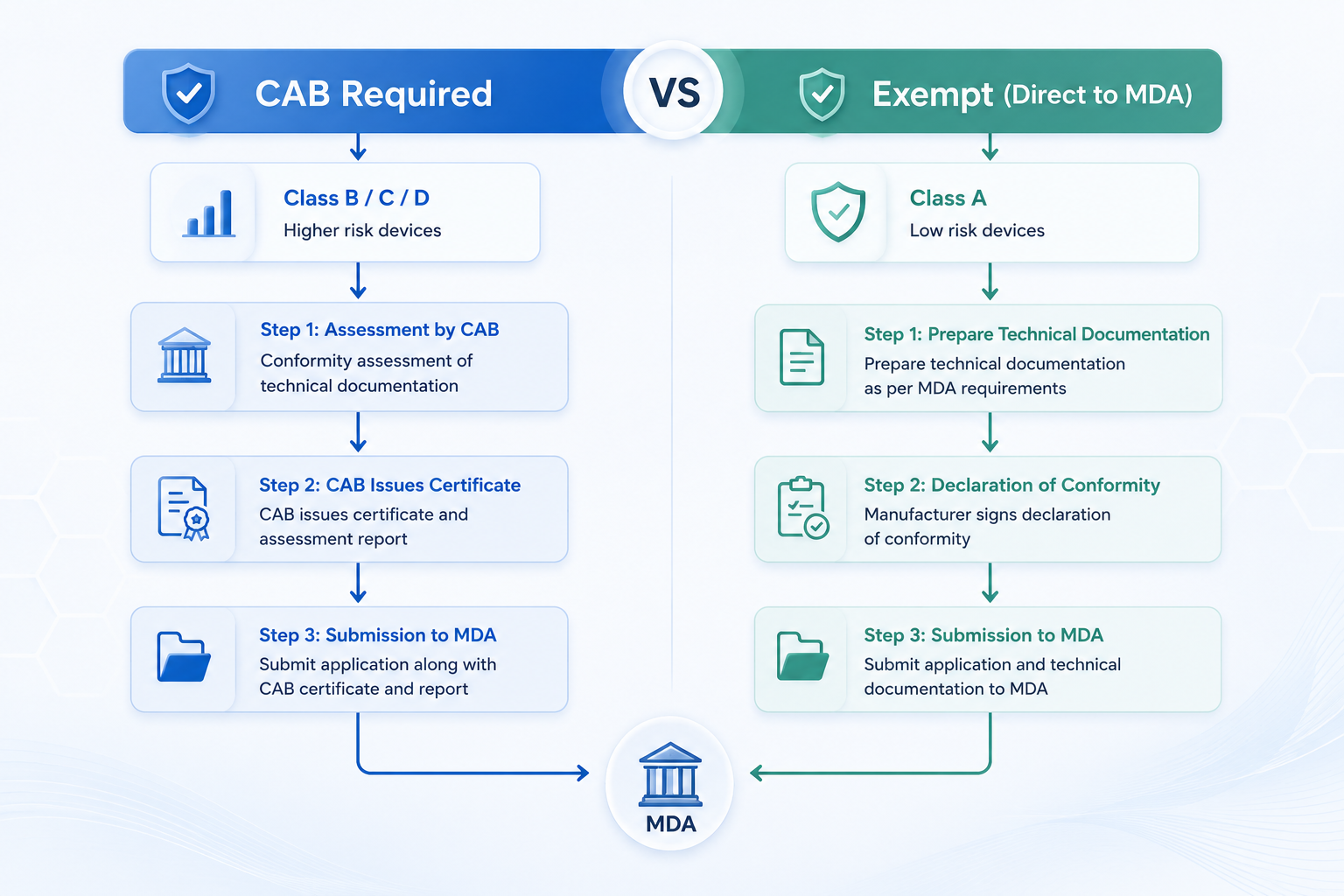
Does My Device Need CAB? The Answer by Class
- Class B — Low to moderate risk
- Class C — Moderate to high risk
- Class D — High risk
- All IVD Classes B, C & D
- Two routes: full assessment or verification
- Class A standard devices
- Class A IVD devices
- Submit directly to MDA via MeDC@St
- Registration still mandatory
- Sterile & measuring subtypes: extra docs needed
What Class A Devices Still Need in 2026
Class A devices bypass the CAB step but must submit a complete documentation package directly to the MDA. Note that Class A application fees increased from RM 100 to RM 500 effective 1 January 2026 under the Medical Device (Amendment) Regulations 2025 — update your regulatory budget accordingly.
| MeDC@St application form | Completed via the MDA online portal. Application fee: RM 500 (effective 1 Jan 2026) | Required |
| Establishment licence | LAR, importer, or manufacturer licence issued by MDA | Required |
| AR Declaration | Annex B format per MDA/GD/0041 | Required |
| GMDN code | Global Medical Device Nomenclature code for the device | Required |
| GDPMD certificate | Good Distribution Practice for Medical Devices certificate | Required |
| Device description and intended use | Clear, precise statement of medical purpose, indications, and patient population | Required |
| ERSP checklist | Essential Requirements for Safety and Performance, per MDA template | Required |
| Declaration of Conformity | MDA format per Appendix 1A, Medical Device Regulations 2012 — signed by top management | Required |
| Labelling and IFU | All labels, packaging, and Instructions for Use. Home-use devices: e-labelling now permitted under 2026 MDA Seventh Edition Labelling Guidance | Required |
| Sterilisation validation | For Class A sterile devices only — additional documentation required | If sterile |
| Metrological confirmation | For Class A measuring devices only — metrological confirmation records required | If measuring |
What Changed in 2026 That Affects Your CAB Decision
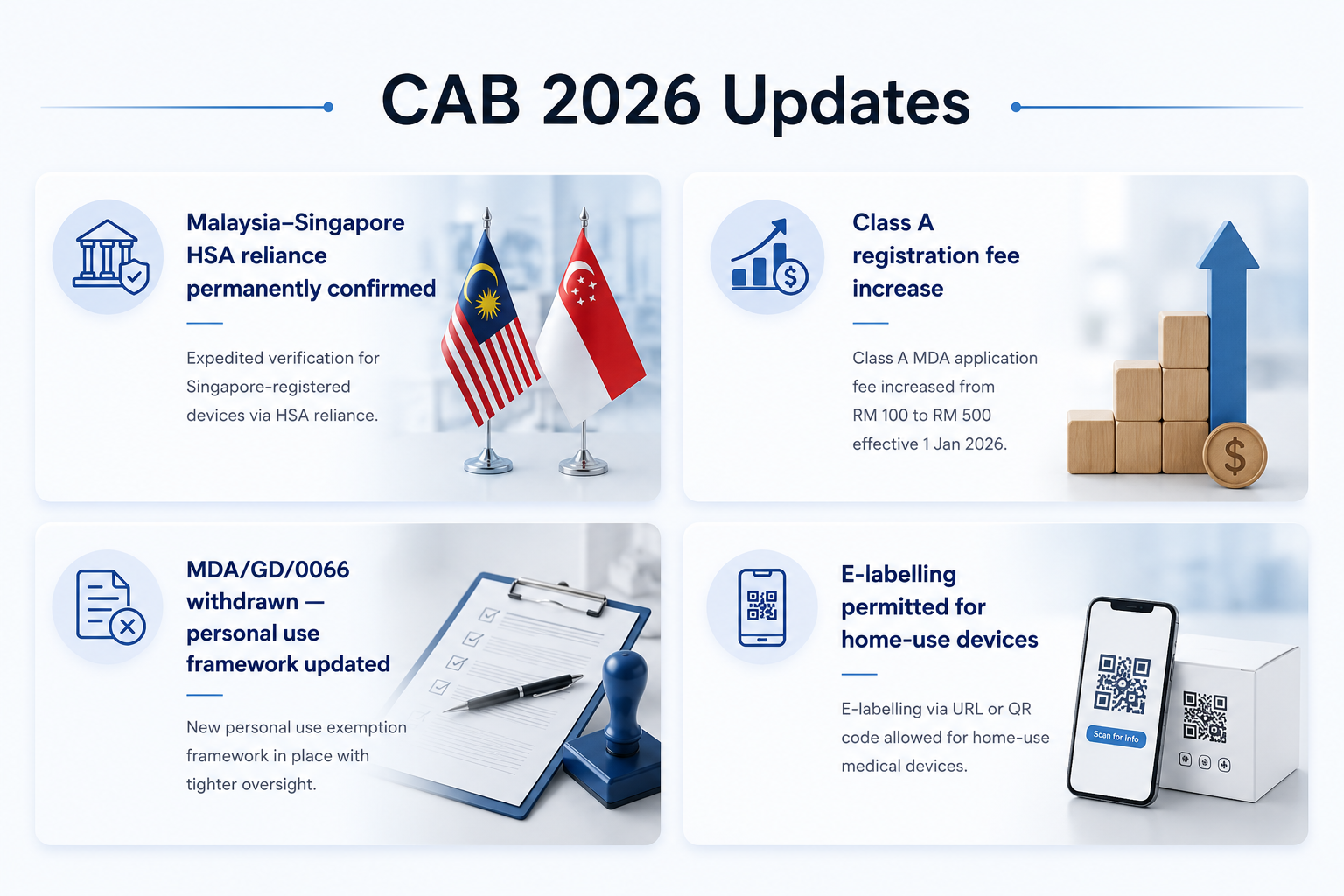
On 1 March 2026, Malaysia permanently confirmed its regulatory reliance arrangement with Singapore's Health Sciences Authority (HSA). Devices already registered on the Singapore Medical Device Register (SMDR) now qualify for the expedited verification route with lower CAB fees and shorter review timelines. This is a significant development for manufacturers already in the Singapore market looking to extend into Malaysia — it now represents one of the most efficient dual-market entry pathways in ASEAN.
Under the Medical Device (Amendment) Regulations 2025, the Class A MDA application fee increased from RM 100 to RM 500 effective 1 January 2026. This represents a fivefold increase. While Class A registration remains a lighter process without CAB involvement, manufacturers should update their cost forecasting for Malaysian market entry accordingly.
On 16 February 2026, the MDA withdrew Guidance Document MDA/GD/0066 on importation of medical devices for personal use. The updated Personal Use Medical Device Exemption framework on the MDA portal now applies. Manufacturers and distributors who previously relied on the 2016-era notification process should confirm they are operating under the current exemption framework — the transition is designed to tighten oversight and reduce unregistered devices entering Malaysia under personal-use exemptions.
The MDA issued the Seventh Edition of its Guidance Document on Requirements for Labelling of Medical Devices in 2026, introducing e-labelling for home-use medical devices. Manufacturers can now deliver instructions and safety information electronically (via URL or QR code), subject to a risk assessment. For Class A home-use devices submitting directly to MDA, this affects labelling requirements — ensure your IFU meets the updated standard.
Devices Exempt from Registration Entirely
Beyond the CAB exemption for Class A devices, the Medical Device (Exemption) Order 2024 also provides exemption from the registration requirement itself under Section 5 of Act 737 for specific device categories. These are not exemptions from all MDA processes — a formal exemption application must still be submitted.
Devices imported by an individual for personal use only — not for sale or distribution. The old notification-based approach under MDA/GD/0066 has been withdrawn as of 16 February 2026. Manufacturers and importers must now refer to the updated Personal Use Medical Device Exemption framework on the MDA portal.
Devices used solely for non-clinical demonstration at exhibitions or symposia, or for non-promotional teaching and training. Cannot be used on patients or sold during the exemption period. A formal exemption application must be submitted to and approved by the MDA.
Devices used in systematic clinical studies to evaluate safety and effectiveness in human subjects. Must be approved under the relevant clinical research framework. Cannot be commercialised or used outside the approved study protocol under this exemption.
In vitro diagnostic devices imported specifically to verify performance characteristics. Applies to evaluation purposes only — not for commercial distribution or patient care.
Devices manufactured in or imported into Malaysia solely for export — with no intention of being placed on the Malaysian market. An exemption application must be submitted and approved. MDA/GD/0051 applies.
A category introduced in the 2024 Order — devices imported into Malaysia specifically to be re-exported, without being placed on the Malaysian market. This was not available under the 2016 Order.
Devices approved for emergency use or when conventional treatment is unavailable — ensuring patients can access essential devices in critical situations. This pathway has its own requirements and should not be confused with standard registration exemptions.
What the CAB Exemption Does Not Mean
Wrong. The CAB exemption is from conformity assessment only. All Class A devices still require MDA registration under Act 737 before they can be sold or distributed in Malaysia. Selling an unregistered Class A device remains a legal violation — particularly important given the tightened oversight of the 2024 Exemption Order.
Wrong. Class A devices require a complete administrative and technical package including device description, ERSP checklist, Declaration of Conformity, labelling, IFU, GMDN code, and establishment licence. The submission goes direct to MDA — but it must be complete and correct.
Deliberately describing a Class B or higher device as Class A to avoid the CAB step is one of the most consequential mistakes a manufacturer can make. The MDA reviews classification independently. Reclassification resets the entire timeline and wastes all documentation prepared for the wrong class. See our guide on common classification mistakes.
The 2026 Malaysia–Singapore HSA reliance arrangement expedites the CAB process via the verification route — it does not remove the CAB requirement. Manufacturers with HSA registration still need to go through a registered Malaysian CAB. The difference is that the CAB assesses the Singapore approval as supporting evidence, significantly reducing the timeline and cost compared to full assessment.
Support from TT Medical
Whether your device qualifies for direct Class A submission or requires full CAB coordination, TT Medical manages the complete process as your Local Authorised Representative. We confirm classification, prepare documentation to the standard required for first-time approval, and coordinate with the MDA or CAB on your behalf — including advising on the most efficient route given the 2026 updates.
Final Thoughts
The core answer hasn't changed: Class A devices don't need CAB assessment; Class B, C, and D devices do. But 2026 has brought meaningful updates — a permanently confirmed HSA reliance arrangement that makes dual Singapore–Malaysia registration more efficient, higher Class A fees, updated personal use exemption rules, and new e-labelling options for home-use devices.
If you're planning a submission in 2026 and unsure whether your device qualifies as Class A or requires CAB assessment, confirm your classification before preparing any documentation. Understanding what the CAB assesses and how the process works is the best preparation for Class B and above. Speak to our consultancy team to get clarity before you begin.
FAQ