
After a medical device is registered in Malaysia, the LAR's responsibilities do not end — they shift from registration to ongoing compliance. The LAR is the legally responsible entity for post-market surveillance, mandatory problem reporting (adverse event reporting), field safety corrective actions, distribution records management, change notifications, and registration renewal. All of these obligations are governed by the Medical Device Act 2012 (Act 737) and the Medical Device (Duties and Obligations of Establishments) Regulations 2019. Failure to fulfil any of these obligations can result in enforcement action, suspension of the Establishment Licence, or cancellation of the device registration.
Most manufacturers focus on the LAR's role during registration — coordinating documentation, managing the CAB assessment, submitting to the MDA, and securing the registration certificate. But the LAR's most sustained and legally consequential work begins after the certificate is issued.
Under the Medical Device (Duties and Obligations of Establishments) Regulations 2019, the LAR — as the licensed establishment on the device's registration — carries a comprehensive set of ongoing obligations. These are not optional. The MDA does not distinguish between a LAR that fulfils post-approval obligations and one that does not: both are held to the same legal standard, and the consequences of non-compliance apply equally.
If you are evaluating a Local Authorised Representative or reviewing an existing LAR relationship, understanding the full scope of post-approval obligations is essential. This guide covers every obligation — what it is, what the MDA requires, and what happens if it is not met.
Key Takeaways
- The LAR's legal responsibilities under Act 737 and the 2019 Regulations continue for the full duration of the device's market presence in Malaysia.
- Mandatory problem reporting (adverse event reporting) has strict timeframes — 48 hours for public health threats, 10 days for death or serious injury, and 30 days for incidents likely to cause serious injury on recurrence.
- The LAR must maintain complete distribution records for all registered devices — enabling traceability for recalls and adverse event investigations.
- Device registrations must be renewed every five years — the renewal application should be submitted up to one year before expiry via MeDC@St.
- Change notifications must be submitted to the MDA before implementing significant changes to a registered device — three categories apply with different requirements and timelines.
- If the LAR fails to fulfil post-market obligations, the MDA can revoke the Establishment Licence and cancel the device registration.
- Post-approval obligations are the core reason why choosing a LAR with genuine regulatory expertise — not just a licence — is so important.
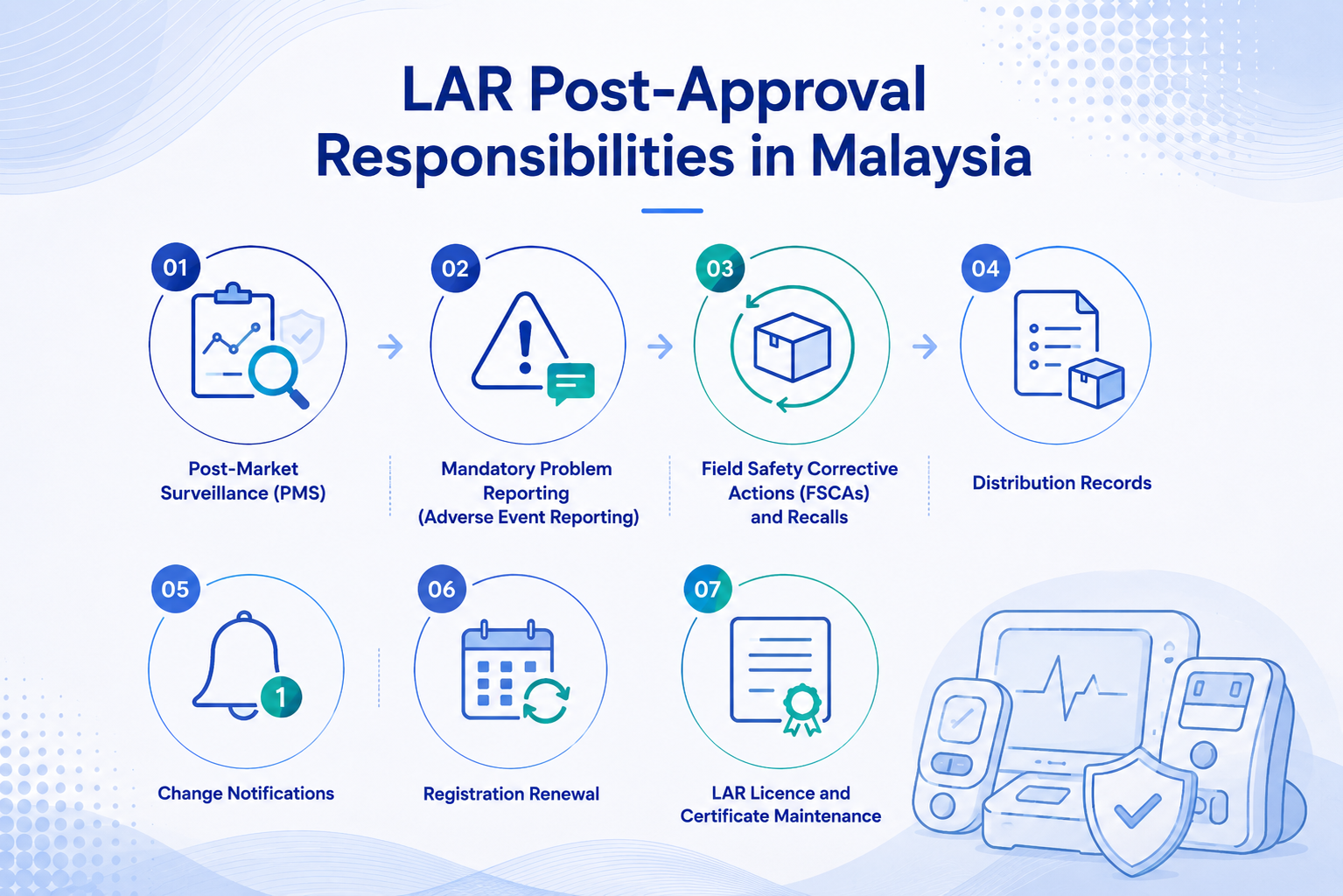 Core Obligation 1
Post-Market Surveillance (PMS)
Post-market surveillance is a mandatory, ongoing obligation for all registered medical devices in Malaysia, regardless of device class. The LAR, as the licensed establishment, is responsible for establishing and maintaining a PMS system that continuously monitors the safety and performance of the device in the Malaysian market.
The LAR must have documented procedures for collecting and reviewing post-market data — including feedback from healthcare professionals, patients, distributors, and hospital procurement teams. This includes monitoring device performance data, customer complaints, and any safety signals emerging from the Malaysian market or from the manufacturer's global PMS system.
The LAR must establish a standard complaint form for users to report device-related issues. Complaints may come from patients, healthcare practitioners, maintenance providers, or the general public. Each complaint must be documented, investigated, and closed with a clear record — MDA may request complaint records during inspections or as part of an adverse event investigation.
Beyond complaint handling, the LAR's PMS system should include ongoing trend analysis — identifying patterns in complaint data or field performance that may indicate a developing safety issue before it becomes a reportable incident. This proactive approach is what separates a compliance-grade PMS system from a reactive one.
PMS obligations are set out in Chapter 3 of Act 737 (Sections 37–42) and the Medical Device (Duties and Obligations of Establishments) Regulations 2019. These regulations apply to all licensed establishments, including the LAR as the Authorised Representative for a foreign manufacturer.
Mandatory Problem Reporting (Adverse Event Reporting)
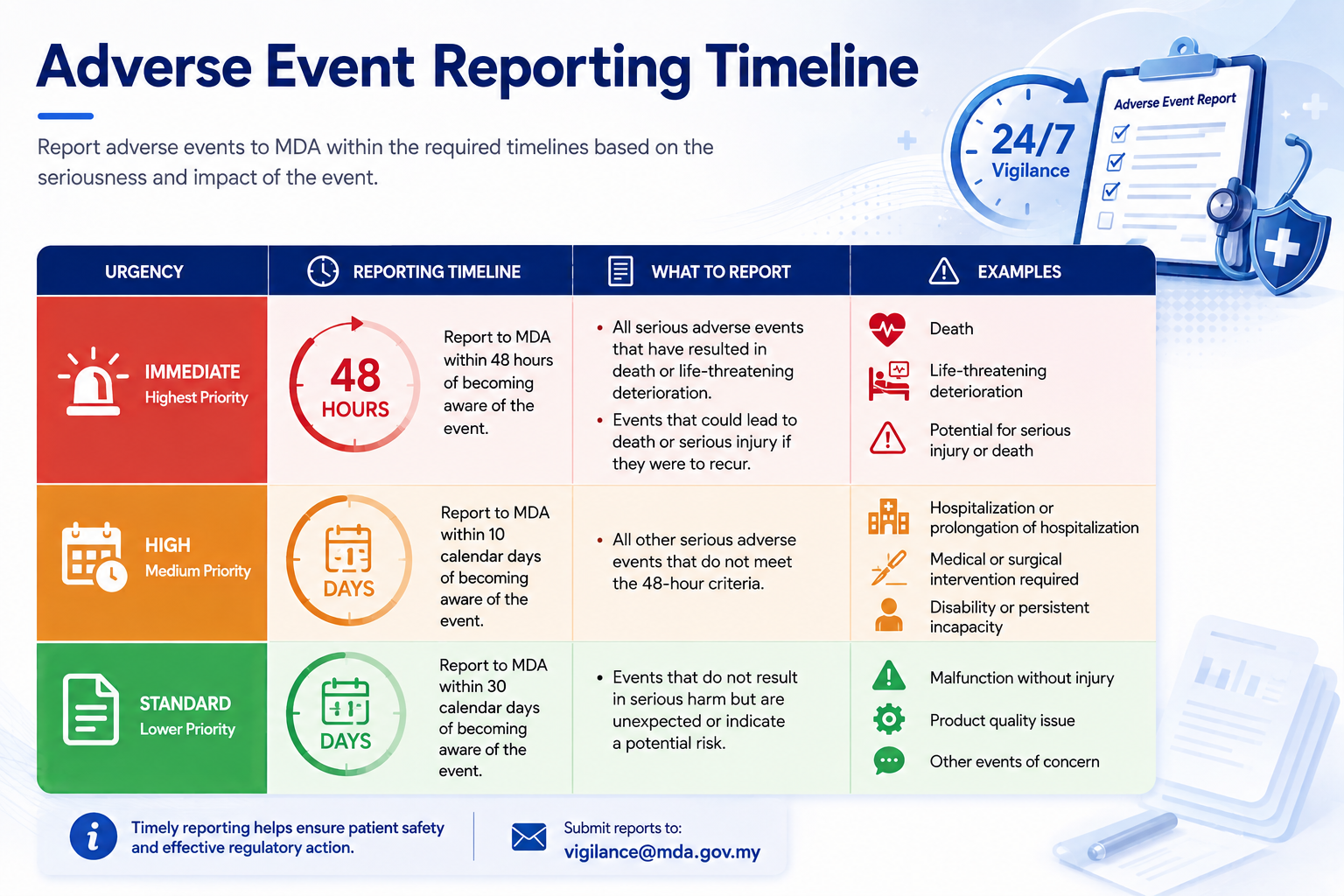
When an incident involving a registered medical device occurs in Malaysia, the LAR is the legally responsible entity for reporting it to the MDA. Mandatory problem reporting — also known as vigilance reporting — is governed by Regulation 5 of the 2019 Regulations and MDA guidance document MDA/GD/0014.
Three reporting timeframes apply, depending on the severity of the incident.
| Incident Type | Reporting Deadline | Examples |
|---|---|---|
| Public health threat | 48 hours from awareness | Widespread contamination, large-scale device failure affecting multiple patients simultaneously |
| Death or serious deterioration of health | 10 days from awareness | Device malfunction causing patient death, serious injury, or life-threatening deterioration |
| Likely to cause serious injury on recurrence | 30 days from awareness | Device defect that has not yet caused serious injury but poses a risk if the incident recurs |
Following the initial mandatory report, the LAR must coordinate with the manufacturer to investigate the root cause of the incident and implement corrective and preventive actions (CAPA) to eliminate or reduce the risk of recurrence. The MDA evaluates the investigation report and, if satisfied, informs the establishment in writing that the case is closed.
Core Obligation 3Field Safety Corrective Actions (FSCAs) and Recalls
If a safety issue is identified that requires action on devices already in the Malaysian market, the LAR is responsible for coordinating and executing the Field Safety Corrective Action on behalf of the manufacturer. FSCAs include product recalls, device modifications, software updates, and labelling corrections issued while devices are already in use.
The LAR notifies the MDA of the FSCA, communicates with affected distributors and healthcare facilities in Malaysia, coordinates the physical retrieval or correction of affected devices, and submits the required reports to the MDA documenting the actions taken and the scope of the corrective action.
Effective FSCA execution depends entirely on the LAR having accurate, current distribution records — who received the affected devices, in what quantities, and when. Without complete distribution records, a recall cannot be executed effectively, which is itself a regulatory breach. See Core Obligation 4 on distribution records.
For significant FSCAs, the LAR issues a Field Safety Notice to all affected parties in Malaysia — distributors, hospitals, clinics, and in some cases patients. The FSN must be reviewed and approved by the MDA before it is sent. The LAR manages this review process and the distribution of the FSN.
Distribution Records
The LAR must maintain complete, accurate, and up-to-date distribution records for every registered device in Malaysia. These records are the foundation for traceability — enabling the LAR to identify which devices went where, in what quantities, and when, in the event of a recall or adverse event investigation. Full requirements are set out in MDA/GD/0012.
| Device identification | Product name, model number, catalogue number, lot/batch number, serial number (where applicable), and expiry date |
| Quantity | Number of units supplied in each transaction |
| Recipient details | Name and address of the distributor, hospital, clinic, or facility receiving the device |
| Transaction date | Date of each supply or distribution transaction |
| Supplier details | Name and address of the supplier for each batch or delivery |
| Record retention | Distribution records must be retained for a minimum period after the last sale or expiry of the device — typically aligned with the device's projected useful life or a minimum of five years |
Change Notifications
Any significant change to a registered device must be notified to the MDA before the change is implemented. The MDA classifies changes into three categories, each with different requirements and processes. The LAR manages all change notification submissions on behalf of the manufacturer via MeDC@St.
Significant changes to intended use, design, or materials that fundamentally alter the device's safety or performance profile. Category 1 changes require a new registration application — they cannot be managed through a change notification alone.
Changes that affect the device's safety or performance but do not warrant a full new registration — such as manufacturing site changes, labelling modifications, or design changes within the existing intended use. Category 2 changes require a formal change notification submitted via MeDC@St, reviewed and endorsed by the MDA before implementation.
Minor changes such as company name updates, contact detail changes, or administrative corrections. Category 3 changes can be implemented immediately, with notification submitted to the MDA via MeDC@St. No MDA endorsement is required before implementation, but records must be maintained.
Registration Renewal
Medical device registrations in Malaysia are valid for five years. The LAR is responsible for ensuring renewal applications are submitted before expiry — and this is an area where proactive management from the LAR is essential, not reactive administration.
Renewal applications should be submitted via MeDC@St up to one year before the registration expiry date. Waiting until close to expiry is a risk — if the MDA has queries on the renewal application, there may not be enough time to resolve them before expiry, creating a gap in registration status.
An updated Declaration of Conformity reflecting the current state of the device, a current ISO 13485 certificate, updated labelling if any changes have occurred, and confirmation that no unapproved changes have been made to the device since the original registration. Any changes made during the registration cycle must have been properly notified to the MDA before the renewal.
If the registration expires without renewal, the device can no longer be legally imported, sold, or distributed in Malaysia. Distribution of an unregistered device is a violation of Act 737. The LAR must cease all commercial activities for that device until a new registration is approved — which effectively means a market access gap that directly impacts revenue.
LAR Licence and Certificate Maintenance
Beyond the device-specific obligations above, the LAR must maintain their own MDA Establishment Licence and GDPMD certificate in good standing throughout the engagement. If either lapses, the device registrations held under the LAR's licence are at risk.
The LAR's Establishment Licence must be renewed periodically. The LAR is responsible for managing this renewal — but manufacturers should also monitor their LAR's licence status as part of their own risk management. Ask your LAR to confirm renewal dates and request copies of renewed licences as a matter of routine.
The Good Distribution Practice for Medical Devices certificate must remain current. GDPMD audits are conducted periodically by the MDA, and a lapsed GDPMD can result in suspension of the Establishment Licence — which would affect all device registrations held under the LAR's name.
What Happens If Post-Approval Obligations Are Not Met
The MDA does not treat post-market obligations as suggestions. The consequences of failing to fulfil them are graduated but can be severe.
The MDA has authority under Act 737 to take formal enforcement action against establishments that fail to comply with post-market obligations. This may include formal warnings, compliance notices, and directed corrective actions.
Serious or repeated violations of Act 737 and the 2019 Regulations can result in the MDA suspending or revoking the LAR's Establishment Licence — which would affect all device registrations held under that LAR's name, not just the non-compliant device.
The MDA can cancel a specific device registration if the LAR fails to comply with post-market obligations for that device. Once cancelled, the device cannot be sold or distributed in Malaysia until re-registration is secured — with a new application and full review.
Under Act 737, the MDA has authority to seize unregistered devices or devices associated with a suspended licence from the Malaysian market. This is a commercial and reputational event that directly affects the manufacturer's standing in Malaysia.
Post-Approval Compliance Support from TT Medical
TT Medical manages the full scope of post-approval obligations as your Local Authorised Representative — from maintaining your PMS system and managing adverse event reports, to coordinating FSCAs, submitting change notifications, and managing registration renewal. Manufacturers working with TT Medical deal with a single point of contact for all ongoing Malaysian regulatory obligations, with proactive monitoring of key dates and compliance milestones.
Final Thoughts
Getting the registration certificate is not the end of the regulatory journey in Malaysia — it is the beginning of an ongoing compliance obligation that runs for the full life of your device's market presence. Post-market surveillance, adverse event reporting, FSCA management, distribution records, change notifications, and renewal are all non-negotiable LAR responsibilities under Act 737 and the 2019 Regulations.
This is why the quality of your LAR relationship matters long after registration is approved. A LAR who fulfils these obligations proactively — not reactively — protects your market access, your brand reputation, and your relationship with the MDA. A LAR who treats post-approval obligations as an afterthought puts all of that at risk.
If you would like to discuss what post-approval support looks like in practice, or if you are reviewing your current LAR arrangement, speak to our consultancy team.
FAQ