
Manual re-usable surgical devices fall within Class A (Rule 6 of the First Schedule to the 2012 Medical Device Regulations). They can then register with the MDA through MeDC@St. There is no requirement for these devices to be assessed by a Conformity Assessment Body (CAB). Single-use sterile surgical devices are Class B. Electrically powered surgical devices are at least Class B. Surgical devices which come into contact with, or are specifically for use on, the central nervous system fall under Class D. This applies to both re-usable and single-use devices. All surgical devices must register with the MDA under the Medical Device Act 2012 (Act 737) before they can be legally imported, exported and sold in Malaysia.
There is a broad definition of surgical devices. As well as simple tools such as forceps and scissors, there are also electrically powered bone drill machines and electro-surgery equipment. Due to the diverse designs, functions and degree of risk posed by surgical devices, there is no standardised way of categorising them under Malaysia's medical device legislation. Correctly assessing the class of your device is critical in identifying whether a CAB is required to assess it, as well as in effecting the cost and duration of the registration process.
This information outlines the surgical device classifications under the Medical Device Act 2012 (Act 737). It also describes factors which cause devices to be classified at a higher level. Furthermore, it details the information required to compile a registration dossier. Common misclassification issues and incorrect labelling practices are also explained as they frequently result in stalled or rejected registration submissions.
Key Takeaways
- Manual re-usable surgical instruments are classed as Class A (Rule 6, First Schedule, Medical Device Regulations 2012). For a device to fall into this category, it must be manually operated, designed for re-use and have short-term interaction.
- Single-use sterile, powered and devices linked to an active device are all a minimum of Class B. These require evaluation by a CAB prior to MDA registration.
- Any device which interacts with the central nervous system or is specialised for heart and central circulatory system usage is Class D. Again, this applies whether or not the item can be re-used.
- Currently, the combined MDA statutory registration charge for a Class A device is RM1,250. Incorrect categorisation of a wide catalogue can therefore substantially increase these charges.
- Within the IFU, re-processing guidance is amongst the aspects of a Class A surgical device registration that receives most scrutiny. General guidance is not in compliance with MDA/GD/0026.
- A foreign manufacturer without a Malaysian establishment must appoint a Local Authorised Representative (LAR) to hold the registration and submit on their behalf.
Do Surgical Instruments Need to Be Registered in Malaysia?
Yes. All surgical instruments that meet the definition of a medical device under Act 737 must be registered with the MDA before they can be legally placed on the Malaysian market. It is an offence to import, export or supply a non-registered medical device. Offenders may be fined up to RM200,000 and/or face imprisonment for a maximum period of 3 years.
Class A devices are a lower classification than others and do not constitute a deregulated category. Class A devices can be submitted directly to the MDA through the MeDC@St portal, so avoiding the need for a CAB. Although this process is more streamlined and cost-effective, registration is still required.
How Are Surgical Instruments Classified Under Malaysian Law?
Surgical instruments are classified under Rule 6 of the First Schedule of the Medical Device Regulations 2012. This rule sets out the categorisation of 'minimally-invasive' medical devices which are designed for short-term usage (under 60 minutes' continual engagement). Typically, surgical instruments come under this heading.
By default, minimally-invasive, short-term medical devices are assigned to Class B. Nevertheless, Rule 6 also identifies an exception; re-usable surgical instruments are categorised as Class A provided that three criteria are fulfilled.
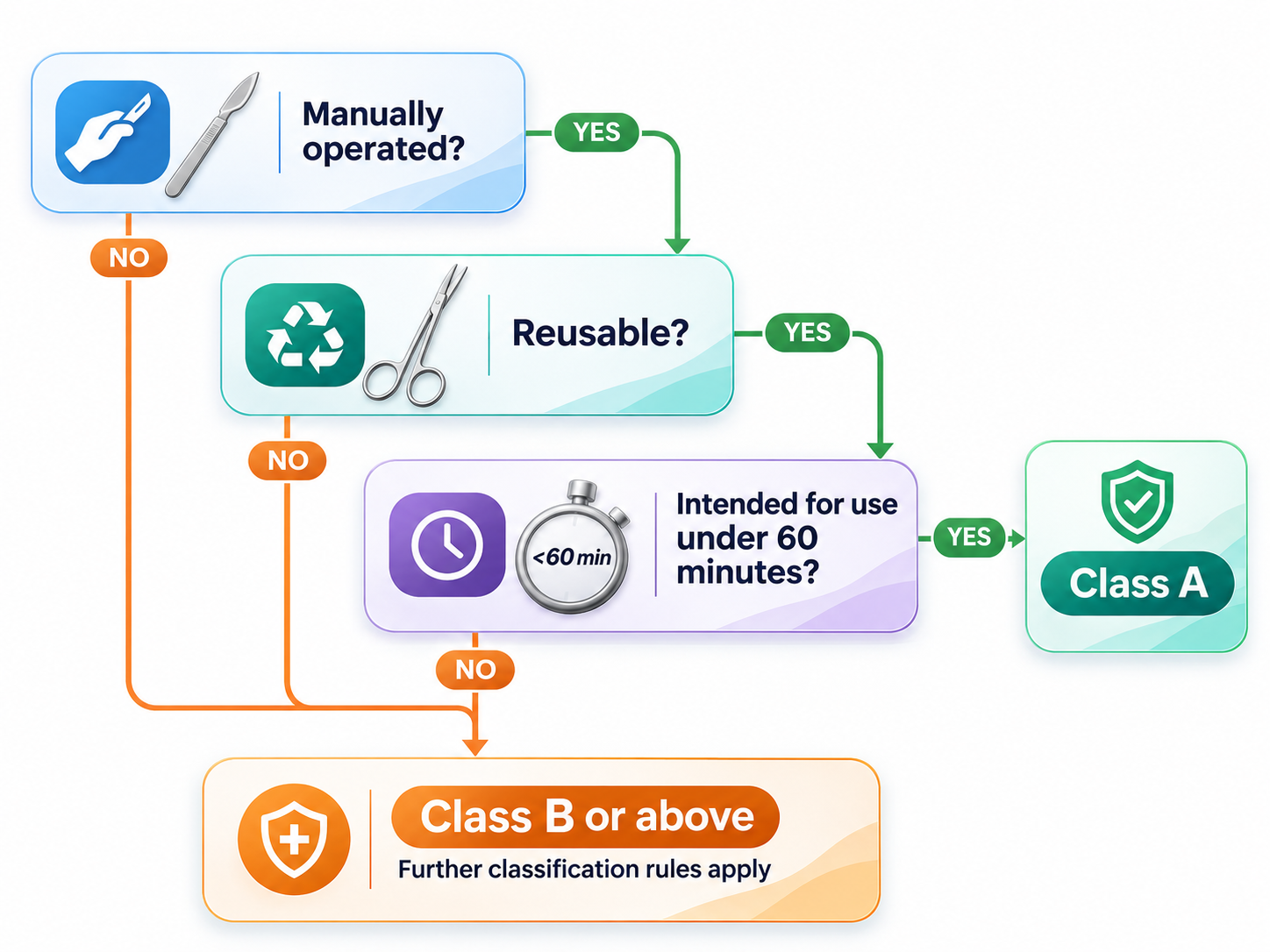
An instrument must be manually operated. Should an item be related to a motorised device then it will not qualify for Category A. Even though certain surgical instruments are labelled as manually operated (for instance, motorised osteotomes, handpieces and electrosurgery units), these cannot be categorised as Category A.
It must be stated that an item is re-usable and that it can indeed be re-used having been appropriately re-processed (cleaned and sterilised). As emphasised in MDA/GD/0009, it is the manufacturer's planned re-usability which is used to identify an item's category. Despite frequently undergoing extensive re-processing in hospitals, single use labelled items continue to be categorised as Category B.
Patient contact must occur for under 60 minutes. Although surgeries may extend for many hours, individual scalpel cuts for instance only last a few seconds. Patient contact is therefore analysed for each use rather than for each surgery. (For further information, please see MDA/GD/0009).
Surgical Instrument Classification by Device Type
The table below sets out the typical classification for common surgical instrument categories and the regulatory basis for each. Classification is always confirmed against the intended use stated on the label and IFU, and the MDA can confirm classification via a formal classification application.
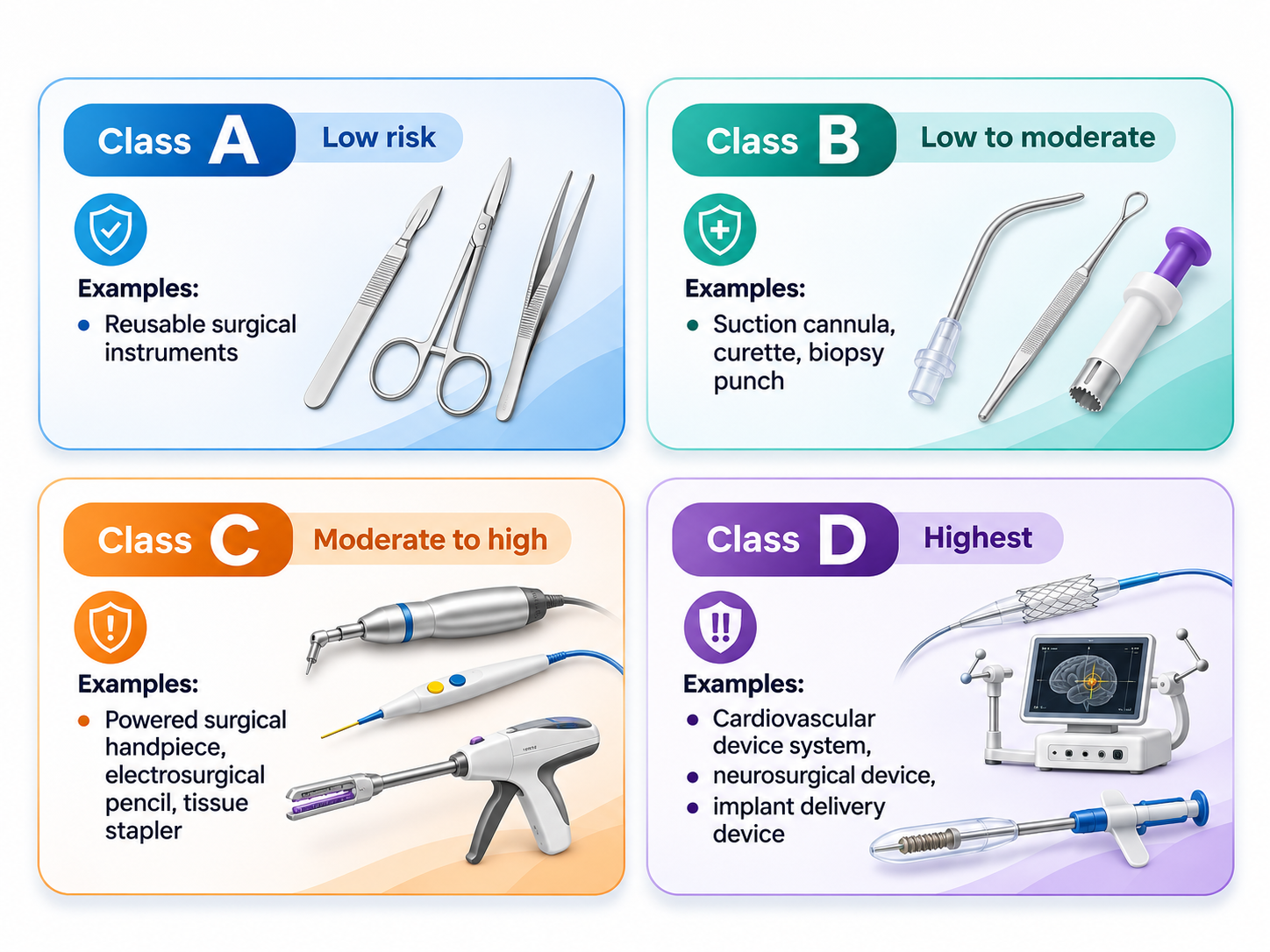
| Instrument Type | Class | Basis |
|---|---|---|
| Scissors, forceps, clamps, blades, hand-held retractors (reusable) | A | Rule 6 reusable surgical instrument carve-out; MDA/GD/0009 examples |
| Scalpels, scissors, forceps (single-use, sterile) | B | Single-use label removes the Rule 6 carve-out; surgically invasive transient use |
| Manual bone drills, saws, bone files (reusable) | A | Rule 6 reusable surgical instrument carve-out; GD/0062 |
| Manual bone drills, saws, bone files (single-use) | B | Single-use label; surgically invasive transient use; GD/0062 |
| Drill bits, burs, saw blades for powered handpieces | B | Connected to an active medical device; active device rules apply |
| Powered surgical drills and handpieces | B | Rule 9(i) active medical device; not eligible for reusable carve-out |
| Surgical staplers | B | Surgically invasive; classified as active device or single-use depending on type |
| Electrosurgical generators and RF cutting apparatus | C | Active device delivering energy that could be hazardous; Rule 9 |
| Ophthalmic knives, manual trephines, trabeculotomes (reusable) | A | Rule 6 reusable surgical instrument carve-out |
| Ophthalmic knives, manual trephines, trabeculotomes (single-use) | B | Single-use label; surgically invasive transient use |
| CNS-contact instruments (brain spatulas, spinal retractors) | D | CNS contact overrides reusable carve-out; Rule 6 special rule |
| Dedicated disposable cardiovascular instruments | D | Dedicated contact with heart and central circulation; Rule 6 special rule |
| Reusable carotid clamps (vascular, not dedicated cardiovascular) | A | Not dedicated for heart or central circulation use; Rule 6 carve-out applies |
What Factors Move a Surgical Instrument into a Higher Class?
Many reasons will cause medical devices to be upgraded above Class A. Again these are not rare situations and are commonly seen within product ranges which contain both re-usable and single-use medical devices.
Regardless of a device's design, if it is specified as single-use then the exception provided for re-usable devices under Rule 6 is not available. Consequently, even if a device is identical to a re-usable Class A device, if it is identified as single-use then it will be upgraded to Class B and must undergo CAB assessment.
All instruments which are designed to link to an active or powered device are not covered by the Rule 6 reusable exception. This includes, for example, drill attachments for powered handpieces and electrosurgery probes. Such items are a minimum of Class B. If there is potential for dangerous energy transfer to occur then a Class C upgrade is necessary.
Items which are used surgically and continuously for between 60 minutes and 30 days are subject to Rule 7. As a minimum, these items are upgraded to Class B and there is no exception for re-usability. Only Rule 6's re-usable exception for items used for under 60 minutes applies to items in this time bracket.
All surgically used items which are designed to touch the central nervous system (CNS) are Class D irrespective of re-usability. For example, brain and spinal instruments and those with a 'neurosurgery' intended use. Contact with the CNS will always override previous classification rules.
Those items which are specialised for direct contact with the heart or central cardiovascular system are also Class D. Note that just because a re-usable carotid clamp is used in vascular surgery, this does not automatically make it Class D. Only items which are specialised for contact with the heart or central cardiovascular system are upgraded to Class D. Not all vascular items fall into this category.
How to Group a Surgical Instrument Catalogue
Regulation 3(1)(b) and the Second Schedule of the Medical Device Regulations 2012 require devices to be grouped before registration. The grouping rules are set out in MDA/GD/0005 (Second Edition, January 2024). Getting grouping right matters because each application carries its own fee: a catalogue of 40 codes filed as 40 individual applications costs significantly more than the same range filed as four grouped applications.
Under GD/0005, there are four grouping types available for surgical instruments.
A group of similar instruments which differ in size and/or design. All items within a family must be of the same class, name, design, production method and intended use. Permitted variations are those identified in MDA's list of allowable differences. These include length, breadth, diameter, size, form, colour, grip strength and flexibility. There may also be different methods of sterilisation, but only if these result in equivalent sterilisation. Different materials are not permitted so titanium and stainless steel items cannot be grouped. Only codes registered can be marketed.
A collection of instruments (such as a tray), which are marketed as a combined unit. The group is assigned to the highest class of the instruments contained within it. Should a single-use item be included in a group of re-usable instruments then the whole set is upgraded to Class B and will require CAB evaluation. Further, if instruments are both sold as part of a set and separately then each must be registered individually. Full details of the set contents must be included on labelling.
Items which are designed to be used with a particular active device or implant system, such as an electrosurgery device and related instruments. System groupings can only supply items for that system. Typically, systems relate to powered instrument systems and not manual devices.
An individual instrument which may be provided in different packaging sizes. Any item which does not fit into family, set or system groupings has to be registered separately. Within extensive ranges comprising a wide variety of designs and intended uses, often many items will need to be registered as singles.
What Does a Class A Surgical Instrument Registration File Need?
Class A surgical instrument applications are submitted directly to the MDA via MeDC@St. The file does not go through a CAB. However, the requirements are detailed and the reprocessing section in particular is reviewed closely by MDA reviewers. The core documents required are as follows.
Either as a local manufacturer or as a Local Authorised Representative (LAR) licensed by the MDA, the applicant must have a current establishment licence. Overseas manufacturers must designate a licensed LAR who will both hold the registration and lodge the registration application on their behalf if they do not themselves have a Malaysian entity.
This should detail all product codes to be registered. Each entry should contain the relevant code reference (catalogue, model, part or UDI number). It must exactly match labelling. Product codes not included in the registration cannot be marketed in Malaysia.
Multi-use products must provide comprehensive reprocessing information, including cleaning, decontamination and (where appropriate) re-sterilisation procedures. Required validation data includes bioburden testing, packaging validation, and evidence of post-sterilisation functionality. Information must also specify how and when a product should be disposed of having reached the end of its multi-use life. Particular signs of wear and the maximum number of times a product may be re-used should be indicated. General advice such as "clean and autoclave" is insufficient for compliance with GD/0026. Reprocessing information is most commonly lacking in registrations for Class A surgical products.
Labelling must display a batch or serial number and be both clear and permanent. Labelling can be applied to the product, its secondary pack or its outer pack. In exceptional circumstances, where this is impracticable, labelling may instead be provided in a leaflet. The Malaysian registration number must be affixed to labelling within 6 months of registration. Labelling must additionally indicate whether a product is multi-use or single-use.
ISO 13485, MDSAP, US FDA QSR or Japan MHLW Ordinance 169 certification is necessary. Certificates must cover the relevant range of products. Currently, for private-labelled products, both the OEM's ISO 13485 certificate and the MDA's Traceability of Evidence attestation are recognised. Manufacturers should however watch developments in GD/0070 as the Third Edition will no longer accept this dual certification.
A summary of reportable adverse events and field safety corrective actions (including recalls) over the past three years. If no events occurred, an attestation letter stating this is required in its place.
The DoC must follow the Third Schedule format and MDA/GD/0025, on company letterhead, signed by top management, and listing all standards applied. See our DoC guide for the full format requirements.
Five Mistakes That Delay Surgical Instrument Registrations
Generic reprocessing statements are the most common reason Class A surgical instrument files are queried or returned. MDA/GD/0026 requires specific cleaning, disinfection, packaging, and re-sterilisation protocols with defined parameters, not general references to autoclave compatibility. Each reusable product needs instructions validated to the instrument's material and design.
Including a single single-use item in a tray of reusable instruments moves the entire set to Class B, triggering CAB assessment and significantly increasing both cost and timeline. Reusable trays should be reviewed before submission to confirm that every included item is labelled reusable. If a disposable must be included, it is typically better to register it separately.
Only codes listed in the original registration may be marketed. Adding a new size, length, or pattern after registration is a post-market change that requires MDA change notification before the variant can be sold. Catalogue updates do not update a registration, and unregistered variants are treated as unregistered devices.
The proprietary name must appear consistently on the label, the DoC, the grouping list, and all technical documents. It must also appear on each individually packaged family member. Any discrepancy between documents will trigger a query and can result in the entire application being returned for correction.
Describing a general instrument for neurosurgery or cardiac use on the label, even informally, can trigger Class D classification. Manufacturers should define intended use as narrowly as the clinical evidence supports. If the instrument is not specifically designed for CNS or cardiovascular contact, the label should not reference those applications.
Class A Surgical Instrument Registration: Step by Step
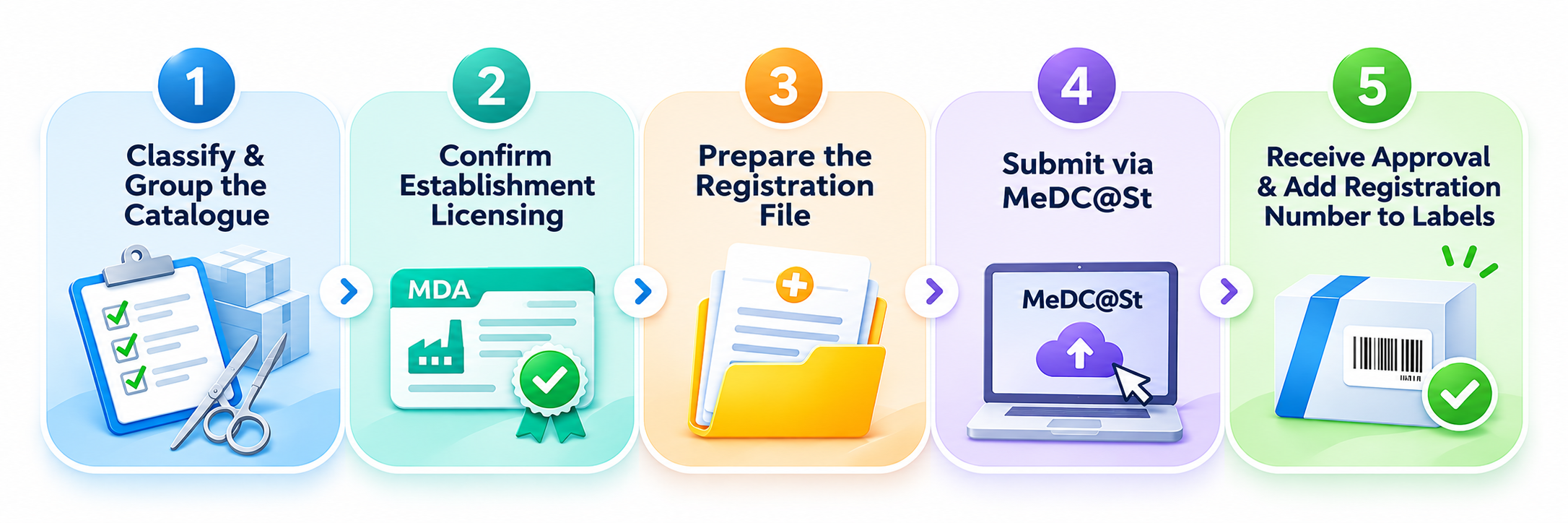
Review every product code against Rule 6, the classification guidance (MDA/GD/0009, GD/0062), and the intended use on each label and IFU. Produce a grouping map showing which codes will be filed in which applications. This determines the total number of applications and the total registration cost before any work begins.
The applicant must hold a valid MDA establishment licence as a local manufacturer or as a licensed LAR, and must have an active MeDC@St account registered under that establishment before any application can be submitted. If no licence or account is in place, this is typically the longest lead item in the entire process and must be initiated before file preparation begins. Foreign manufacturers need a licensed LAR on record before any application can be submitted.
Compile the grouping list, labels and IFU, reprocessing instructions to GD/0026 standard, QMS certificate, post-market history, and DoC. Reprocessing instructions require the most preparation time for reusable instruments and should be drafted early. Labels should be reviewed against MDA traceability requirements before final file assembly.
Class A surgical instrument applications go directly to the MDA via MeDC@St, without a CAB step. The standard MDA review period for Class A applications is 90 days, though this clock pauses whenever the MDA issues a request for additional information. The applicant has 90 days to respond under Regulation 5(3). Incomplete files or non-conforming reprocessing instructions are the most common reasons for information requests and can effectively double the total timeline.
Once approved, the registration is valid for five years. The MDA registration number must appear on product labels within six months of the approval date. Any post-approval change to the product, label, or grouping requires a formal change notification to the MDA before the change can be implemented.
MDA Registration Fees for Surgical Instruments (Effective 1 January 2026)
The Medical Device (Amendment) Regulations 2025 (P.U. (A) 330/2025), gazetted 11 September 2025, took effect on 1 January 2026. The changes apply to all new applications and re-registrations submitted on or after that date.
| Device Class | Application Fee (RM) | Registration Fee (RM) | Total MDA Statutory Fee (RM) |
|---|---|---|---|
| Class A | 500 | 750 | 1,250 |
| Class B | 250 | 1,000 | 1,250 |
| Class C | 500 | 2,000 | 2,500 |
| Class D | 750 | 3,000 | 3,750 |
Each application carries its own fee. For a large surgical instrument catalogue, grouping decisions made before filing have a direct and significant impact on total MDA statutory costs. A catalogue of 40 reusable instrument codes filed as 40 individual applications incurs RM50,000 in MDA fees under the 2026 rate. The same catalogue structured as four grouped family applications incurs RM5,000. Catalogue review and grouping planning should be completed before any applications are submitted.
FAQ